
By William Ryan, for Eurasia Business News, May 28, 2023
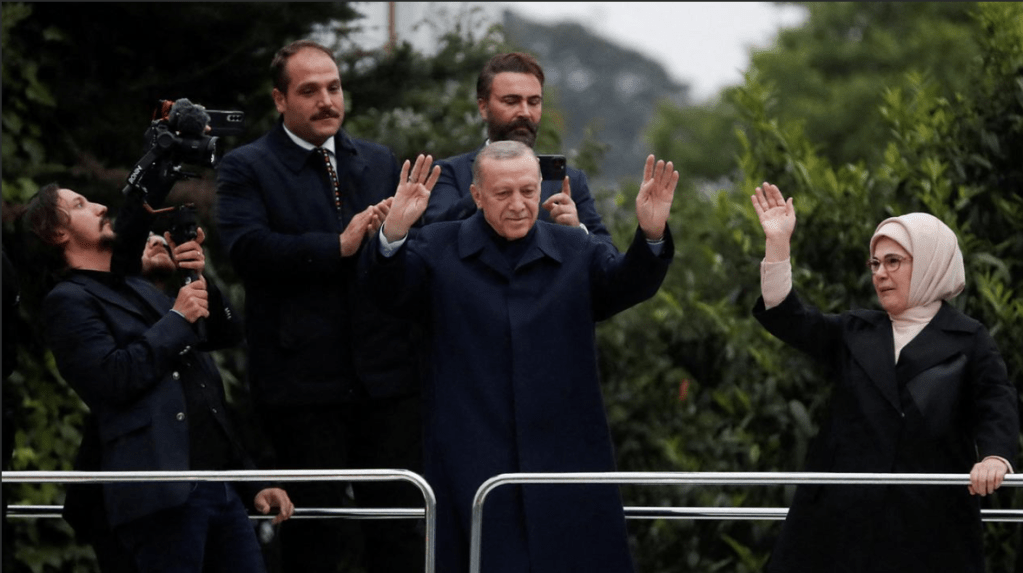
Turkey experienced Sunday, May 28, an unprecedented day of voting for this second round of the presidential election, opposing Recep Tayyip Erdogan and the opposition candidate, Kemal Kiliçdaroglu. Tonight, the president Erdogan was declared the winner by the electoral commission with 52.14% of the vote.
Erdogan has led Turkey for 20 years, now he will be president for another five years.
Turkish President Recep Tayyip Erdogan won the second round of presidential elections, Anadolu Agency reported on Sunday, citing the Turkish Central Election Commission.
The head of the Commission, Ahmet Iner, announced that, according to the data after processing 99.75% of the ballots, candidate Erdogan receives 52.1% of the vote, and thus he is re-elected for a new term.
His opponent, the opposition leader Kemal Kılıçdaroğlu, won 47.9%.
The participation rate is slightly down with 83% against 87% in the first round.
Earlier, President Erdogan announced his victory during a speech to a crowd of supporters in Istanbul and thanked the citizens of Turkey for their support. “Our nation has entrusted us with the responsibility of governing the country for the next five years,” he said on the roof of a bus parked outside his Istanbul residence to which an enthusiastic crowd converged. He took the floor in Istanbul to thank the people for choosing him again. A crowd has gathered and hundreds of people continue to flock to the presidential palace.
Erdogan’s rival called the elections “the most unfair in recent years” and promised to continue the fight. According to Kemal Kılıçdaroğlu, there was an atmosphere of fear in the country, pressure was exerted on his supporters, but despite this, the results showed that the Turkish people are determined to “change the authoritarian government.”
In the first round of the presidential election, Recep Tayyip Erdogan won 49.52% of the vote, Kemal Kılıçdaroğlu – 44.88%. To win the elections in the first round, it was necessary to gain more than 50% of the vote. The leader of the right-wing Father’s Coalition party, Sinan Ogan, who won 5.17% in the first round, urged his supporters to vote for Mr. Erdogan.
64.1 million voters registered to participate in the second round.
Turkey is facing significant economic challenges in 2023. Despite high growth rates between 2002 and 2017, inflation, high unemployment, and macro-financial instability have been exacerbated by the COVID-19 pandemic in 2020 and 2021. The Turkish government’s economic policy response to COVID-19 was swift but focused on loose monetary policy and rapid credit expansion, which fueled inflation. The cost of living crisis sparked by Erdogan’s unorthodox economic program over the past 1-1/2 years has led to runaway inflation, with food prices surging 54% year-on-year in April 2023. The Turkish lira has lost 44% in 2021 and 30% in 2022, shedding 76% under Erdogan’s second term as president.
The stakes are high after President Erdogan’s drive to further cut interest rates sparked a historic currency crisis in late 2021, and sent inflation as high as 85.5% in 2022.
Thank you for reading us.
Our community already has nearly 110,000 members!
Sign up to get our exclusive news before others.
Follow us on Telegram, Facebook and Twitter
© Copyright 2023 – Eurasia Business News
 Eurasia Business News