
By William Miller, special correspondent. Eurasia Business News, July 12, 2023
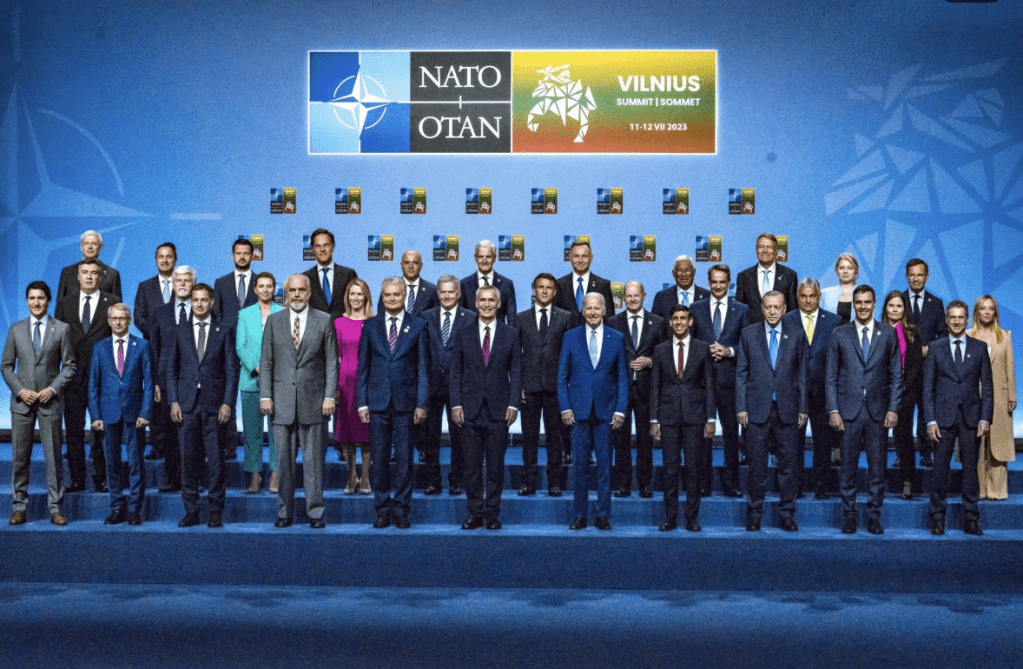
The G7 countries pledged Wednesday to provide long-term military support to Ukraine, a decision welcomed by the Ukrainian President Volodymyr Zelensky, who stressed, however, that it should not replace a future membership of his country to the Atlantic Alliance.
On the second day of the NATO summit in the Lithuanian capital Vilnius and almost 18 months after the start of the Russian invasion, the members of the G7 (United States, United Kingdom, France, Canada, Germany, Italy, Japan) presented a plan for Ukraine’s security. This is to help it deal with the current Russia’s operations in Ukraine and to deter Moscow from any “future armed attack” against its neighbor.
This announcement, which angered Russia, was described as an “important victory for the security of the Ukraine” by the President Volodymyr Zelensky. But the Ukrainian leader was careful to recall that “the best guarantee for Ukraine is to be in NATO“, after having sharply criticized the leaders of the Alliance the day before for not having set a timetable for the integration of his country into this organization after the end of the war.
“Ukraine’s future is in NATO”
“Ukraine’s future is in NATO ” assured U.S. President Joe Biden. But, in the meantime, “we will help (the Ukrainians) to build strong defensive capabilities on land, at sea and in the air,” he said, before praising the courage of this country, an example “for the whole world“.
The G7 declaration provides a framework for the subsequent conclusion of bilateral agreements between its member states and Kiev detailing the arms they will supply. Eight other countries have joined the initiative, according to Madrid: Spain, the Netherlands, Portugal, Iceland, Norway, Denmark, Poland and the Czech Republic.
“We must ensure that when the war ends, there are credible mechanisms in place for Ukraine’s security so that history does not repeat itself.” NATO Secretary General Jens Stoltenberg also said before the first meeting of the “Ukraine-NATO Council” with Volodymyr Zelensky.
“Today we meet as equals and I look forward to the day when we meet as allies.“, continued the Norwegian official, who has just been reappointed for one year at the head of NATO.
A shortened process
The day before, on the first day of the NATO summit in Vilnius, Western leaders pledged to shorten the process Kiev would have to follow to join the Alliance. “We will be able to extend an invitation to Ukraine to join the Alliance once Allies have decided and the conditions are met,” the final communiqué states. For Volodymyr Zelensky, these conditions are “related to security“: “we understand that Ukraine cannot become a member as long as the war continues.” He said he was “confident” about membership “after the war“.
Read also : Gold : Build Your Wealth and Freedom
The final communiqué of the Vilnius NATO Summit does not go much further than the commitment made in April 2008 at the Bucharest NATO Summit on Ukraine’s future integration. The United States, which is the leading military power, is worried about being dragged into a possible nuclear conflict with Russia. Volodymyr Zelensky has held bilateral talks with several leaders, including Joe Biden, who advocates a model similar to the one agreed with Israel, under which Washington has pledged to provide substantial military aid over time. Supporters of Ukraine are now disappointed.
Ukraine applied for NATO membership on September 30, 2022, and other countries waited an average of 5-6 years for an invitation, after which the accession process was completed within about 14 months. But this is in normal times. There have been no precedents for a country with heated territorial disputes to join NATO.
Not a Global Alliance
In addition, NATO Secretary General Jens Stoltenberg urged not to perceive the intensification of the organization’s actions in the Asia-Pacific region (APR) as a claim to expand the alliance to a global one.
“It’s not about NATO becoming a global alliance. It’s about recognizing that this region is facing global challenges. And what China is doing in the High North, and in critical infrastructure, and in cyberspace, this is a cause for concern,” Stoltenberg said on Wednesday at the final press conference of the organization’s summit, held on July 11-12.
The Norwegian official reported on “a number of targeted programs” with partners in the Asia-Pacific region: to counter cyber threats and disinformation, the participation of partners in NATO cybersecurity exercises, and maritime security.
Thank you for reading us.
Our community already has nearly 110,000 members!
Sign up to get our exclusive news before others.
Follow us on Telegram, Facebook and Twitter
© Copyright 2023 – Eurasia Business News
 Eurasia Business News