
By Paul Jouvenet, jurist and essayist. Eurasia Business News, August 22, 2023
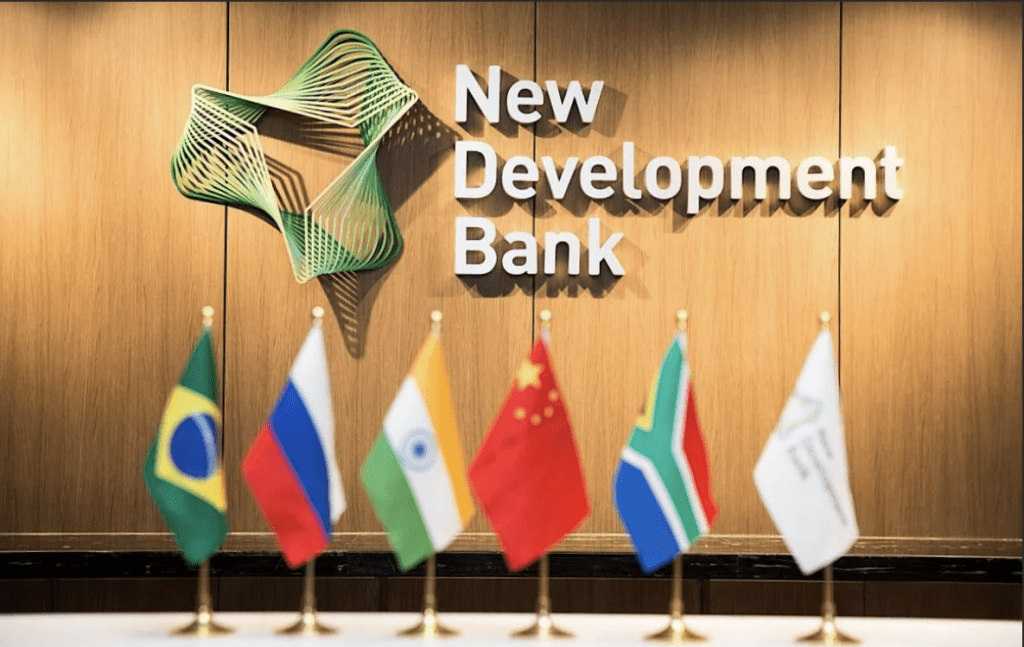
The BRICS New Development Bank (NDB) intends to start lending in the South African and Brazilian currencies to reduce dependence on the US dollar. This was stated in an interview with the Financial Times by the head of the bank, Dilma Rousseff.
Based in Shanghai, NDB may start lending in South African rand, Brazilian reals, and in the future, possibly in Indian rupees. The bank is already issuing loans in Chinese yuan. At the same time, the bank refused new projects in Russia due to the risk of sanctions and disconnection from the international financial system.
The NDB issued its first rand bond in South Africa last week and could consider local currency issuance in members Brazil, Russia and United Arab Emirates, Vladimir Kazbekov told a press briefing ahead of the BRICS Summit in Johannesburg on Aug. 22-24.
“This year, we expect to provide loans ranging from $8 billion to $10 billion, and our goal is to cover about 30% of everything we lend to in local currency,” said Dilma Rousseff, the Chairman of the NDB.
According to the head of the NDB, lending in local currency will help the BRICS member countries avoid currency risk and interest rate fluctuations in the United States. She added that the currencies of the countries of the association are not an alternative to the dollar. “It’s an alternative to the [financial] system. Until now, it has been a unipolar <…> it will be replaced by a multipolar one,” the head of the bank said.
Dilma Rousseff clarified that the bank “respects the policy of each country“, therefore it does not set political conditions for loans, unlike the World Bank and the International Monetary Fund, which left bad memories to many emerging and developing countries.
The NDB, with a capital of $100 billion and headquartered in Shanghai, was created by the BRICS countries – Brazil, Russia, India, China and South Africa – in 2014 and established in 2015. The purpose of the bank’s activities is to finance infrastructure projects and sustainable development projects in the BRICS countries and developing countries.
Yesterday, the NDB and Trans-Caledon Tunnel Authority (TCTA) signed a Loan Agreement for the implementation of Phase II of the Lesotho Highlands Water Project (LHWP). The NDB will provide a project loan of ZAR 3.2 billion to TCTA under the sovereign guarantee of South Africa.
In January, the Russian Foreign Minister Sergey Lavrov said that at the BRICS summit, which will be held on August 22-24 in South Africa, the countries will discuss the creation of their own currency of the association.
“Serious, self-respecting countries are well aware of what is at stake, they see the inability of the “masters” of the current international monetary and financial system to negotiate,” said the minister.
On April 13, during his first state visit to China since taking office in January, Brazilian President Luiz Inácio Lula da Silva proposed choosing an alternative currency to the dollar for trade among BRICS countries.
Read also : How to invest in gold
President Lula da Silva said that other countries could be more active in using their own currencies in trade, without using the dollar.
The BRICS are striving to promote cooperation and coordination on economic, financial and smonetary issues since 2014. The geopolitical events in 2022 accelerated this tendency.
Read also : Brazil’s President Supports BRICS Expansion
The BRICS could be the G7 of emerging countries and the South Global and change the world order by promoting multipolarity and multilateralism. The most important is not the expansion of the BRICS, but the growing influence of the group’s decisions on the global economy and the strengthening of its voice in the international financial arena, thanks in particular to the New Development Bank established in 2015, facing the IMF and the World Bank. The BRICS bank has already financed 98 infrastructure development projects worth a total of $33 billion since 2015. The attractiveness of the BRICS as a “balancing force in world affairs” is now at an unprecedented level.
By 2030, the BRICS could together account for 50% of global GDP.
Our community already has nearly 110,000 members.
Sign up to receive our exclusive items.
To receive premium content, subscribe, it’s only €9.99/month. You will see the subscription form on restricted publications.
Sign up to receive our latest articles, it’s free!
Follow us on Telegram, Facebook and Twitter
© Copyright 2023 – Paul Jouvenet, jurist and essayist.
 Eurasia Business News