
By Paul Jouvenet, jurist and essayist. Eurasia Business News, August 24, 2023
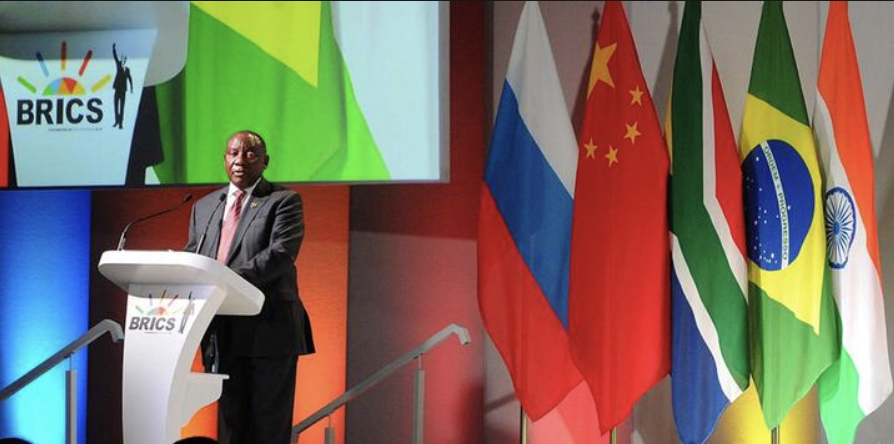
From January 1, 2024, six new Member States will join the BRICS, including Argentina, Iran and Saudi Arabia. Following the results of the BRICS summit in South Africa, in which the Russian President Vladimir Putin participated via video link, it was noted that other phases of the organization’s expansion would follow in coming years.
The leaders of Russia, Brazil, India, China and South Africa at the XV BRICS summit in Johannesburg agreed today to expand the BRICS interstate association from five to 11 members.
“We have decided to invite Argentina, Egypt, Ethiopia, Iran, Saudi Arabia and the United Arab Emirates to become full members of BRICS,” announced the South African President Cyril Ramaphosa at a press conference following the summit.
The United Arab Emirates, Saudi Arabia, Iran, Argentina, Egypt and Ethiopia are officially invited to the BRICS. Full membership of the new member States in the group will begin on January 1, 2024.
“Following the results of the 15th BRICS summit, the BRICS leaders had the opportunity to hold talks over the past two years < … > and as a result of those negotiations, we agreed on the adoption of the Johannesburg Declaration. This declaration, which covers a wide variety of issues that have been presented to the leaders, on which negotiations have been conducted for almost a year, < … > and as a result, we adopted this document” said the South African president.
The five BRICS countries have agreed on guidelines, standards, criteria and procedures for expanding the association. “We have reached a consensus on the first phase of this expansion. It will be followed by other stages. We have decided to invite the Argentine Republic, the Arab Republic of Egypt, the Federal Democratic Republic of Ethiopia, the Islamic Republic of Iran, the Kingdom of Saudi Arabia and the United Arab Emirates to become full members of BRICS,” added Cyril Ramaphosa.
The Russian President Vladimir Putin noted that the adoption of this decision was not easy, as well as the coordination of the final declaration of the BRICS as a whole.
“I should note that this work was not easy. President Ramaphosa showed amazing diplomatic skill in coordinating all positions, including those related to the expansion of BRICS,” said the Russian president.
The Indian Prime Minister Narendra Modi welcomed the decision to admit new members to the BRICS. “The expansion will give us a new dynamic (…). It will strengthen countries’ faith in the new world order,” he said.
On August 23, the BRICS agreed on the expansion plan. They announced their final choice of new Member States today, on August 24.
Read also : Gold : Build Your Wealth and Freedom
On August 22, the BRICS summit opened in Johannesburg (South Africa). This is the XV forum of Brazil, Russia, India, China and South Africa, where cooperation between countries in the geopolitical and economic fields is discussed.
The five BRICS leaders adopted a final declaration at this 26-page summit, covering 94 points. Among the points adopted are the reminder of the attachment to inclusive multilateralism, in the spirit of the Charter of the United Nations or the concern for the use of “unilateral coercive measures” as a diplomatic tool.
The BRICS consider this recourse as incompatible with the principles of the Charter of the United Nations and as a source of negative effects, particularly in the developing world. The BRICS reaffirm their commitment to improve and improve global governance “by promoting a more agile, effective, efficient, representative, democratic and accountable international and multilateral system.”
Through their Final Declaration, the BRICS also call for greater representation of emerging markets and developing countries in international organizations and multilateral forums in which they play an important role. They renew their call for a reform of the Security Council of the United Nations, endowed with five permanent members with the right of veto. India and Brazil would like to obtain a permanent seat each, in order to take into account the new distribution of power since 1945. China and Russia, permanent members since 1945, support them in this direction.
Read also : Brazil’s President Supports BRICS Expansion
The BRICS could become the G7 of emerging countries and the Global South and change the world order by promoting multipolarity and multilateralism. The most important is not the expansion of the BRICS, but the growing influence of the group’s decisions on the global economy and the strengthening of its voice on the international financial scene, thanks in particular to the New Development Bank created in 2015, opposite the IMF and the World Bank. The BRICS bank has already financed 98 infrastructure development projects worth a total of $33 billion since 2015. The attractiveness of the BRICS as a “balancing force in world affairs” is now at an unprecedented level. By 2030, the BRICS could together account for 50% of global GDP.
Our community already has close to 115,000 members.
Sign up to receive our exclusive items.
To receive premium content, subscribe, it’s only 14,99€/month. You will see the subscription form on restricted posts.
Sign up to receive our latest articles and don’t miss any international news!
Follow us on Telegram, Facebook and Twitter
© Copyright 2023 – Paul Jouvenet, jurist and essayist.
 Eurasia Business News