
By Anthony Marcus, correspondent. Eurasia Business News, August 14, 2024. Article n°1172
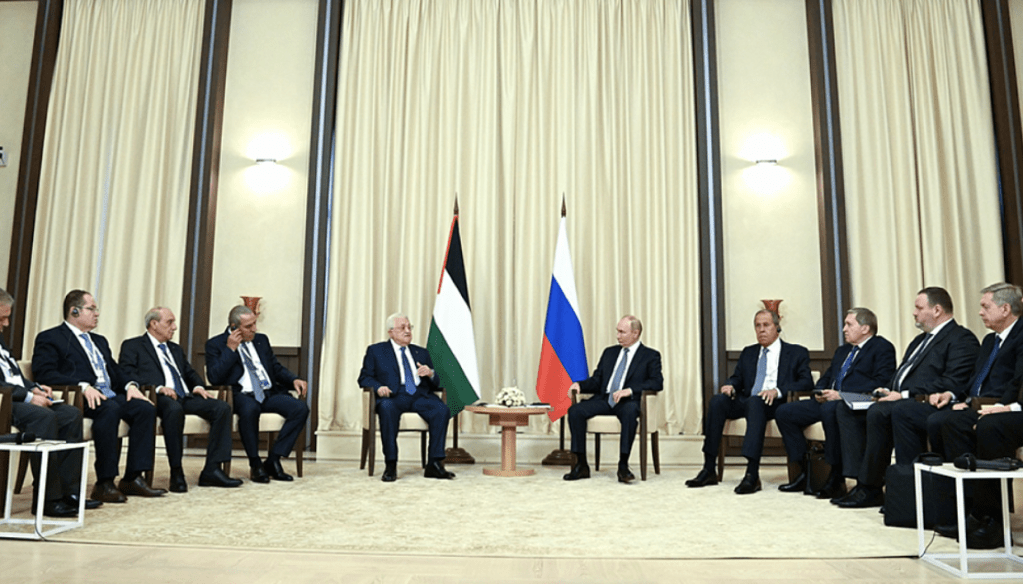
The President of Russia continues to monitor the Israeli-Palestinian conflict
The Russian President Vladimir Putin held talks with the Chairman of the Palestinian National Authority (PNA) Mahmoud Abbas at his residence in Novo-Ogaryovo on August 13. On the Russian side, the meeting was attended by Foreign Minister Sergei Lavrov, Chief of the GRU of the General Staff Igor Kostyukov, Representative in Ramallah Gocha Buachidze and Minister of Labor Anton Kotyakov. The Palestinian delegation included Minister of Civil Affairs Hussein al-Sheikh, head of the General Intelligence Service Majed Feraj, Palestinian Ambassador to Moscow Abdelhafiz Nofal, as well as Abbas’s adviser on diplomatic affairs Majdi Khaldi.
Vladimir Putin is “watching with pain and anxiety the humanitarian catastrophe” that has unfolded in Palestine. According to him, despite the military operation in Ukraine, the events in the Middle East do not go unnoticed by the Russian side. Since the beginning of the war in the Gaza Strip on October 7 2023, Moscow has sent about 700 tons of humanitarian supplies to support the affected Palestinians. Putin recalled that Russia is in favor of a peaceful settlement of the Palestinian-Israeli conflict on the basis of the creation of a sovereign state of Palestine within the 1967 borders.
Abbas thanked Putin for the warm welcome and added that the Palestinians trust the Russian leadership, as Russia remains “one of the dearest friends of the Palestinian people.” He also blamed the UN for the failure of the mission to resolve the Palestinian issue. According to him, since the adoption of the resolution on the division of Mandatory Palestine into Jewish and Arab parts in 1947, the international organization has adopted more than 1,000 resolutions in the General Assembly and the Security Council on the Palestinian problem, but due to US pressure, the Palestinians have not been able to realize their rights.
Russia’s role in the Palestinian-Israeli conflict
In January 1997, Russia, together with the United States, managed to convince the Israeli authorities to transfer the city of Jericho on the West Bank of the Jordan River, occupied by Israel in 1967, under the full control of the Palestinian Authority. At the end of 2001, at the initiative of Russia and the European Union, the so-called “Middle East Quartet” was created, which, in addition to them, included the United States and the UN. A year later, Moscow supported UN Security Council Resolution 1397, which reaffirmed the need to create a Palestinian state within the 1967 borders, as well as the Arab Peace Initiative, aimed at ending the Arab-Israeli conflict on the condition of Israel’s withdrawal from the occupied territories and its recognition of the state of Palestine. In 2003, at the initiative of Russia, UN Security Council Resolution 1515 was adopted, which supported the roadmap developed by the Quartet, calling on the parties to renounce violence and finally determine the status of Palestine.
The Palestinian leader also accused Israel of forcibly deporting Palestinians from the Gaza Strip, the West Bank and East Jerusalem. According to the UN, since the beginning of the military escalation, 1.9 million Palestinians, or 85% of the population of Gaza, have been forced to leave their homes.
Read also : Gold : Build Your Wealth and Freedom
In a situation of uncertainty in the Middle East, Abbas is trying to enlist Moscow’s support, especially in the context of the growing popularity of the radical Hamas movement among the Palestinians, Paul Jouvenet, consultant in international affairs, believes. According to him, during the fighting in Gaza strip, Hamas has earned more influence in the Muslim world and if Israel does not destroy this group, then they can oust Abbas’s supporters from the West Bank of the Jordan River. Therefore, the leader of the PNA needs to earn points among the leaders on the world stage and, if possible, receive international assistance for the Palestinians.
Mahmoud Abbas and his team are also trying to expand the pool of their supporters in the international arena in order to put pressure on Israel, continues Andrei Zeltyn, senior lecturer at the School of Asian Studies at the Higher School of Economics. “Benjamin Netanyahu’s government is an inconvenient negotiating partner for the Palestinians. The Palestinian Authority would like to put pressure on the Israelis with the hands of Moscow, given that Washington does not intend to do this,” the Russian expert added.
Read also : Gold is gaining weight in investors’ portfolios
However, Moscow is unlikely to want to get involved in the Middle East conflict, according to Paul Jouvenet. Although the Jewish state in the context of the Russian-Ukrainian conflict takes an unfriendly position towards Moscow and has even been seen in the supply of military equipment to Kiev, Russia, fearing the expansion of the Israeli military supplies to Ukraine, will not toughen its rhetoric towards Israel. Most likely, Russia will continue to balance between regional forces in the Middle East, and all its actions will be limited to the supply of humanitarian goods to the affected residents.
Russia has worked to maintain its rapprochement with Arab states, which could be jeopardized by regional war. The Kremlin views with apprehension the formation of an anti-Iranian bloc uniting Israel and Gulf Arab states under U.S. auspices
Our community already has nearly 135,000 readers!
Subscribe to our Telegram channel
Notify me when a new article is published:
Follow us on Telegram, Facebook and Twitter
© Copyright 2024 – Eurasia Business News. Article No. 1172.
 Eurasia Business News