
By Swann Collins, investor, writer and consultant in international affairs – Eurasia Business News. November 16, 2024. Article no 1309.
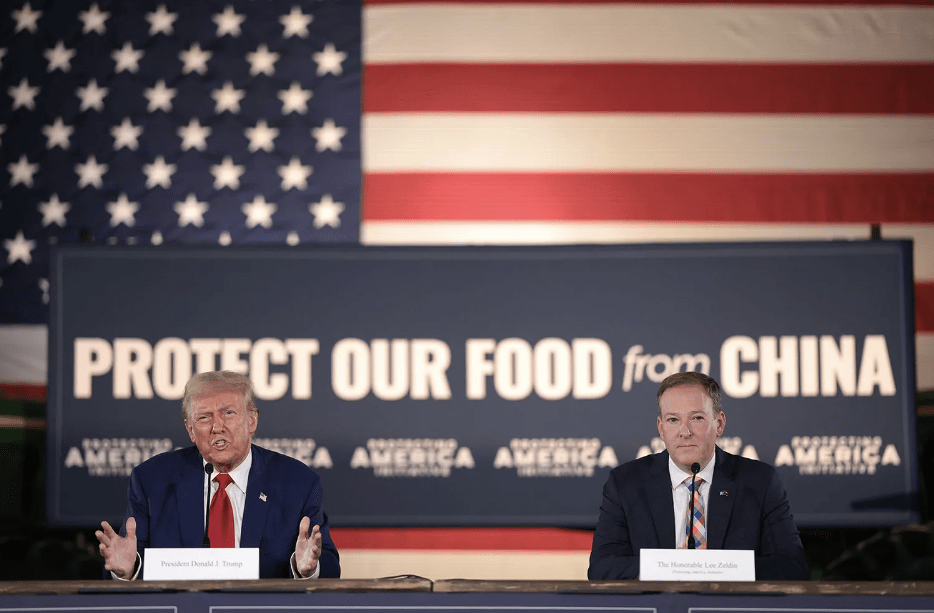
Former U.S. President Donald Trump (left) speaks about the threat of China to U.S. agriculture at the Smith Farm in Smithton, Pennsylvania, on Sept. 23.
Donald Trump’s return to the U.S. presidency next January is set to significantly impact global trade dynamics, particularly concerning China and Europe. His proposed trade policies, characterized by protectionism and high tariffs, are expected to escalate tensions in an already fraught economic landscape.
Key Aspects of Trump’s Trade Policy
Increased Tariffs: Trump has indicated plans to impose punitive tariffs of up to 60% on Chinese goods and 10-20% on imports from other countries. This aggressive stance aims to bolster U.S. manufacturing but poses risks of retaliation and trade wars, particularly with Europe and China.
On October 29 during a public meeting the Republican U.S. presidential candidate Donald Trump had said the European Union would have to “pay a big price” for not buying enough American exports. Now Trump won the election and became the 47th U.S. President.
Impact on Europe: European leaders are bracing for a potential two-front trade war, as Trump’s tariffs could disrupt transatlantic trade while also redirecting Chinese exports toward Europe. This could harm European industries reliant on competitive pricing and access to the U.S. market.
Economic Consequences: Analysts warn that such tariffs could lead to increased costs for consumers and businesses in the U.S., potentially stifling economic growth. The indirect effects on Europe could be severe, as they may face a flood of cheaper Chinese goods if U.S. tariffs push them out of American markets.
Geopolitical Implications
Shifts in Alliances: Trump’s transactional approach may weaken traditional alliances, particularly with NATO and European partners. This could embolden China to strengthen its ties with countries seeking alternatives to U.S. influence.
Read also : Gold : Build Your Wealth and Freedom
Collateral Damage for Europe: The European economy, deeply integrated into global supply chains, may suffer collateral damage as U.S.-China tensions escalate. Sectors such as automotive, pharmaceuticals, and technology could be particularly vulnerable if tariffs disrupt trade flows.
Global Reactions
China’s Position: China is preparing for a turbulent period under Trump’s presidency, anticipating that his policies will not only impact its economy but also create opportunities for strengthening ties with other nations disillusioned by U.S. protectionism 6. Chinese officials believe that Trump’s tough stance may be unpopular in Europe, potentially allowing Beijing to forge stronger economic connections there.
European Response: European leaders are concerned about the ramifications of a renewed trade war and are strategizing on how to mitigate the impacts while maintaining their economic interests. The EU’s reliance on exports to both the U.S. and China makes it particularly susceptible to shifts in U.S. trade policy.
Conclusion
Trump’s second term is likely to usher in a new era of heightened protectionism that could reshape global trade relations, particularly between the U.S., China, and Europe. The potential for increased tariffs and trade conflicts poses significant risks not only for these regions but also for the broader global economy, which is already grappling with inflationary pressures and supply chain disruptions.
Our community already has nearly 145,000 readers!
Subscribe to our Telegram channel
Follow us on Telegram, Facebook and Twitter
© Copyright 2024 – Eurasia Business News. Article no. 1309.
 Eurasia Business News
America’s future is Trump is bullying America’s allies and building friendly relations with their adversaries. America first = America alone.
LikeLike