
By Paul de Neuville, Paris correspondent, for Eurasia Business News, on December 5, 2024. Article no. 1323.
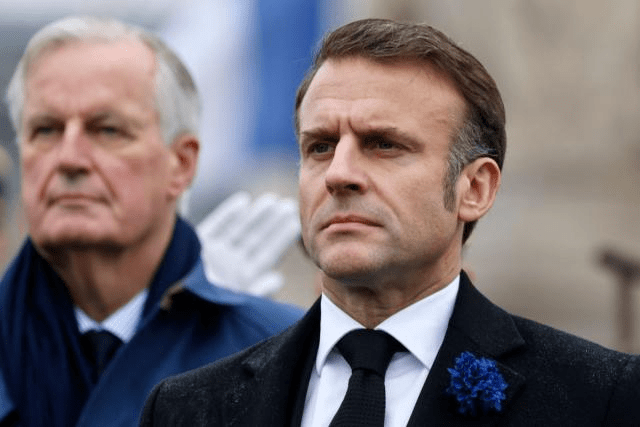
The yesterday collapse of the French government, led by Prime Minister Michel Barnier, has plunged the nation into a significant political crisis. This unprecedented event marks the first time since 1962 that a French government has fallen due to a no-confidence vote in the National Assembly. The vote was primarily orchestrated by a coalition of the left-wing NFP and the far-right National Rally (RN), who united against Michel Barnier after he attempted to push through a controversial social security budget plan using Article 49.3 of the French Constitution, bypassing a parliamentary vote.
This political unstability is detrimental for France as French borrowing costs have reached a significant milestone, matching those of Greece for the first time in history. On November 28, the yield on 10-year French bonds briefly climbed to 3.03%, equaling that of Greek bonds, which also hovered around similar levels. This is a stark contrast to the situation a year ago when French borrowing costs were considerably lower than Greece’s.
Political Landscape and Reactions
The fallout from this political upheaval has intensified calls for President Emmanuel Macron to resign, reflecting widespread dissatisfaction with his leadership amid rising political chaos since the dissolution of the National Assembly on June 9, after the defeat of this political allies at the European Union elections.
Recent polls indicate that only 22% of the French citizens are satisfied with Macron’s performance, highlighting a significant decline in his popularity. Political analysts suggest that Macron’s failure to foster a collaborative atmosphere in parliament has contributed to this crisis. The current fragmented political landscape complicates his ability to appoint a new prime minister who can command sufficient support from lawmakers.
Future Implications
In the wake of Barnier’s resignation, he will likely serve as a caretaker prime minister until Macron nominates a successor. However, this choice is fraught with challenges, as any new appointee must navigate a divided assembly without a clear majority. Potential candidates include Sébastien Lecornu, current Minister of Armed Forces, and Lucie Castets, a socialist economist previously proposed by the left-wing coalition but rejected by Macron earlier this year.
Both lack of political experience and authority to lead a government with no majority in the Parliament.
If no budget is approved by the Parliament by December 20, the French government may resort to emergency measures that could further destabilize France’s economy and investor confidence.
French President Emmanuel Macron is expected to address the nation at 20:00 local time.
Broader Context
The political turmoil in France not only poses risks domestically but also raises concerns for European stability. As the second-largest economy in the EU, France’s ongoing instability could impact broader economic conditions across Europe, particularly in light of existing pressures such as high public debt and rising poverty levels.
Analysts believe that without significant reforms and effective governance, France may struggle to address its pressing economic challenges leading up to the next presidential election scheduled for 2027.
In summary, Macron finds himself in a precarious position as he contemplates his next moves amidst increasing pressure for his resignation and the urgent need for effective leadership to navigate France through this turbulent period.
Read also : Gold : Build Your Wealth and Freedom
At the end of Q2 2024, French public debt in the sense of Maastricht was € 3,228.4 billion, an increase of €68.9 billion, after +€58.2 billion in the previous quarter. Expressed as a percentage of gross domestic product (GDP), it climbs to 112.0%, after 110.5% in the first quarter of 2024, according to INSEE.
French state debt was € 2,100 billion in 2019.
Our community already has nearly 145,000 readers!
Subscribe to our Telegram channel
Follow us on Telegram, Facebook and Twitter
© Copyright 2024 – Eurasia Business News. Article no. 1323.
 Eurasia Business News