
By Anthony Marcus, correspondent – Eurasia Business News. December 9, 2024. Article no 1326.
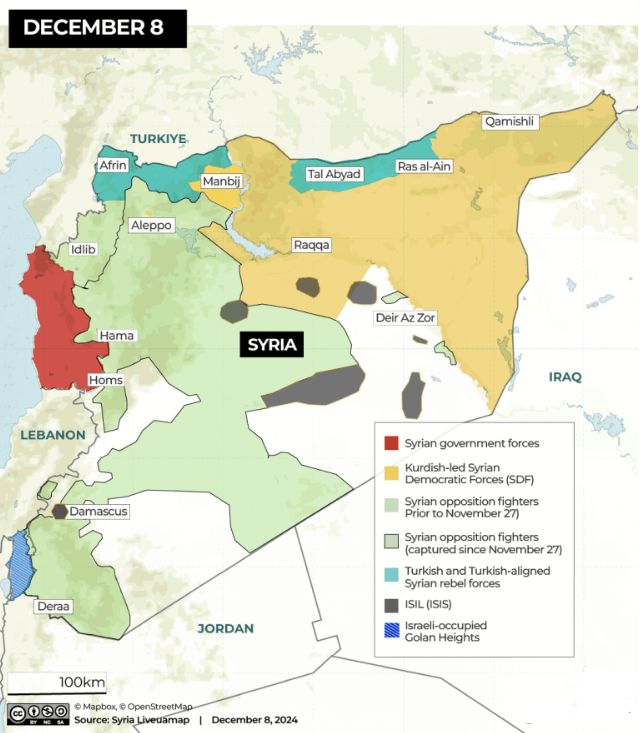
Ousted Syrian President Bashar al-Assad has reportedly fled to Moscow, where he and his family have been granted asylum by Russian authorities. This development follows a dramatic offensive by rebel forces that led to the capture of Alep, Homs and Damascus in few days, effectively ending Assad’s 24-year rule over Syria.
The geopolitics of Middle East is changing. With the fall of the Assad’s rule, Turkey gains, Russia and Iran lose sway and Syrians hope a new round of civil war can be averted.
Key Updates
Flight to Moscow: Bashar al-Assadleft Damascus early on December 8, 2024, as rebels declared the city liberated. Russian state media confirmed that he arrived in Moscow and received asylum on humanitarian grounds.
Rebel Control: The swift advance of opposition forces culminated in their entry into Damascus, marking the first time since 2018 that such a significant portion of the capital fell under rebel control. Celebrations erupted among Syrians in the streets as they marked the end of the Assad family’s five-decade dominance.
On Sunday morning, opposition forces entered Damascus without encountering any resistance from the Syrian army, which left the capital without a fight after the armed opposition arrived. Part of the Syrian army went over to the side of the rebels, the other part fled, including to neighboring Iraq.
Power Vacuum: Assad’s departure creates a power vacuum that could lead to further instability. With no clear successor or governing authority, various factions may vie for control, potentially leading to increased violence and fragmentation along ethnic and sectarian lines.
Negotiations and Resignation: According to Russia’s Foreign Ministry, Assad resigned after negotiations with opposition groups, which included directives for a peaceful transfer of power. However, Russia stated it did not participate in these negotiations.
International Reactions: U.S. President Joe Biden commented on the situation, acknowledging the regime’s collapse and expressing hope for a new beginning for the Syrian people. He noted uncertainty about Assad’s exact whereabouts before confirmation of his arrival in Moscow.
New geopolitical balance : Russia has lost a key ally in the Middle East. In the midst of the Ukrainian conflict, Assad’s overthrow threatens to open a new front for Russia, which has previously managed to maintain the Assad ruling regime since its military intervention in September 2015. Nevertheless, the continued Russian military presence in the naval base of Tartus and the Khmeimim Air Base remains for Moscow both a cause for alarm and a tool for future bargaining with the Syrian armed opposition.
Russia now operates two military bases in Syria: the Khmeimim Air Base, located south-east of the city of Latakia in Hmeimim, Latakia Governorate, Syria, and the Tartus naval facility, located on the northern edge of the sea port of the Syrian city of Tartus.
Assurances from Rebels: Reports indicate that Syrian opposition leaders have assured Russia regarding the safety of its military bases and diplomatic missions within Syria, indicating a potential shift in regional dynamics following Assad’s departure.
This significant political shift raises questions about Syria’s future governance and stability after years of civil conflict.
Our community already has nearly 145,000 readers!
Subscribe to our Telegram channel
Follow us on Telegram, Facebook and Twitter
© Copyright 2024 – Eurasia Business News. Article no. 1326
 Eurasia Business News