
By Anthony Marcus, correspondent. Eurasia Business News, February 19, 2025. Article n°1422.
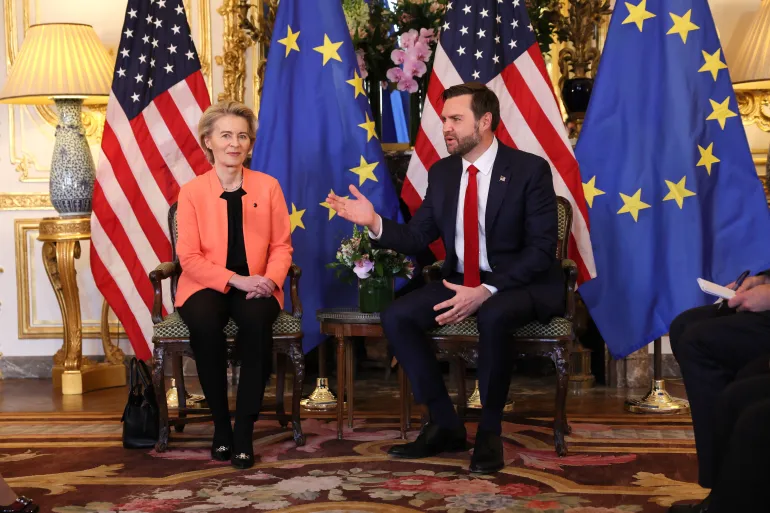
European leaders are grappling with the implications of President Donald Trump’s recent comments blaming Ukraine for the ongoing war with Russia. During a press conference at his Mar-a-Lago estate, Trump suggested that Ukraine initiated the conflict and criticized Ukrainian President Volodymyr Zelensky for his leadership, stating, “You should have never started it” and questioning Zelensky’s negotiation skills. This rhetoric aligns with Russian narratives and has left European allies stunned and concerned about the future of transatlantic relations.
The Trump administration has announced that Europe will not be involved in peace talks between Russia and Ukraine, but will instead be consulted by the United States. U.S. Special Envoy for Ukraine and Russia, Keith Kellogg, suggested that Europe might not have a place at the table during peace negotiations with Russia, arguing that too many voices could derail negotiations.
In response to Trump’s remarks, which many perceive as a significant shift in U.S. foreign policy, European officials are struggling to find a unified stance. French President Emmanuel Macron convened an emergency meeting with European leaders to discuss their collective response, emphasizing the need for both Ukraine and Europe to be included in any peace negotiations with Russia. Macron’s call reflects a broader anxiety among European nations about being sidelined from critical discussions regarding their security.
Read also : Gold : Build Your Wealth and Freedom
European leaders have expressed alarm over Trump’s apparent willingness to negotiate directly with Russia without involving Ukraine or European representatives. This has sparked fears that Trump may compromise Ukraine’s interests, leading to a sense of betrayal among traditional allies who have relied on U.S. support since the onset of the conflict in 2022.
The situation is further complicated by Trump’s insistence on increasing European defense spending and his criticism of NATO commitments, which many see as undermining the alliance’s foundational principles. Analysts suggest that Trump’s approach could exacerbate divisions within Europe and weaken collective security efforts against Russian aggression.
As European leaders attempt to recalibrate their strategies in light of Trump’s comments, they face the challenge of maintaining a united front while navigating a changing geopolitical landscape marked by uncertainty and shifting allegiances.
Our community already has nearly 145,000 readers!
Subscribe to our Telegram channel
Follow us on Telegram, Facebook and Twitter
© Copyright 2025 – Eurasia Business News. Article no. 1422.
 Eurasia Business News