
By William Miller, for Eurasia Business News, June 10, 2025. Article no. 1551.
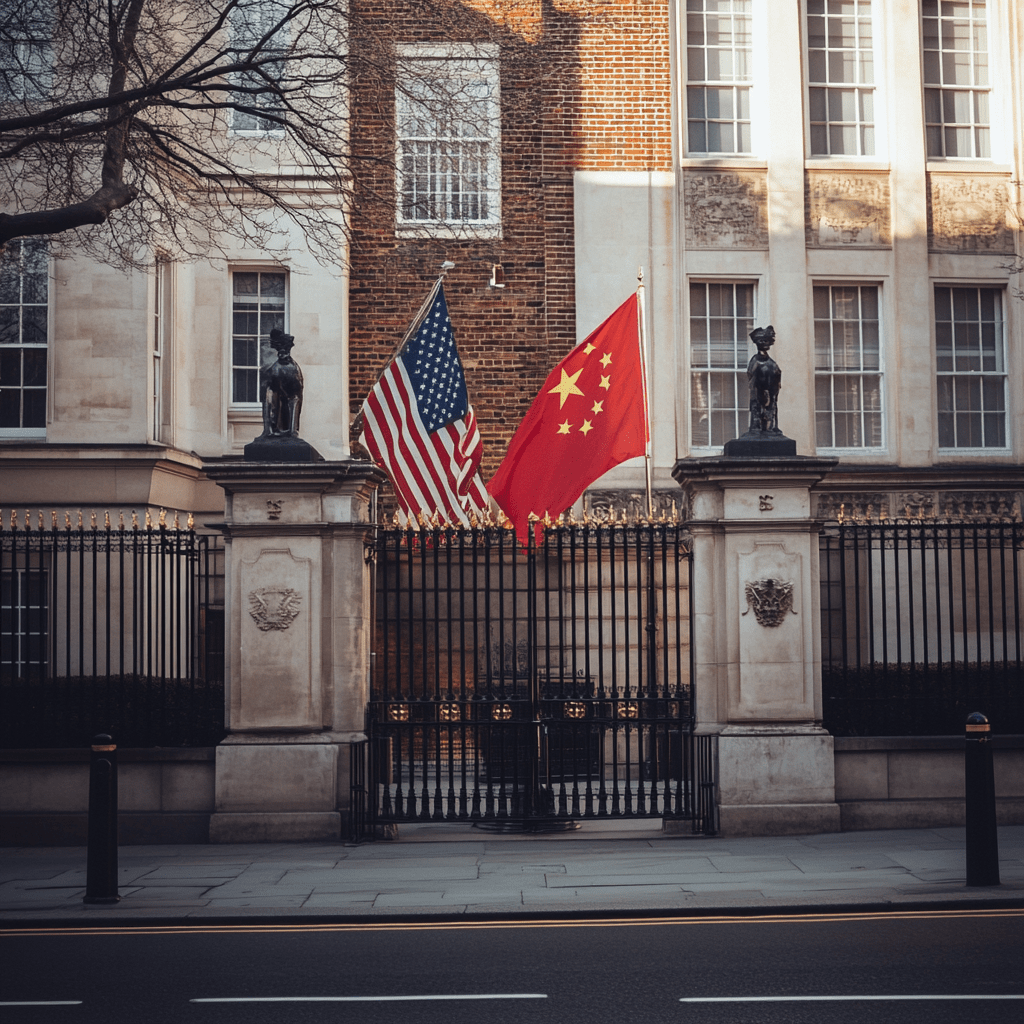
The US-China trade talks in London have entered their second day as of June 10, with the aim of easing the ongoing trade conflict between the two nations. The talks are taking place at Lancaster House, a historic mansion near Buckingham Palace, and involve high-level delegations from both sides.
The Chinese delegation is led by Vice Premier He Lifeng, accompanied by Commerce Minister Wang Wentao and trade negotiator Li Chenggang. The US team includes Commerce Secretary Howard Lutnick, Treasury Secretary Scott Bessent, and Trade Representative Jamieson Greer.
These discussions follow a preliminary agreement reached in Geneva last month, where both countries agreed to a 90-day pause on most tariffs exceeding 100% that had been imposed during their escalating trade war. Despite this, tensions have continued, particularly over issues such as advanced semiconductors critical for artificial intelligence, visa policies for Chinese students in the US, and export controls on rare earth minerals vital to automotive and other industries.
President Donald Trump has commented that China is “not easy,” but the US is “doing well” in the negotiations. He expressed a desire to “open up China” to American goods, indicating that if China does not open its market, progress may stall.
Read also : Gold : Build Your Wealth and Freedom
A key focus of the talks is the export restrictions on rare earth elements, which China dominates globally and which are essential for various high-tech industries. China has hinted at potentially relaxing these export restrictions, which has caused concern among global automakers dependent on these materials. In return, China seeks the US to remove barriers on Chinese access to technology used in producing advanced semiconductors.
The talks come after a recent phone conversation between Trump and Chinese President Xi Jinping aimed at realigning bilateral relations. The UK government is facilitating the logistics and venue for the talks but is not participating in the discussions themselves.
Read also : Tax Management strategies for Digital Nomads
Overall, these negotiations are closely watched by investors and world leaders as they hold significant implications for global economic stability and supply chains.
On April 9, U.S. stock markets experienced a historic rally after President Donald Trump announced a 90-day suspension of most reciprocal tariffs, while simultaneously raising tariffs on Chinese imports to 125%. This decision marked a significant shift in trade policy amidst escalating tensions with China and other trading partners.
Trump then announced that if China did not remove its 34% tariff on U.S. products by April 8, 2025, the U.S. will impose an additional 50% tariff on Chinese imports starting April 9. Today, the 125% tariff on China came into force.
The U.S. and China agreed to a 90-day truce starting May 14, lowering the reciprocal tariffs from as high as 125% down to 10%. However, the existing 20% fentanyl-related tariffs remain in place, making the effective tariff rate on most Chinese goods about 30% currently.
Our community already has nearly 150,000 readers!
Subscribe to our Telegram channel
Follow us on Telegram, Facebook and Twitter
© Copyright 2025 – Eurasia Business News. Article no. 1551.
 Eurasia Business News