
By Alexander Miller, consultant in energy markets. Eurasia Business News, July 11, 2025. Article n°1612.
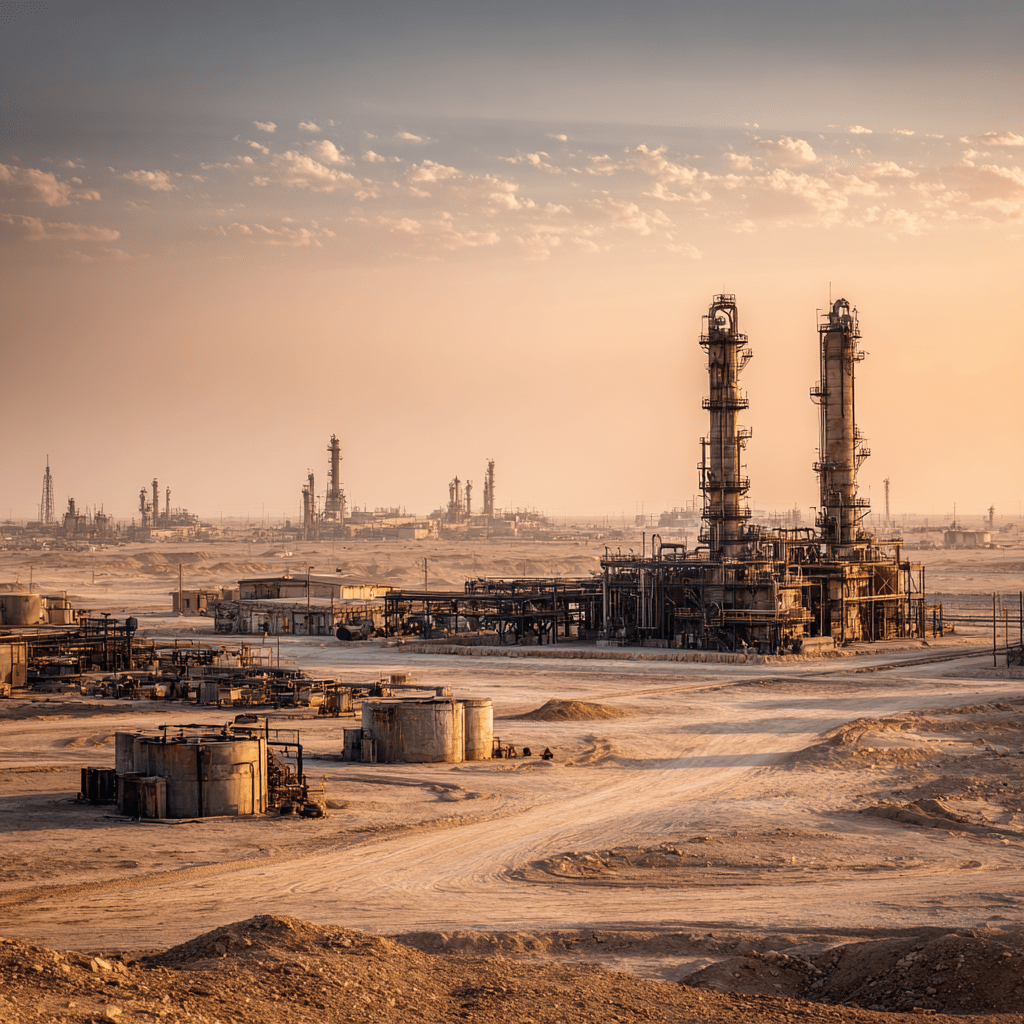
Russia is actively expanding its oil interests in Iraq, capitalizing on opportunities created by Baghdad’s need to modernize its hydrocarbon sector and boost crude exports. In February, Moscow and Baghdad signed four major energy cooperation agreements and memorandums of understanding, signaling a significant escalation in bilateral energy ties.
These agreements were concluded during the 10th session of the Russia-Iraq Intergovernmental Commission on Trade, Economic, and Scientific-Technical Cooperation in Baghdad. The session was co-chaired by Russian Energy Minister Sergei Tsivilev and Iraqi Foreign Minister Fuad Hussein.
🛢️ The Key Drivers Behind Russia’s Push for Oil Deals in Iraq :
1. Massive Russian Investments in Iraqi Oil Fields
Russian oil companies have already poured nearly $19 billion into Iraq’s oil sector, according to Iraq’s Ministry of Oil.
- Lukoil: Operates the West Qurna-2 field, one of Iraq’s largest, with estimated reserves of over 14 billion barrels.
- Gazprom Neft: Involved in the Badra oil field, producing around 85,000 barrels per day (bpd).
- Bashneft: Active in Block 12 exploration and contributing to upstream development.
In addition, Block 10, operated by Lukoil and Japan’s Inpex, has shown promising results with estimated reserves of over 2.5 billion barrels, reinforcing Russia’s long-term strategic presence in Iraq’s upstream sector.
2. Restart of Kurdish Oil Exports via Turkey
A major breakthrough in the agreements involves the resumption of crude exports from the Kurdistan Region of Iraq (KRI) to Turkey’s Ceyhan port, halted since 2023 due to legal and political disputes. The suspension reportedly cost Iraq over $23 billion in lost revenue.
Russian firms, particularly those involved in pipeline infrastructure and field services, stand to benefit from the reactivation of the Kirkuk–Ceyhan pipeline and the return of KRI volumes to international markets.
3. Long-Term Strategic Energy Cooperation
Moscow and Baghdad agreed to review and expand existing oil and gas contracts over the next five years, signaling a deepened commitment to energy diplomacy and bilateral cooperation. The objective is to:
- Secure stable Russian oil investments in Iraq’s southern and central regions
- Expand technical assistance and upstream services
- Foster knowledge transfer between Rosneft, Tatneft, and Iraqi national oil companies
This positions Russia as a long-term partner in Iraq’s oil development roadmap.
🌐 A Broader Economic Partnership Beyond Oil
The energy agreements are part of a larger geopolitical strategy to reinforce Russia-Iraq economic relations across multiple sectors. The latest cooperation packages also include:
- Maritime transport and logistics infrastructure, aimed at improving Iraqi export capabilities
- Public health initiatives, including medical training and equipment supply
- Trade and commerce facilitation, with a focus on dual-currency trade mechanisms using the Russian ruble and Iraqi dinar, partially insulating both economies from Western sanctions
🔗 Explore related topic: How Russia is Reshaping Global Energy Markets
📈 Strategic Implications: Russia’s Energy Diplomacy in the Middle East
Russia’s proactive energy diplomacy in Iraq must be seen in the context of its broader strategy to:
- Counterbalance Western influence in OPEC and the Middle East
- Diversify its oil export markets following the EU embargoes and G7 price cap sanctions
- Strengthen its role as a major external power in the Persian Gulf
As noted in Tatiana Mitrova’s 2024 analysis in The Russian Energy Outlook, Russia’s strategy hinges on leveraging state-backed oil giants to secure long-term supply contracts and infrastructure deals in energy-rich but institutionally fragile countries.
🛢️ Outlook for Russia-Iraq Oil Relations
With these recent deals, Russia is positioning itself as a preferred partner for Iraq’s long-term energy strategy, just as China and India increasingly dominate global demand for Middle Eastern oil.
Read also : Gold : Build Your Wealth and Freedom
As Iraq seeks to ramp up production to 6 million bpd by 2027 and modernize infrastructure via foreign partnerships, Russian firms are uniquely positioned due to:
- Their technical experience in mature oil fields
- Government-to-government coordination via strategic commissions
- Geopolitical alignment in resisting Western dominance of energy governance
✅ Conclusion
Russia’s pursuit of new oil deals in Iraq is a calculated move to expand its energy footprint, deepen bilateral ties, and capitalize on shifting oil geopolitics. As both nations face economic pressures and navigate a rapidly evolving global energy landscape, this partnership—grounded in hydrocarbons—may evolve into a pillar of post-Western energy diplomacy.
Our community already has nearly 150,000 readers!
Subscribe to our Telegram channel
Follow us on Telegram, Facebook and Twitter
© Copyright 2025 – Eurasia Business News. Article no. 1612.
 Eurasia Business News