
By John Meyer, consultant in financial affairs – Eurasia Business News, July 27, 2025. Article no. 1656
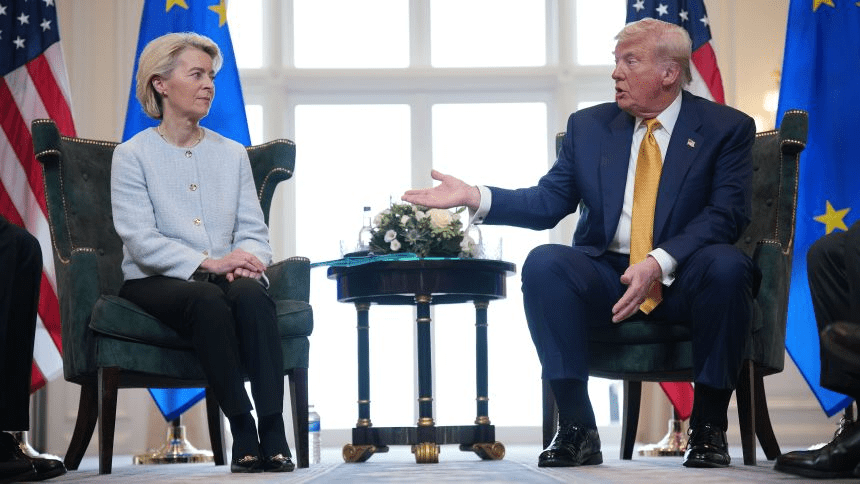
The United States, under President Donald Trump, and the European Union have just reached a significant trade deal that imposes a 15% tariff on most EU imports to the U.S., including automobiles, semiconductors, and pharmaceuticals, thereby avoiding a threatened trade war and a previously proposed 30% tariff that was set to take effect on August 1.
This agreement was finalized after high-stakes negotiations between Trump and European Commission President Ursula von der Leyen at Trump’s golf resort in Scotland.
In late June, negotiators said they were near a deal.
On April 17, President Trump had expressed strong optimism about reaching a trade deal with the European Union before the end of a 90-day pause on global tariffs in July.
Key elements of the deal include:
- A uniform 15% tariff rate on a majority of EU exports to the U.S., which is lower than the previously proposed 30% rate and the 50% tariffs on steel and aluminum that remain in place.
- The EU’s commitment to purchase around $750 billion worth of American energy products, including liquefied natural gas (LNG), oil, and nuclear fuels, aiming partly to reduce Europe’s reliance on Russian energy.
- An additional $600 billion in EU investments in U.S. energy, defense, and military equipment beyond previous plans.
- Creation of zero-tariff zones for strategic products like aircraft parts, semiconductor equipment, and certain chemicals, benefiting sectors critical to both economies.
- A framework modeled on UK-EU agreements for reduced tariffs and quotas on steel and aluminum to address global overcapacity issues.
Trump described this agreement as the largest deal he has negotiated and emphasized fairness as a central consideration. Von der Leyen highlighted the pact as both a substantial and challenging achievement that will bring stability and predictability to transatlantic trade. Although the 15% tariff is seen by many in Europe as a compromise compared to their aim of zero tariffs, it is viewed as preferable to the threatened higher tariffs that would have disrupted significant trade flows.
Read also : Tax Management strategies for Digital Nomads
This deal ends months of escalating tensions between the US and the EU that threatened to severely disrupt trade between the two largest economies worldwide, which together represent nearly a third of global commerce. The agreement was seen as critical to avoiding the negative economic impact a full-scale trade war would have caused for businesses and consumers on both sides of the Atlantic.
In summary, the Trump-EU trade deal:
- Caps tariffs on EU goods to 15%, avoiding sharp tariff hikes.
- Secures significant energy purchases and investments from the EU to the U.S.
- Ensures some zero-tariff zones for strategic products.
- Maintains current higher tariffs on steel and aluminum with a quota system.
- Provides trade stability and predictability ahead of the August 1 tariff deadline.
This agreement signals a de-escalation in transatlantic trade tensions while reflecting compromises on both sides to balance trade relations.
Our community already has nearly 150,000 readers!
Subscribe to our Telegram channel
Follow us on Telegram, Facebook and Twitter
© Copyright 2025 – Eurasia Business News. Article no. 1656
 Eurasia Business News