
By Swann Collins, investor and consultant in international affairs – Eurasia Business News. November 29, 2025. Article no 1921.
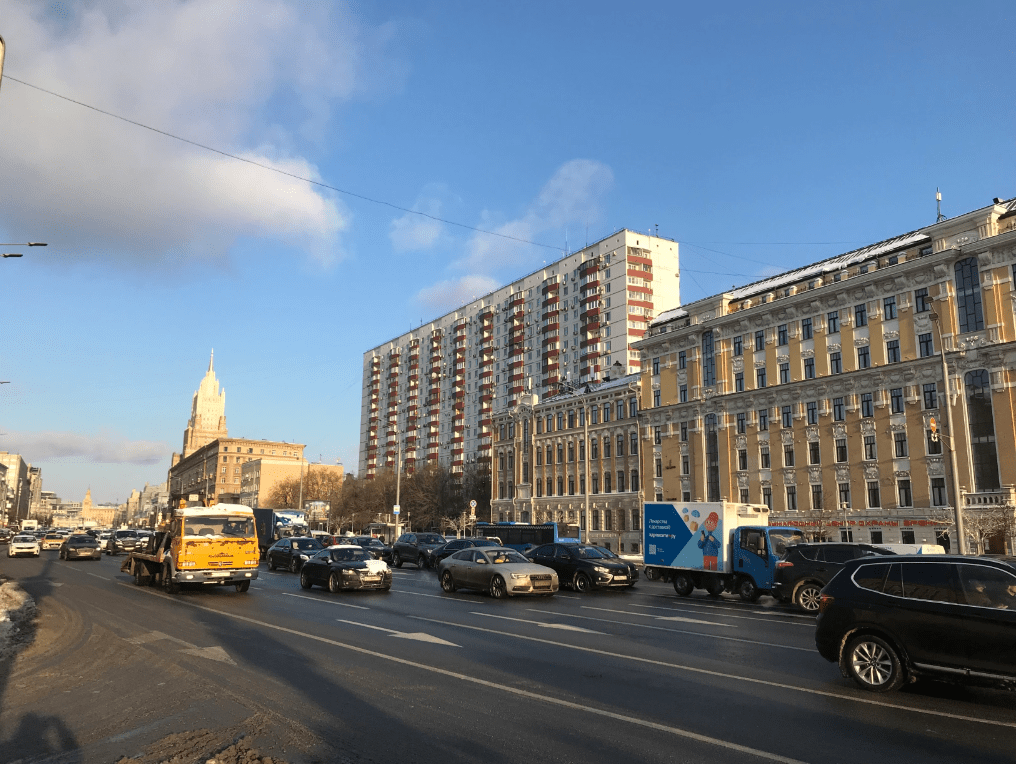
Smolenskyi Boulevard, Moscow, 2021– Photo credit : Swann Collins.
President Vladimir Putin on Friday signed a major tax overhaul that will raise Russia’s value-added tax to 22% from 20% next year, a move aimed at closing the fiscal gap created by soaring military expenditures and falling oil and gas revenues amid Western sanctions.
On top of an increase in the corporate profit tax this year, regular citizens and small businesses will experience a hike in the value-added tax (VAT) that takes effect at the start of next year.
Russia has approved a tax reform that raises the standard VAT rate from 20% to 22% starting 1 January 2026 and sharply lowers the turnover threshold at which small firms must register and pay VAT, from 60 million ($ 732,000) to 10 million rubles ($ 122,000) in annual revenue.
What exactly is changing
Standard VAT rate: increased from 20% to 22%, coming into force in 2026 (the official language is “from next year” in late‑2025 reports, referring to 2026). This is explicitly tied to plugging a growing federal budget deficit and financing higher defense and security spending.
Reduced VAT rate: the preferential 10% VAT rate on “socially important” goods (basic foodstuffs, medicines, children’s goods, etc.) is preserved, so the 22% rate applies to the standard basket of goods and services rather than these protected categories.
VAT registration threshold: the annual revenue threshold at which companies must register and pay VAT is cut from 60 million rubles to 10 million rubles, bringing many more small businesses into the VAT net.
Russia last raised VAT in 2019, when it increased the rate to 20% from 18%.
Economic purpose and fiscal effect
The main stated purpose is to close the fiscal gap caused by high military expenditures and weaker oil and gas revenues under sanctions; the government and independent analysts estimate the VAT hike will generate on the order of 0.5% of GDP or roughly about 1 trillion rubles in extra annual revenue, a large share of which is earmarked for “defense and security.”
Read also : Gold : Build Your Wealth and Freedom
This measure complements other tax increases on corporate profits and higher‑income individuals and is part of the 2026–2028 federal budget package passed by the State Duma and then signed by the president.
The Russia’s economy indicators for 2025 and 2026 are not good. The Federal state tries to increase fiscal income amid economic slowdown in the country. However, the Russian economy has strengths that Europe has not, such as strong industrial basis, a national currency and growing trade ties with major economies like China or India, generating trade surplus.
Expected impact on prices and businesses
Inflation: the VAT increase is expected to cause a one‑off bump in inflation around the time it takes effect, with economists and the Russian Central Bank estimating roughly 1 percentage point of added inflation pressure spread over several months, similar to the 2‑point VAT rise in 2019.
Read also : Wealthy Russians are more active in “packing” foreign assets in Dubai
Consumers: because VAT is embedded in almost all goods and services outside the reduced‑rate categories, households will see a broad‑based increase in prices, which effectively shifts part of the war‑related fiscal burden onto consumers.
Small businesses: many more small firms will have to register for and administer VAT due to the lower 10‑million‑ruble threshold, increasing their tax burden and compliance costs; there has already been lobbying and some minor softening of the strictest proposals in response to small‑business concerns, but the core threshold cut remains.
Read also : Tax Management strategies for Digital Nomads
Our community already has 190,000 readers, joins us !
Subscribe to our Telegram channel
Follow us on Telegram, Facebook and Twitter
© Copyright 2025 – Eurasia Business News. Article no. 1921
 Eurasia Business News