
By Swann Collins, investor, writer and consultant in international affairs – Eurasia Business News. November 29, 2025. Article no 1920.
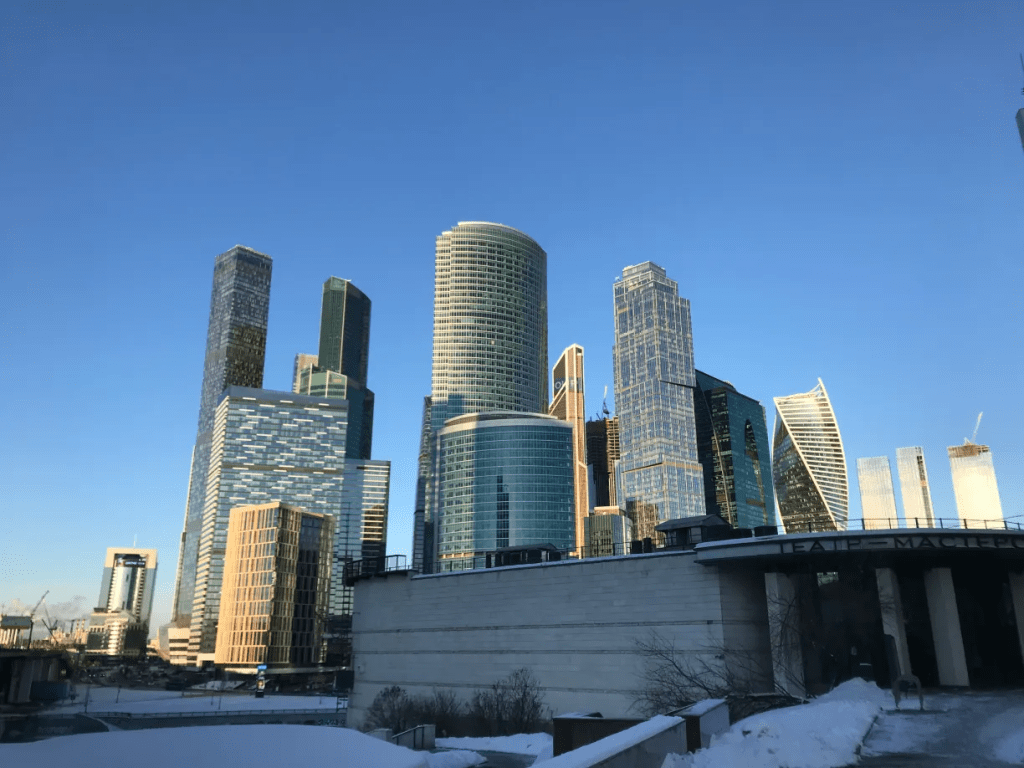
View on “Moskva City”, the financial hub of Moscow. December 2021. Photo credits : Swann Collins.
Slowing Growth, Persistent Inflation, and Structural Constraints
After a year of unexpectedly strong, war-driven expansion in 2024, Russia’s economy is entering a phase of marked deceleration. For decision-makers in banking, trade finance, commodities, and industrial investment, the 2025–2026 horizon presents a far more complex and constrained macroeconomic environment. Growth is expected to weaken sharply, inflationary pressures remain elevated, and structural bottlenecks—particularly labor shortages and sanctions—are weighing increasingly on productive capacity.
This outlook signals a transition from mobilization-driven expansion to a low-growth, high-inflation equilibrium, with significant implications for capital allocation, currency risk, and long-term investment strategies.
GDP Growth Projections
Russia’s wartime economy produced unexpectedly strong growth in 2023–2024, driven primarily by:
- Massive defense spending
- Import substitution
- State-directed industrial production
- Reorientation of exports toward Asia and the Global South
However, this momentum is now fading. All major forecasting institutions anticipate a pronounced slowdown in 2025 and only marginal recovery in 2026.

The International Monetary Fund (IMF) forecasts GDP expansion of 0.6% in 2025 and 1% in 2026.
Russia’s Economic Development Ministry anticipates 1% growth in 2025 and 1.3% in 2026, while the Central Bank of Russia estimates 0.5%-1.0% for 2025 and 0.5%-1.5% for 2026.
Read also : Gold : Build Your Wealth and Freedom
Other institutions like the World Bank project 1.4% in 2025 and 1.2% in 2026, citing factors such as labor shortages, declining energy prices, and sanctions.
Structural Causes of the Slowdown
The deceleration is not cyclical alone; it is structural:
- Labor shortages
Mobilization, emigration of skilled labor, and demographic decline have created persistent workforce constraints, particularly in manufacturing, construction, and high-tech sectors. - Capital market isolation
Russia’s effective exclusion from Western financial markets continues to restrict:- Foreign direct investment
- Technology imports
- Long-term external financing
- Declining energy rent
Lower global energy prices, combined with severe export discounts on Russian crude and gas, are compressing fiscal and current-account buffers. - Diminishing returns from import substitution
The initial rebound from replacing Western imports with domestic or Chinese alternatives is largely exhausted. Further productivity gains are proving difficult without Western capital goods and software.
For bankers and industrial executives, the implication is clear: Russia is transitioning to a low-potential growth regime, structurally capped near 1–1.5% even in optimistic scenarios.
Inflation: Persistent Pressure Despite Tight Monetary Policy
Inflation remains the dominant macroeconomic risk for 2025. The IMF projects consumer inflation at approximately 9% in 2025, before easing to 5.2% in 2026. Russia’s own baseline forecast anticipates a gradual return toward the 4% target only by 2026.
In October, annual inflation decreased in 65 out of 85 Russia regions and remained or grew in 20 regions, reported the Russian central bank.
Key inflationary drivers include:
- Wartime fiscal stimulus: Defense and security spending continues to grow faster than civilian output.
- Supply constraints: Sanctions, logistics bottlenecks, and labor shortages restrict supply.
- Import-driven price transmission: Parallel imports and Asian supply chains operate at higher transaction and insurance costs.
- Ruble depreciation risk: Any weakening of the current account directly feeds into CPI.
High Interest Rates as a Structural Feature
The Central Bank of Russia is compelled to maintain tight monetary conditions to contain inflation expectations. For the banking sector, this creates:
- Elevated lending rates
- Credit rationing for civilian SMEs
- Increased default risk in consumer and mortgage portfolios
- Improved margins on short-term instruments but weaker loan growth
For investors, Russia in 2025–2026 resembles a high-inflation, high-yield, high-risk environment, unsuitable for conventional long-term capital formation.
3. Investment and Capital Formation: Weakening Momentum
Russia’s Ministry of Economy now projects a 0.5% decline in investment in 2026, a significant downward revision from earlier growth expectations. This reversal reflects:
- Sanctions-driven technology embargoes
- Rising cost of capital due to elevated interest rates
- Declining private sector confidence
- Increased crowding-out by state defense spending
Sectoral Divergence
- Defense and security industries continue to absorb the bulk of investment and state subsidies.
- Civilian manufacturing faces:
- Limited access to advanced machinery
- Dependency on Chinese equipment with lower productivity
- Energy and mining remain profitable but face shrinking margins due to:
- Export price caps
- Extended transport routes
- Higher insurance and shadow-fleet costs
Non-war-related sectors are now projected to grow at only about 1% annually through 2027, essentially stagnation in real terms.
Our community already has 190,000 readers, joins us !
Subscribe to our Telegram channel
Follow us on Telegram, Facebook and Twitter
© Copyright 2025 – Eurasia Business News. Article no. 1920
 Eurasia Business News