
By Anthony Marcus for Eurasia Business News, February 15, 2026. Article n°2026
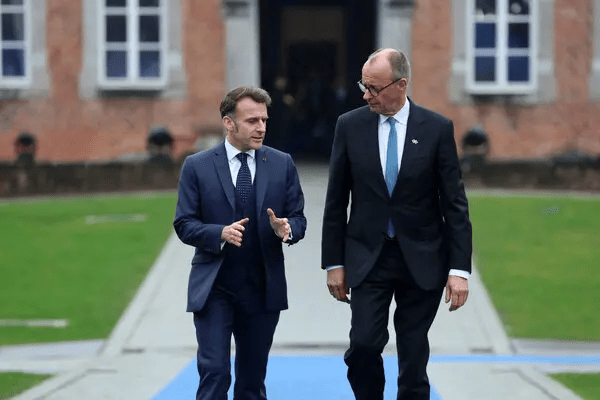
French President Emmanuel Macron and German Chancellor Friedrich Merz have engaged in confidential discussions on a possible “European” nuclear deterrent, as part of the continent’s security in the face of Russia and the uncertainties linked to U.S. nuclear protection.
Merz told the Munich Security Conference that he has begun talks with Macron on a European nuclear deterrent, presented as complementary to NATO’s “nuclear sharing” mechanism and not as an alternative.
The idea being explored is that of a European “nuclear umbrella”, relying mainly on the French arsenal (the EU’s only nuclear power since Brexit in 2016), for the wider benefit of European partners.
Merz insists on the respect of German legal commitments (the 1990 Two-plus-Four Treaty: renunciation of the production, possession or control of nuclear weapons) and on strict anchoring within the framework of NATO.
However, the weak political legitimacy of Macron in France could weaken this project of sharing the French nuclear military deterrence with European partners, a sensitive issue.
Macron’s position
Macron has been advocating for several years for Europe to “redefine” its own security architecture and take more control of its deterrence, especially in the face of a Russia considered more aggressive and Washington’s unpredictability with Trump as President.
In Munich in February, French president Emmanuel Macron speaks of a “holistic” approach to nuclear deterrence, integrating French forces into a broader reflection on European defence, while retaining national control of nuclear weapons.
He announced a “new strategic reflection” and promised to specify in the coming weeks how French doctrine could be articulated with common security interests, particularly with Germany.
Why now?
The war in Ukraine and Russia’s military build-up are pushing Europeans to reconsider their dependence on the US nuclear umbrella.
US President Donald Trump’s statements and political line revive doubts about the United States’ automatic willingness to defend Europe militarily, including as a nuclear last resort.
In this context, Paris and Berlin are testing the idea of an additional specifically European safety net, while taking care not to fracture the Atlantic Alliance.
Limits and grey areas
Germany remains legally non-nuclear: it can neither possess nor control nuclear weapons, even within a European framework, which requires a very cautious architecture (participation, consultation, but not direct control). This regime comes from the NATO framework following the WWII, forbidding Germany from acquiring nuclear weapons.
Germany is a non‑nuclear‑weapon state party to the Treaty on the Non‑Proliferation of Nuclear Weapons (NPT) of 1968, which obliges it not to manufacture or acquire nuclear weapons and to accept international safeguards on its nuclear activities.
The 1990 “Two‑plus‑Four” Treaty (between the two German states and the four Allied powers) confirmed a unified Germany’s renunciation of producing, possessing or controlling nuclear, biological and chemical weapons, locking this status into the post‑Cold War European order
Many points remain unclear: concrete methods of protection, sharing of decisions, the role of other European states, and the exact link with NATO’s nuclear guarantees.
This debate concerns ultimate sovereignty (the use of nuclear weapons) and is likely to arouse political reluctance in several countries, which means that we are currently at the exploratory stage, not at an operational agreement.
Why France should not share nuclear deterrence with Germany ?
First, French nuclear weapons are explicitly conceived as a strictly national, sovereign tool; sharing them would dilute France’s ultimate control over the “vital interests” they are meant to protect.
Then, nuclear use decisions must be taken in minutes by a single authority; involving Germany or others would create ambiguity over who decides and under what procedure, which weakens deterrence rather than strengthens it.
Third point, Germany is bound by the NPT as a non‑nuclear‑weapon state and by the 1990 Two‑plus‑Four Treaty not to possess or control nuclear weapons; any arrangement that looks like giving Germany real control would risk being seen as violating these obligations.
Creating a new, bespoke “nuclear sharing” scheme around French forces could stretch the letter and spirit of the NPT, encourage others to seek similar deals, and erode the global non‑proliferation regime.
Credibility of deterrence
Deterrence works only if adversaries believe France would actually risk Paris to defend, for example, Berlin; some analysts doubt that promise would be seen as fully credible, making the whole scheme fragile.
If a shared system requires joint French‑German approval under extreme time pressure (minutes), potential delay or disagreement could make a nuclear threat look non‑credible in a real crisis.
Political and strategic risks
Sharing France’s deterrent could alarm other EU states (who might feel excluded or dominated) and Russia (which could interpret it as escalation), increasing tensions and possibly sparking counter‑measures.
A French–German nuclear arrangement might be read in Washington as a step away from the US umbrella, complicating NATO cohesion and burden‑sharing debates at a sensitive time
Our community already has nearly 215,000 readers!
Subscribe to our Telegram channel
Follow us on Telegram, Facebook and Twitter
© Copyright 2025 – Eurasia Business News. Article no. 2026
 Eurasia Business News