
By Alexander Miller, consultant in energy markets. Eurasia Business News, March 13, 2026. Article n°2049
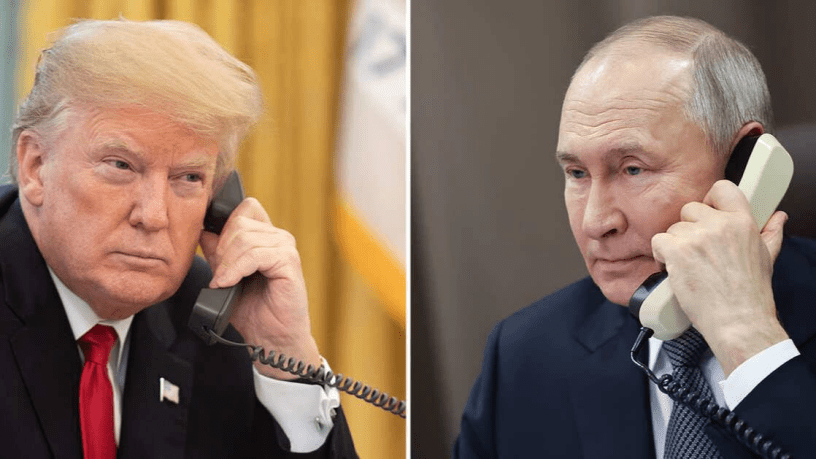
US President Donald Trump and Russian President Vladimir Putin held on March 9 the ninth official telephone conversation since February 2025.
“I had a very good conversation with President Putin. During the call, many people were present both from our side and from his,” the U.S. president said. According to him, he discussed with his Russian counterpart the American-Israeli operation in Iran. He mentioned that Moscow offered assistance in resolving the conflict in the Middle East, but at the same time stressed the need to focus on the Ukrainian settlement.
As Yuri Ushakov, aide to the Russian president, noted, the main topics of conversation were the wars in Iran and Ukraine. The topic of Venezuela was touched upon from the perspective of the state of affairs of the oil market.
The Kremlin says Putin presented several proposals for a “quick” political and diplomatic resolution to the Iran conflict, drawing on his talks with Gulf and Iranian leaders.
Both sides raised the surge in oil prices, which have jumped above 100 dollars a barrel amid fears over disruption in the Strait of Hormuz.
Oil markets are bracing for an even bigger potential price shock with Iran on warning that crude could surge to $200 per barrel if the war involving the U.S. and Israel against the Iranian regime continues to destabilize the Middle East’s energy corridors.
During a press conference on the same day, President Trump announced his intention to partially ease the sanctions pressure on the oil sector of “some countries” through an exclusion mechanism (waiver). When using it, the responsible government departments suspend the monitoring of the implementation of the U.S. sanctions regime for individual legal entities and their transactions and, accordingly, allow previously prohibited transactions.
Read also : The Private Investor Deal Evaluation Handbook
Waiver is usually used to ensure national security interests, including stabilizing prices and preventing a deepening financial crisis. They also vary in urgency and can be valid from 30 to 180 days with the possibility of extension or re-approval.
“We have imposed sanctions on some countries. We want to remove them until the [Strait] of Hormuz resumes normal functioning,” Trump said. At the same time, on March 6, the US Treasury, according to the head of the department, Scott Bessent (oversees sanctions policy), approved the issuance of a 30-day license to India to buy Russian oil, which is already in tankers.
“Reverse your decision to lift oil sanctions on Russia. Your attempts to help Russia look like a betrayal,” said Democrat Congressman Ted Lieu (quoted by The Miami Times on March 9).
At the same time, on March 8, U.S. Energy Secretary Chris Wright said that the administration’s policy towards Russian oil, in particular in terms of sanctions pressure, would not change. In addition, according to the European Commissioner for Economic Affairs Valdis Dombrovskis, the United States assured its European partners of the temporary nature of the sanctions relief.
However, we think that the main plot is not the lifting of sanctions, but a signal to the oil market, which Trump sends in the hope of minimizing panic and convincing of an improvement in the situation.
So far the energy market does not believe that oil prices will be high for a long time, and they have already gradually begun to decline. As for Russia, it is not yet known about the signing of any document or license aimed at easing sanctions against Russian oil producers and exporters.
Brent futures are closing the week above $100 for the first time in years, reaching $101.96 per barrel (+1.49). WTI was trading up $1.49 per barrel on the day at $97.22, up more than $7 per barrel week over week.
The license for India looks strange because it was not prohibited from buying Russian hydrocarbons. The U.S. president Trump simply threatened to impose duties on New Delhi, but there was and is no ban on the purchase of Russian oil. As soon as the market realizes that nothing has changed, then the news of new strikes on the oil infrastructure of the countries of the Middle East region will again push prices to rise. There are many factors in favor of the continued growth of the deficit and, accordingly, prices.
Read also : Tax Management strategies for Digital Nomads
With his statements, Trump wants to bring down the rise in gasoline prices in the United States itself, since this rise in price threatens the already rather vulnerable chances of the Republican Party in the midterm elections in November. Party members are literally begging the U.S. president to “end the Iranian war.” At the same time, we can not rule out that Trump may turn to Moscow for help in resolving the Middle East crisis.
As The New York Times reported on March 10, the average price of gasoline in the country has increased by 17% since February 28 (since the beginning of the joint US-Israeli operation in Iran). According to a joint Reuters poll and an Ipsos questionnaire published on the same day, 67% expect further price increases. At the same time, only 29% of Americans support US military strikes against Iran.
Yuri Ushakov also said that Trump again expressed interest in ending the conflict in Ukraine with an early ceasefire “to achieve a long-term settlement.”
“This has already been said many times. And all the modalities that are related to the ceasefire are already well understood. Everyone is well aware of President Putin’s consistent position. But in general, everyone is really interested in an early ceasefire. It is difficult to argue with this here,” Dmitri Peskov said.
Without resolving the Iranian crisis, it seems now hardly possible to conduct a dialogue to end the Russian-Ukrainian conflict, which entered its 5th year. This is due to doubts that could arise about the Trump administration on the part of the Russian authorities. After all, it is difficult not to pay attention to Trump’s systematic bluff. This will clearly be kept in mind during any contacts and promises.
Our community already has nearly 220,000 readers!
Subscribe to our Telegram channel
Follow us on Telegram, Facebook and Twitter
© Copyright 2026 – Eurasia Business News. Article no. 2049
 Eurasia Business News