
By Paul Jouvenet, jurist and essayist. Eurasia Business News, July 20, 2023
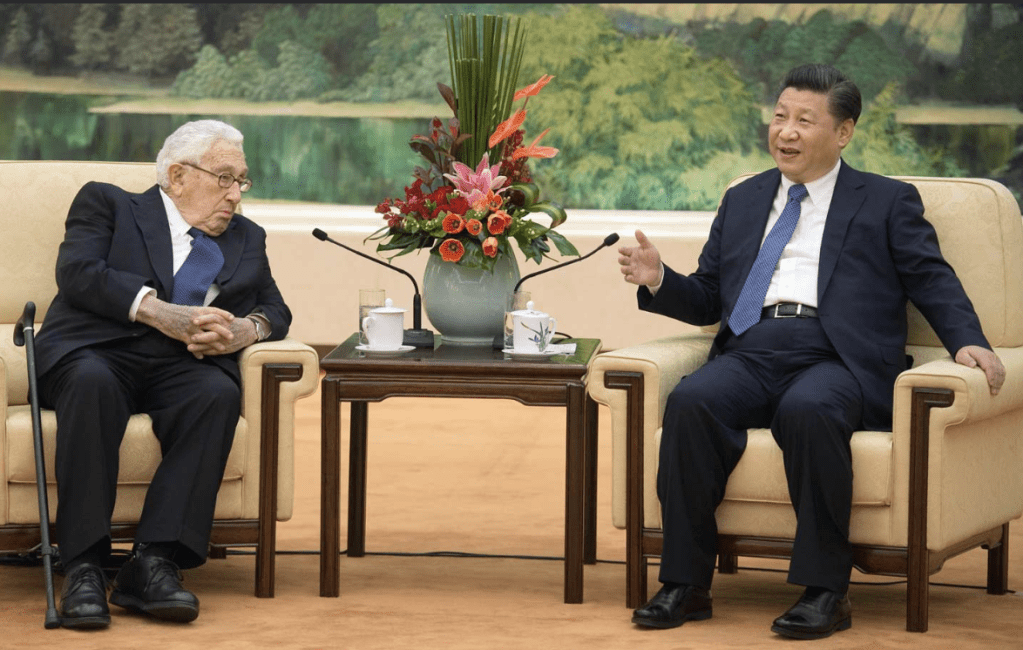
Photo: Henri Kissinger and Xi Jinping, President of the People’s Republic of China, shake hands on July 20, 2023 in Beijing.
Former US Secretary of State and now centenarian Henry Kissinger met with Chinese President Xi Jinping on Thursday during a surprise visit to Beijing. The purpose of this trip is to discuss with Chinese leaders their thoughts, to better guide Washington in its difficult relationship with Chinese power. The meeting comes two days after spontaneous talks between Kissinger and China’s defense minister, Li Shangfu, on Tuesday.
The surprise visit was scheduled at least two months ago, according to local sources. During the trip as a private person, Henry Kissinger hopes to have “more intimate conversations” with Chinese leaders, which is often difficult during official visits.
“Kissinger is certainly traveling as a private citizen, not at the behest of the U.S. government. Naturally, he is invited to meet with senior officials when he visits a foreign country, especially China, and they invariably express their opinion and ask him,” a source close to Kissinger’s team said.
On July 18, Henry Kissinger met with China’s defense minister, Li Shangfu, who refuses to meet with Pentagon representatives due to the fact that he has been on the US sanctions lists since 2018 for purchasing weapons from Russia. The Chinese official also pointed out that “some people in the United States have not been able to go along with China in the same direction” and this is what led to the lowest point in relations between the two countries since the establishment of diplomatic relations in 1979.
On July 19, Kissinger met with the head of the office of the Foreign Affairs Commission of the CPC Central Committee, Wang Yi, a former Chinese foreign minister, who had visited Moscow last February to conduct important negotiations on the situation in Ukraine.
“China’s development has a powerful internal driving force and inevitable historical logic, it is futile to try to transform China, let alone contain it,” Wang Yi said during his meeting with Kissinger. The Chinese official warned that the United States must distance itself from “Taiwanese separatists” if it wants to maintain stability in the Taiwan Strait.
On July 20, the former US secretary of state met with Chinese leader Xi Jinping. According to the Chinese Foreign Ministry, the Chinese president noted Kissinger’s contribution to the process of normalizing relations between Beijing and Washington, “which has not only benefited both countries, but also changed the world,” and called the US politician an “old friend” of China.
Born in May 1923, Henry Kissinger is hailed in the Chinese state media as a “legendary diplomat”, who allowed the rapprochement in the 1970s between China and the United States, in the middle of the Cold War. The normalization of relations between the two states, then in enmity with the USSR, greatly influenced the outcome of the Cold War. Now, in the US-China-Russia triangle, it is Washington that has difficult relations with the other two countries, as Kissinger pointed out during Donald Trump’s presidency.
“Since 1971, Kissinger has visited China more than 100 times,” Chinese state television said Thursday.
Read also : Gold : Build Your Wealth and Freedom
Xi Jinping said today that at present, China and the United States are “at a crossroads” and must make a choice again. According to the Chinese leader, countries can achieve mutual achievements and common prosperity. “The key point is to follow the three principles of mutual respect, peaceful coexistence and mutually beneficial cooperation. On this basis, China is willing to explore with the U.S. side the right path for the two countries and promote the steady progress of China-U.S. relations, which will benefit both sides and the world,” said the Chinese president.
Xi Jinping also expressed hope that Kissinger and “astute people in the United States” will continue to play a “constructive role” in returning relations between the countries to the “right track.”
In turn, Kissinger said that relations between Washington and Beijing are crucial for the development of both countries and the entire world. “Under the current circumstances, we should adhere to the principles set out in the Shanghai communiqué, understand the extreme importance of the one-China principle for China, and promote the development of U.S.-China relations in a positive direction. I stand ready to continue my efforts to strengthen mutual understanding between the people of the United States and China,” the former US secretary of state said.
China considers Taiwan its territory, while the island’s authorities declare Beijing’s claims illegitimate. The US adheres to the one-China policy, but at the same time supplies arms to Taiwan. U.S. President Joe Biden has also said the U.S. will intervene if China attacks Taiwan.
The conservative of Chinese diplomacy at the Communist Party Central Committee, Wang Yi, with whom Kissinger spoke the day before, attended the meeting.
Kissinger served as Secretary of State during the presidency of Richard Nixon (1969-1974). It was during this period that the United States and Communist China established relations. In particular, Nixon visited China in 1972, becoming the first U.S. president to do so.
Wang Yi, in a meeting with the 100-year-old expert, said U.S. policy needed his “diplomatic wisdom” and Nixon’s “political courage.” He also stressed the importance of Washington’s adherence to the one-China principle. Kissinger, in response, expressed confidence that the United States would continue to do so.
The American journalist Laura Secor, a specialist on Iran, had published in August 2022 in the Wall Street Journal an interview with Henry Kissinger. The former Secretary of State and National Security Advisor had just published his 19th book, “Leadership: Six Studies in World Strategy“, a 528-page book. According to him, the United States is on the brink of war with Russia and China, due to Washington’s erratic foreign policy, conducted without a clear purpose and without a far-sighted statesman.
Since the 1950s, while teaching as an academic at Harvard, writing on nuclear strategy, Kissinger has defined and analyzed diplomacy as an exercise in balancing the great powers, darkened since 1945 by the potential for nuclear catastrophe and mutual destruction. The apocalyptic capacity of modern weapons technology, he said, makes maintaining the balance of hostile powers, however difficult, a paramount imperative in international relations. Order and stability through the balance of power is a fundamental principle of the realist theory of international relations, whose main theorists are Hans Morgenthau, Raymond Aron, Kenneth Waltz, John Mearsheimer and of course Henry Kissinger.
Read also: Henry Kissinger : “There are three possible outcomes to this war”
In line with the realism school of international relations, Henry Kissinger suggests to work on a new international structure, that would guarantee order and stability. In order to preserve the balance of power, Kissinger recommended that Russia have a place in this new order, as a place had been allocated to France after 1815, and to Germany after 1918 and 1945.
“The objective of a peace process would be twofold: to confirm Ukraine’s freedom and to define a new international structure, especially for Central and Eastern Europe. Eventually, Russia should find a place in such an order.”
Although Kissinger has not held office since 1977, he has advised virtually every U.S. president since Nixon. His record and views deeply divide opinion, but he is rarely ignored. His influence on U.S. foreign policy is real.
In Richard Nixon’s team, Henry Kissinger developed the policy of détente with the Soviet Union. Kissinger negotiated the SALT I treaty with Moscow, an agreement limiting the number of nuclear weapons of the two superpowers. Similarly, in June and October 1971, for the first time, Kissinger secretly made contact with Communist China with the complicity of Pakistani President Yahya Khan who allowed Kissinger’s plane to fly to Beijing from Islamabad. Then Kissinger accompanied US President Nixon on his official visit to China (the first by an American president) in February 1972. In 1973, Kissinger played an important role in ending the Yom Kippur War by brokering the ceasefire between Israel and Egypt.
The visit of Henry Kissing to Beijing can also be seen as an attempt to prevent China to play only for its alliance with Russia, as Washington is the main opponent of the geopolitical goals of Moscow. Kissinger wants to avoid or at least, limit the scale of a full alliance between Russia and China, in order to ease the task of Washington on the international stage.
The alliance between China, an industrial giant, and Russia, the leading power in mineral resources, constitutes indeed a geopolitical force unequalled in history, whose base is Eurasia, “heart of the world”, as already considered by the British geographer Halford John Mackinder in 1904 in his article The Geographical Pivot of History. This theory was, however, criticized by Nicholas John Spykman, professor of international relations at Yale University in the 1930s, defending the primacy of the “Rimland”, this coastal strip of the Eurasian continent, over the “Heartland”.
Thank you for being one of our readers.
Our community already has nearly 110,000 members.
Sign up to receive our exclusive items.
To receive premium content, subscribe, it’s only €9.99/month. You will see the subscription form on restricted publications.
Sign up to receive our latest articles, it’s free!
Follow us on Telegram, Facebook and Twitter
© Copyright 2023 – Paul Jouvenet, jurist and essayist.
 Eurasia Business News