
By Antoine Mayet, Brussels correspondent for Eurasia Business News, on 24 June 2024. Article no. 1052.
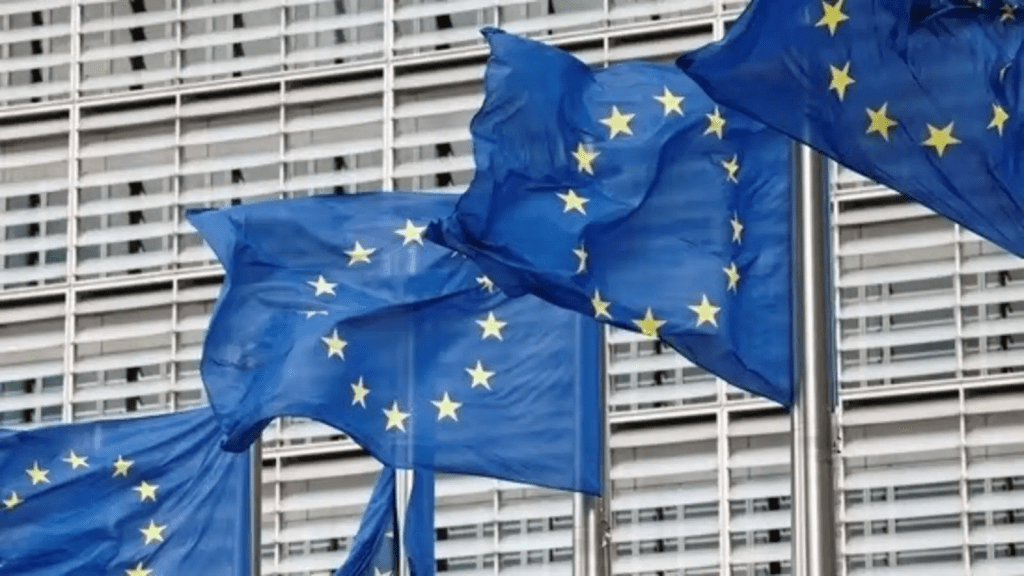
The European Union (EU) has adopted a 14th package of sanctions against Russia, aimed at the energy, finance and trade sectors, according to the press service of the Council of the EU. These measures had been expected for a week. In particular, Germany has slowed down the adoption of this new sanctions prosecutor’s office. These new sanctions cover several billion euros of trade.
« The package includes restrictive measures against 116 other natural and legal persons “, says the press release.
The European Union has imposed restrictions on the transit of Russian liquefied natural gas (LNG) through European ports. According to the EU Council, the measures are aimed at reducing Russia’s revenues from sales and transport. The restrictions cover both ship-to-ship and ship-to-shore transhipment. It should be noted that these restrictions only apply to re-export to third countries via the EU – they do not apply to imports.
The EU has also banned investment, the supply of goods, technology and services to carry out LNG projects. Among them are Arctic LNG 2 and Murmansk LNG. Restrictions are also imposed on the import of Russian gas through EU terminals that are not connected to the natural gas system.
The new sanctions package has given companies registered in the European Union the responsibility to ensure that their subsidiaries in third countries do not circumvent the restrictions imposed on Russia. It also required companies that sell arms to put in place due diligence mechanisms that will identify and assess the risks of re-exporting goods to Russia. EU operators who transfer industrial know-how for arms production to trading partners in third countries must now include clauses in contracts ensuring that the know-how will not be used for goods destined for Russia.
According to the EU Council’s press release, the restrictions target the Financial Messaging System (SPFS), which was developed by the Central Bank of Russia to break free from the SWIFT payment system. The new sanctions package prohibits European organisations from connecting to the SPFS or equivalent specialised financial messaging services. EU operators have also been banned from transacting with organisations using SPFS outside of Russia.
In addition, the Council of the EU has banned transactions with targeted financial institutions and crypto-asset providers established outside the EU, in the event that these organisations facilitate transactions to support the Russian military-industrial complex.
Read also : Gold : Build Your Wealth and Freedom
The Council of the EU has also banned political parties and foundations, including think tanks and the media, from accepting funds from Russia and its proxies. “The measures agreed today will not prevent media service providers and their employees from carrying out other activities in the EU, such as research and interviews,” the EU Council said in a press release.
For the first time, the European Union has taken action against specific vessels allegedly participating in Russia’s military operations. They are banned from European ports, and a ban on providing services is also imposed. The Council added 61 new organisations to the list of restrictions, which will be subject to export restrictions on dual-use goods and technology. Some of them are located in countries such as China, Kazakhstan, Kyrgyzstan, Turkey, and the United Arab Emirates.
The Council of the European Union has banned its airlines from operating charter flights and private flights worldwide at the request of Russian natural and legal persons.
The ban on landing, taking off or flying over EU territory will also apply to any aircraft used for a non-scheduled flight and where a Russian natural or legal person, entity or body is able to effectively determine the place or time of its take-off or landing, for example a holiday destination or a business meeting. In addition, operators must provide any information requested by the competent national authorities of the Member States on non-scheduled flights, including the ownership of the aircraft and possibly the passengers.
These measures on civil air links are legally questionable, since the Council of the EU generally deprives Russian and European citizens and their families of the possibility of travel in the context of their private lives (Article 8 of the 1950 European Convention on Human Rights). : Article 8 of the Convention provides that “Everyone has the right to respect for his private and family life, his home and his correspondence.” This right to privacy includes the possibility of visiting loved ones. The general ban on sanctions decided in this 14th prosecutor’s office can easily be annulled by an appeal to the General Court of the European Union at the CJEU.
It also banned the import of helium from Russia and the export of manganese ores to the Russian Federation. The package imposed restrictions on the acceptance of applications for registration of certain intellectual property rights in the EU from Russian citizens and companies. It also prohibited the acquisition, import, transfer and export of cultural values of Ukraine and other objects of rare archaeological, historical, cultural, scientific or religious significance.
These new restrictions, according to the head of the EU’s diplomatic service, Josep Borrell, in addition to the Russian energy sector, will also affect the defence and finance sectors.
In 2022-2023, the European Union imposed an embargo on maritime imports of oil and petroleum products from Russia and on the supply of Russian coal, after tough negotiations between member states. In addition, the EU joined the price cap on Russian oil and petroleum products introduced by the G7 countries in December 2022 (including the United Kingdom, Germany, Italy, Canada, France, Japan and the United States). This regime prohibits the importation, transport and insurance of oil at a price above a ceiling of $60/barrel for oil and $45/barrel for cheaper petroleum products (e.g. fuel oil) and $100/barrel for more expensive petroleum products (diesel fuel).
Russia has previously said it will not sell oil to countries that impose a limit on its value. Since March 2022, Russia has reoriented its oil exports to Asia (China, India, South Korea, Japan).
The European Union has not imposed any sanctions against the supply of gas from Russia, whether pipelines or liquefied gas. At the same time, on 21 May 2024, the Council of the EU approved changes to the rules of the European gas market, which allow gas deliveries from Russia to be limited to individual countries independently from 2026.
Experts consulted by Eurasia Business News believe that the sanctions measures will not have a significant negative impact on Russian oil and gas exports. The most important of these sanctions measures is the ban on the transhipment of LNG in European ports.
Read also : Gold : Build Your Wealth and Freedom
For Russia, the European market is important in terms of LNG supply. In 2023, LNG accounted for 46% of the total export volume. For the Yamal LNG project and the plants in the Leningrad region, this share is even higher – up to 67%.
In January-May 2024, the European Union, taking into account transshipment, accounted for 53.5% of all liquefied gas shipments from Russia, including 82.5% of all Yamal LNG deliveries. The transshipment of Russian LNG in European ports in 2023 amounted to around 1.7 million tonnes.
Yamal LNG is interested in LNG transshipment in Europe as it seeks to accelerate the return of ice-class tankers to load new batches. Alexander Miller, an energy markets consultant, believes that LNG can also be transshipped from the board, including in the waters of the Murmansk region. All these LNG volumes will be sold and that the ban will almost not affect the total shipments of Yamal LNG, although there will be additional costs.
The expert adds that the EU’s ban on Russian LNG imports was imposed under pressure from the United States. A more sensitive measure could be a complete ban on LNG from Russia. But this would “inevitably” lead to an increase in gas prices in Europe, aggravating the economic and social crisis generated by persistent inflation since 2021.
Essayist and consultant Paul Jouvenet notes that these new European sanctions against Russian LNG projects “raise a number of serious questions about their legal and economic consequences“. The cancellation of long-term LNG import contracts by Sweden and Finland without a blanket ban on EU supplies could be grounds for legal action by Russian companies. In the event of a dispute, appeals may be heard before international arbitration tribunals, such as the International Centre for Settlement of Investment Disputes (ICSID) or the Arbitration Institute of the Stockholm Chamber of Commerce.
Our community already has nearly 130,000 readers!
Notify me when a new article is published:
Follow us on Telegram, Facebook and Twitter
© Copyright 2024 – Eurasia Business News.
 Eurasia Business News