
By Paul Jouvenet, jurist and essayist. Eurasia Business News, September 10, 2024. Article No 1219.
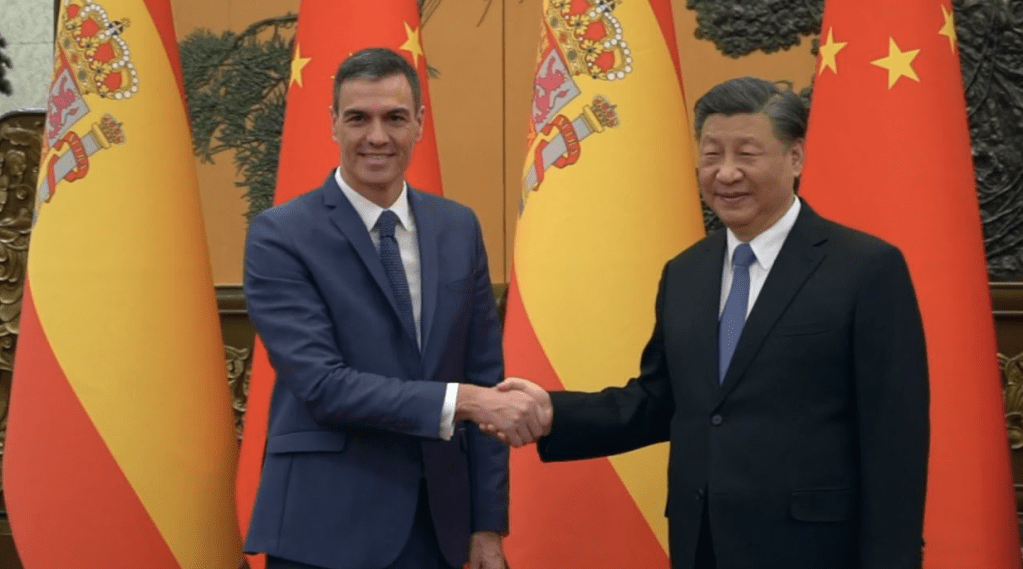
Pedro Sánchez, the Spanish Prime Minister, is currently visiting China with the primary objective of enhancing economic relations between Spain and China, which is Spain’s main trading partner outside the European Union. This visit comes amid escalating trade tensions between China and the EU, particularly regarding tariffs on electric vehicles (EVs) and other trade disputes that have intensified in recent months.
Madrid has been held hostage to these wars: after Brussels imposed increased tariffs on Chinese electric vehicles this summer, Beijing launched an anti-dumping investigation into European pork, which primarily affected Spain.
The first item on the agenda of Spanish Prime Minister Pedro Sanchez’s visit to China was the opening of the 9th Spanish-Chinese Forum in Beijing and participation in a meeting of the Business Advisory Council, which brings together 15 Spanish and 21 Chinese companies. And on Tuesday, already in Shanghai, Mr. Sanchez will be the main guest at the Spanish-Chinese business meeting and will open the Instituto Cervantes, a center for Spanish language and culture.
However, a much more important platform for strengthening economic ties between Madrid and Beijing should be Mr. Sanchez’s meetings with members of the top leadership of China – Premier of the State Council Li Qiang, head of the legislature Zhao Leji and, finally, with Chinese President Xi Jinping, who received a Spanish guest at dinner on Monday (immediately after a meeting with Norwegian Prime Minister Jonas Gahr Støre, who is also on a visit to China).
No statements were made following these meetings in the press, including the Xinhua news agency. However, it can be assumed that Pedro Sanchez expressed about the same idea to Chinese politicians as he did on Monday morning, speaking at a business forum in Beijing. “Even on those issues where our positions do not fully coincide, we remain constructive readiness for dialogue and cooperation… We are committed to developing a positive agenda and looking for agreed solutions that will benefit all parties,” the Spanish prime minister said, according to a video that appeared on his social networks.
Mr. Sanchez’s trip to China comes amid growing tensions in trade relations between China and the EU.
At this stage, the main stumbling block is the introduction by Brussels from July of increased import duties of up to 36% on electric cars imported to Europe from China, on the grounds that most of the Chinese automotive industry is subsidized by the Chinese authorities. Moreover, Spain, the second-largest exporter of electric vehicles in Europe and the ninth automaker in the world, openly supported these EU tariffs along with Italy and France.
But Beijing has found something to respond with. To begin with, China filed a complaint with the World Trade Organization, and then “mirrored” the actions of the Europeans with its anti-dumping investigations regarding EU subsidies for some dairy products supplied to China and pork imports from there. These categories accounted for a total of about €5 billion in 2023, or about a quarter of all EU agri-food exports to China.
At the same time, Beijing’s retaliatory actions potentially jeopardized primarily Spain, which is the largest European exporter of pork.
Beijing’s retaliatory actions in response to the European Union’s proposed tariffs on Chinese electric vehicles (EVs) have significant implications for Spain, particularly as it is the largest European exporter of pork. Following the EU’s consideration of tariffs, China initiated an anti-dumping investigation into European pork imports, which primarily targets Spanish products.
In 2023, Spain exported approximately $1.5 billion worth of pork to China (560,000 tons), making it the leading supplier in the EU, surpassing competitors like the Netherlands and Denmark
Read also : Gold : Build Your Wealth and Freedom
Against the backdrop of the fact that as early as October the leaders of the EU member states will have to vote for or against the introduction of increased tariffs on Chinese electric vehicles on a permanent basis (while this measure has been declared temporary), and fears that Beijing will strike back at the most vulnerable sectors of the EU economy, some countries preferred to negotiate in advance with the Chinese authorities.
One of the first to take up such a safety net was in Germany, whose largest automakers have been present in the Chinese market for many decades. In mid-June, Economy Minister Robert Habeck visited China to personally assure his Chinese counterparts that Berlin does not support the pan-European mood to punish the Chinese auto industry with increased duties. By the way, in July, Germany abstained from a preliminary vote within the EU on this topic.
Then a large delegation from Ireland, which is a supplier of dairy products to China, went to China. And at the end of July, Italian Prime Minister Giorgia Meloni visited China, announcing an agreement to sign a three-year action plan with Beijing on the “development of new forms of cooperation.”
Curious things have happened in recent months in relations between China and France. Paris initially acted as the main ideological inspirer of the anti-dumping investigation into Chinese electric vehicles. And soon he received an answer: in the spring, Beijing announced the launch of an anti-dumping investigation against European brands of cognac (and 99% of imports of this type of alcoholic beverages to China fall on French brands). However, at the end of August, the Chinese authorities announced that tariffs on French cognac would not apply for the time being. And, as many are sure, President Emmanuel Macron, who received him on a state visit in May this year, personally persuaded Chinese President Xi Jinping to change his anger to mercy. However, what they received in Beijing in return remained not completely clear.
On the eve of Pedro Sanchez’s visit to China, Spanish diplomats in an interview with Politico expressed the hope that the head of the Spanish government would be able to conclude a deal similar to the one concluded by President Macron.
The ongoing trade disputes between China and the EU pose a significant risk to Spain’s pork export industry, with retaliatory actions from Beijing potentially leading to substantial economic repercussions. The situation underscores the delicate balance of international trade relations and the need for diplomatic engagement to mitigate conflicts that could adversely affect key sectors of the economy.
Our community already has nearly 135,000 readers!
Subscribe to our Telegram channel
Follow us on Telegram, Facebook and Twitter
© Copyright 2024 – Eurasia Business News. Article no. 1219.
 Eurasia Business News