
By Anthony Marcus for Eurasia Business News, August 6, 2025. Article n°1690.
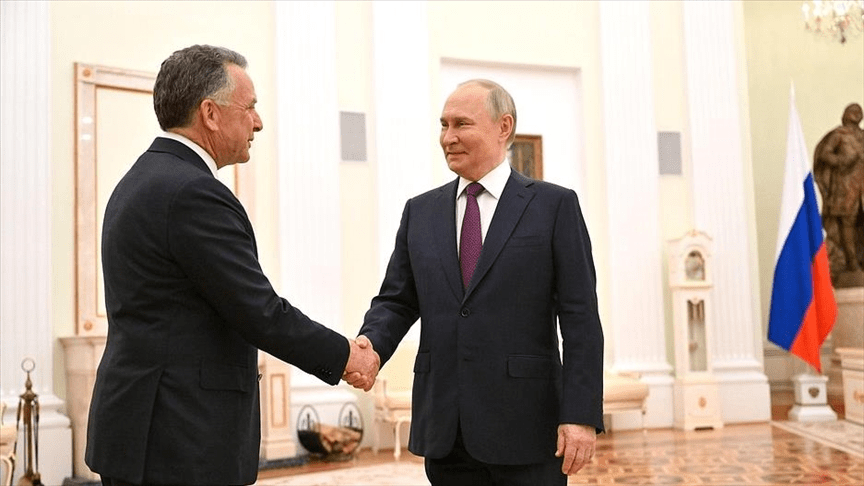
Special Representative of the U.S. President Steve Witkoff visited Russia for the fifth time, where he met with Russian President Vladimir Putin in Moscow.
On August 6, US Special Presidential Envoy Steve Witkoff visited Moscow. He met with Russian President Vladimir Putin in the Kremlin, their meeting lasted about three hours. As presidential aide Yuri Ushakov said after the talks, the meeting had two topics – the conflict in Ukraine and “prospects for the possible development of strategic cooperation between the United States and Russia.”
“A very useful and constructive conversation took place,” Ushakov told reporters. — <… > From our side, in particular, on the Ukrainian issue, some signals were transmitted. Relevant signals have also been received from [US President Donald] Trump.”
The Russian official declined to comment further, explaining that Trump has not yet been informed about the results of the meeting. “Let’s see when Witkoff will be able to report on the conversation that took place today to Trump. After that, obviously, we will be able to supplement my comments now with something more substantial,” he said.
Witkoff arrived in Moscow in the morning of August 6. At Vnukovo Airport, he was met by the head of the Russian Direct Investment Fund (RDIF), Special Representative of the President for Investment and Economic Cooperation with Foreign Countries Kirill Dmitriev. Before going to the Kremlin, Witkoff and Dmitriev visited a restaurant in Zaryadye Park in the center of Moscow. With the departure of the special envoy, the head of the RDIF announced on the X network that he had participated in a meeting in the Kremlin. “Constructive dialogue between the United States and Russia is ongoing and critical to global security and peace,” he wrote.
What Witkoff came to Moscow with
This is Witkoff’s fifth visit to Russia. The last time he met with Putin was on April 25 in the Kremlin – their first four meetings fit into three months. Whitkoff’s current trip was announced by US President Donald Trump. “Yes, he will go to Israel and then to Russia, believe it or not,” he told reporters.
On August 1, Trump’s special envoy arrived at a food distribution point in Rafah (a city in the Gaza Strip), organized by the American Humanitarian Foundation (GHF), and the next day met with the families of hostages held by Hamas. Whitkoff was originally expected to travel to Russia over the weekend, but the visit was later postponed to August 6.
Two days later, on August 8, President Trump’s deadline for a settlement in Ukraine will expire, after which the U.S. president threatens to impose new sanctions against Russia. These measures are expected to include new tariffs on Russian oil supplies: Senators Lindsey Graham and Richard Blumenthal proposed to impose 500% tariffs on goods from countries importing Russian raw materials, and Trump himself announced a rate of 100%.
On the eve of his emissary’s visit to Russia, he, however, refused to give reporters the final figure, but announced “significant” additional tariffs on India for the purchase of Russian oil and weapons. On August 6, after Witkoff left Moscow, Trump signed a decree imposing 25% duties on Indian goods.
“We’re going to do a lot of that,” Trump said Tuesday when asked if he would make similar threats against other countries. “We will have a meeting with Russia tomorrow. Let’s see how it goes. We will then make a decision on this issue.”
On July 14, Trump said he was “unhappy with Russia” and that if there was no deal on Ukraine within 50 days, he would impose “very harsh tariffs” on Moscow. On July 28, he said that there was “no point” in waiting 50 days and he was setting a “new deadline” of 10-12 days. “I would like to be generous, but we just don’t see any progress,” he said at the time.
Disappointment in the Russian position these days was also broadcast by US Secretary of State Marco Rubio. In an interview with Fox Radio, he said that Trump has been waiting for a settlement “for more than six months and has made every possible effort [to it]” and said that the United States will continue to engage with Russia “on Monday or Tuesday” (i.e. August 4 or 5). “We also had a whole conversation with them — not with Putin, but with some of Putin’s senior people — in the hope of reaching some understanding on the way forward that would lead to peace, but we don’t see any progress in that direction,” Rubio said on July 31.
On August 2, the US Permanent Representative to NATO, Matthew Whitaker, spoke about the task facing Witkoff in Moscow.
“President Trump has made it clear that the war in Ukraine will not be resolved on the battlefield. Ultimately, it must be resolved through negotiations, and there must be peace. So I hope that the intervention of the United States and the sale of our weapons to NATO allies will bring Russia back to the negotiating table. And it will indeed allow for a ceasefire. I know that Steve Whitkoff, President Trump’s special envoy, is in Moscow this weekend, and I hope he can make a breakthrough,” he said on NBC’s WHO13News.
What Russia and Ukraine say about the settlement
Vladimir Putin, on the eve of Whitkoff’s visit, commented on the negotiations with Ukraine. “Negotiations are always in demand and always important, especially if it is a desire for peace. I assess [the course of the talks in Istanbul] as generally positive. And how can one not positively assess the fact that hundreds of people have returned to their homeland? This is positive,” said the Russian president at the Spaso-Preobrazhensky Valaam Stavropegic Monastery, which he visited together with his Belarusian counterpart Alexander Lukashenko.
Russia and Ukraine resumed direct negotiations in May 2025, after more than three years of war. Since then, three rounds have passed in Turkey – on May 16, June 2 and July 23. Their key practical agreements are to exchange prisoners and the bodies of dead soldiers. As the head of the Russian delegation, presidential aide Vladimir Medinsky, said at the last round, Moscow handed over 7,000 bodies to Kiev, received “some small number of its own” and is ready to transfer another 3,000 bodies.
On July 23, Russia proposed to Ukraine to create three working groups – on political, humanitarian and military issues, as well as to declare a truce on the contact line for 24-48 hours so that the military has the opportunity to take the wounded and dead from the battlefield. Ukraine insists on a comprehensive ceasefire and on holding a meeting of the presidents by the end of August.
“As for any disappointments on the part of anyone, all disappointments arise from excessive expectations,” Putin said on August 1. According to him, “in order to approach the resolution of the issue peacefully, it is necessary to conduct detailed conversations, and not in public, but this must be done calmly, in the silence of the negotiation process.” It is for this, he said, that Russia proposed to Ukraine to create three working groups.
“In general, the reaction of the Ukrainian side was positive. We agreed that we can conduct such negotiations without a camera, without any political crackle, in a calm mode and look for compromises,” Putin said, specifying that work in groups has not yet begun, but Moscow expects that “the process will be launched.”
A little later, Russian Foreign Minister Sergei Lavrov made a statement on the U.S. position. According to him, the United States, “unlike the Europeans who are focused on aggressive Russophobia, is aware of the current realities, seeks to take into account the root causes of the crisis” and generally adheres to a responsible approach. “Progress in reliably eliminating the root causes of the crisis also involves a clear clarification of the positions of all Kyiv’s patrons regarding the actions of the Ukrainian regime to legislatively and physically exterminate everything Russian: language, education, culture, history, memory, to ban canonical Orthodoxy,” Lavrov said on August 1. ” — <… > We are convinced that the United States, which, unlike many hypocrites in the European Union, is sincerely interested in ensuring human rights and national minorities, could give an objective assessment of such a situation. This would be an important step towards tangible progress.”
Ukrainian President Volodymyr Zelensky outlined his position in response to Russian statements that day. First, he stressed that Kiev “sees and supports Trump’s efforts” to reach a settlement, and then that he hears statements from Russia. “If this is a signal of their serious readiness to end the war with dignity and establish a truly lasting peace, and not just an attempt to buy more time for war and the postponement of sanctions, then Ukraine once again confirms its readiness to meet at the level of leaders at any time,” he said in a Telegram message. — <… > Ukraine proposes to move from the exchange of statements and meetings at the technical level to a conversation between leaders. America proposed this. Ukraine supported this. Russia’s readiness is required.”
The Kremlin did not reject the idea of a Russian-Ukrainian summit, but repeatedly said that the meeting should be prepared – the coordination of memorandums on the settlement, which Moscow and Kyiv exchanged at the second round, is this kind of preparation. “Without how to do all this difficult work, it is hardly advisable to make a substantive appointment. Otherwise, at the highest level, we will have to do this rough very difficult and very capacious work,” presidential spokesman Dmitry Peskov told reporters on the eve of the third round.
Our community already has nearly 150,000 readers!
Subscribe to our Telegram channel
Follow us on Telegram, Facebook and Twitter
© Copyright 2025 – Eurasia Business News. Article no. 1690
 Eurasia Business News