
By Alexander Miller, consultant in energy markets. Eurasia Business News, July 12, 2026. Article n°3026
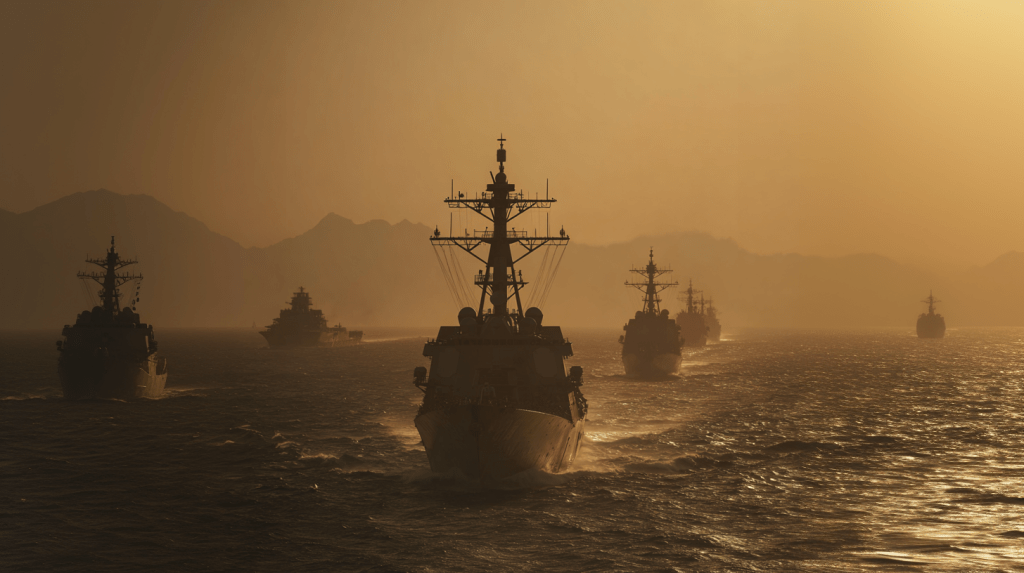
The confrontation between the United States and Iran entered a significantly more dangerous stage on July 11-12, as both countries exchanged military strikes across the Persian Gulf region, after diplomatic negotiations last week.
The latest escalation centers on the Strait of Hormuz, the world’s most important maritime energy chokepoint, through which roughly one-fifth of global oil consumption passes every day.
The crisis began with an Iranian attack on a commercial vessel transiting the strait and quickly evolved into a broader military confrontation involving U.S. airstrikes against Iranian military infrastructure and retaliatory Iranian missile and drone attacks targeting American and allied facilities across the Gulf.
Iran Attacks a Commercial Vessel
The first major development came when Iran’s Islamic Revolutionary Guard Corps (IRGC) claimed responsibility for firing on the GFS Galaxy, a Cyprus-flagged container ship transiting the Strait of Hormuz.
According to Iranian statements, the vessel allegedly used an unauthorized shipping route. The attack reportedly caused extensive damage and resulted in the disappearance of at least one crew member.
Shortly afterward, the IRGC announced that the Strait of Hormuz was “closed until further notice.”
Iranian officials stated that normal maritime traffic would only resume after what they described as the end of American interference in the Gulf region.
This declaration immediately triggered concerns among shipping companies, insurers, commodity traders, and governments worldwide.
The U.S. then launched a third round of military strikes against Iran, accusing the Islamic Revolutionary Guard Corps (IRGC) of attacking the GFS Galaxy commercial cargo vessel in the Strait of Hormuz, further escalating tensions in the region.
Massive U.S. Retaliatory Strikes
The U.S. military responded with one of the largest strike packages conducted against Tehran Iranian military assets since February 28.
According to CENTCOM, the U.S. forces struck approximately 140 military targets during overnight operations spanning July 11–12.
The targets reportedly included:
- Missile launch systems
- Air-defense batteries
- Radar installations
- Command-and-control facilities
- Fast attack boats operated by the IRGC Navy
- Coastal military infrastructure along southern Iran
U.S. officials stated that the objective was not regime change but rather the degradation of Iran’s capacity to threaten international shipping lanes and launch attacks against commercial vessels.
The strikes focused heavily on assets located near the Strait of Hormuz, reflecting Washington’s determination to preserve freedom of navigation through the waterway.
Why the Strait of Hormuz Matters
The Strait of Hormuz is a narrow maritime corridor connecting the Persian Gulf to the Gulf of Oman and the Arabian Sea.
At its narrowest point, the strait is only around 21 miles (34 kilometers) wide.
Despite its limited size, it is arguably the most strategically important shipping lane on the planet, carrying roughly 20% of global seaborne oil trade.
Major exporters that rely on the strait include:
- Saudi Arabia
- Iraq
- Kuwait
- Qatar
- United Arab Emirates
- Iran
Every day, millions of barrels of crude oil and refined petroleum products transit through Hormuz.
Large quantities of liquefied natural gas (LNG), particularly from Qatar, also depend on uninterrupted access to the waterway.
Any disruption can have immediate consequences for:
- Oil prices
- Natural gas markets
- Shipping costs
- Inflation
- Global economic growth
Can Iran Actually Close the Strait of Hormuz?
The events of March–July 2026 have fundamentally altered the debate over Iran’s ability to disrupt traffic through the Strait of Hormuz. For decades, Western analysts generally argued that Tehran lacked the capability to impose a lasting closure of the waterway because of the overwhelming military presence of the United States and its regional allies.
However, the recent crisis has demonstrated that Iran does not need to establish a permanent blockade to generate strategic and economic effects comparable to a partial closure. Since the spring of 2026, Iranian forces have intensified attacks on commercial shipping, expanded the use of drones and anti-ship missiles, and repeatedly challenged freedom of navigation in the Gulf.
The July 12 attack on the Cyprus-flagged container ship GFS Galaxy and Tehran’s subsequent declaration that the strait was “closed until further notice” illustrate this evolving strategy.
Although the United States and its partners retain overwhelming naval and air superiority, Iran continues to possess a substantial asymmetric arsenal, including coastal missile batteries, naval mines, armed drones, ballistic missiles, and fast attack craft operated by the Islamic Revolutionary Guard Corps (IRGC). The objective is not necessarily to prevent all maritime traffic from transiting Hormuz, but rather to create a persistent environment of risk.
By targeting selected vessels, threatening shipping lanes, and forcing insurers and shipowners to reassess operations in the Gulf, Tehran will significantly reduce commercial confidence while driving up transportation and energy costs, as it already did in March and April.
The military exchanges of recent months have also highlighted the limits of conventional deterrence. Despite repeated U.S. and allied strikes against Iranian missile sites, radar systems, air defenses, and naval assets, Tehran has retained sufficient capabilities to continue challenging maritime traffic and launch retaliatory attacks across the region. In practice, the question is therefore no longer whether Iran can hermetically seal the Strait of Hormuz, but whether it can sustain a level of disruption severe enough to affect global oil markets and force political concessions from its adversaries.
The events of 2026 suggest that even without achieving a complete closure, Iran possesses the means to create recurring supply shocks, elevate geopolitical risk premiums, and exert considerable influence over one of the world’s most critical energy corridors.
The Collapse of the U.S.–Iran Interim Agreement
The sharp escalation witnessed in July 2026 has cast serious doubt on the viability of the interim understanding reached between the United States and Iran only weeks earlier. The arrangement was intended to stabilize the Gulf by preventing attacks on commercial shipping, reducing the risk of direct military incidents, and creating conditions for broader diplomatic negotiations. Indirect contacts facilitated by mediators such as Oman, Qatar, and Pakistan were designed to maintain communication channels and prevent misunderstandings from spiraling into conflict. However, the recent exchange of strikes, attacks on maritime traffic, and retaliatory missile and drone operations across the region indicate that the agreement is rapidly collapsing. Mutual distrust remains deeply entrenched, while both sides appear increasingly willing to use military force to defend their interests.
The greatest danger is the emergence of an escalating cycle of action and reaction in which each retaliation prompts another. Gulf history demonstrates that even limited maritime incidents can quickly evolve into broader regional confrontations with significant geopolitical and economic consequences.
The escalation between the United States and Iran in July 2026 has placed the Strait of Hormuz at the center of global attention, raising concerns about oil prices, energy security, and geopolitical stability. Because nearly one-fifth of the world’s seaborne oil trade transits through this narrow waterway, even limited disruptions can have significant consequences for global energy markets.
Analysts currently envision three broad scenarios. In a limited escalation scenario, commercial shipping continues and diplomatic channels remain active, potentially keeping Brent crude between $85 and $100 per barrel. A second scenario involving sustained attacks on shipping, higher insurance costs, and tanker rerouting could push Brent into the $100–130 range. The most severe outcome—a de facto closure of the Strait of Hormuz—could disrupt Gulf exports, force the release of strategic petroleum reserves, and send oil prices above $130–180 per barrel, increasing the risk of a global inflationary shock and economic slowdown.
Read also : The Million-Dollar Retirement Blueprint for U.S. citizens in 2026
Investors are closely monitoring developments. Higher oil prices could benefit major energy companies, LNG exporters, offshore drilling firms, and defense contractors, while airlines, shipping companies, manufacturers, and oil-importing emerging economies face greater risks.
Although the United States retains overwhelming conventional military superiority, Iran continues to demonstrate its ability to impose economic costs through missiles, drones, naval harassment, and other asymmetric capabilities. Consequently, market participants are watching key indicators including shipping traffic through Hormuz, maritime insurance premiums, additional U.S. military deployments, Iranian missile activity, and ongoing mediation efforts led by Oman, Qatar, and Pakistan.
The coming weeks will determine whether the crisis remains contained or evolves into a broader regional conflict with far-reaching consequences for global oil markets, inflation, and investor confidence.
Our community already has nearly 250,000 readers!
Subscribe to our Telegram channel
Follow us on Telegram, Facebook and Twitter
© Copyright 2026 – Eurasia Business News. Article no. 3026

