
By William Collins, consultant in stock markets – Eurasia Business News, October 23, 2026. Article no 3218
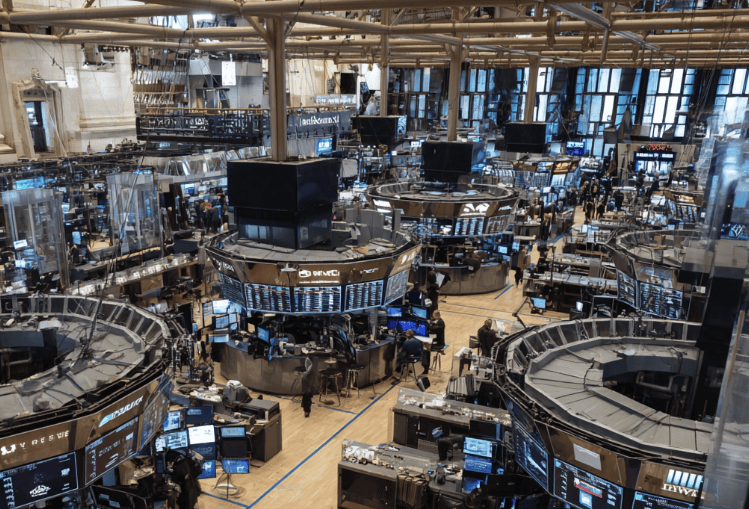
U.S. stocks struggled on Friday, October 23, as surging oil prices revived concerns about inflation, consumer spending and the risk of a wider Middle East conflict. The Dow Jones Industrial Average fell approximately 600 points during trading, while the Nasdaq Composite recovered toward flat, offering tentative evidence that technology selling was losing momentum.
Brent crude traded near $116.72 a barrel, its highest level since late April, as investors assessed the possibility of renewed U.S.–Iran escalation. Strong corporate earnings provided a counterweight, but rising energy costs complicated the outlook for margins and Federal Reserve policy. The market figures describe intraday conditions, not confirmed closing results.
Dow Falls While Nasdaq Stabilizes
At 2:10 p.m. Eastern time, the Dow was down 1.2% at approximately 52,238.5. The S&P 500 declined 0.4% to 7,629.7, while the Nasdaq slipped just 0.1% to 25,984. Energy and technology were the only sectors trading higher in that snapshot.
| Market benchmark | Reported intraday performance |
|---|---|
| Dow Jones Industrial Average | -1.2% |
| S&P 500 | -0.4% |
| Nasdaq Composite | -0.1% |
| Brent crude | Above $116 per barrel |
| WTI crude | Above $103 per barrel |
The Nasdaq’s relative resilience contrasted with the Dow’s weakness. However, one session of stabilization does not establish that the AI correction has ended. Investors continued to reassess valuations and financing conditions following Thursday’s technology selloff.
American Express Weighs on the Dow
American Express fell approximately 4% after announcing plans to eliminate 5% of its global workforce, equivalent to around 3,500 positions. The company presented the reductions as part of an effort to manage rising expenses.
The announcement joined a broader sequence of cost-cutting measures. The Wall Street Journal reported workforce reductions at eBay, Barclays and Volvo during the week, although the circumstances and stated objectives differed between companies. These announcements should not automatically be interpreted as evidence of a uniform collapse in demand.
Nevertheless, they highlighted the tension between resilient headline profits and pressure to contain operating costs.
Brent and WTI Oil Prices Jump
Brent rose approximately 3.1% to $116.72 in the supplied market update, reaching its highest level since April 29. Earlier AFP reporting recorded a high of $116.73, while another intraday report showed Brent briefly reaching $117.20. Those differences reflect changing prices rather than separate settlement results.
At 2:10 p.m. Eastern time, West Texas Intermediate crude was up 3.6% at $103.08 per barrel, while Brent traded at $116.46. Neither quotation should be described as the final close.
The immediate catalyst was fear of renewed escalation in the Middle East and further disruption to energy flows. Elevated crude prices benefited producers: Chevron and ConocoPhillips advanced in midday trading even as most S&P 500 constituents declined.
Read also : Tax Management strategies for Digital Nomads
For the broader economy, expensive oil creates a less favourable combination of higher business costs and reduced household purchasing power.
AI Financing Remains Under Scrutiny
SK Hynix shelved plans for a U.S. initial public offering of its flash-memory business, Solidigm, citing market conditions and share-price trends. The decision illustrated the difficulty of securing attractive valuations even for businesses connected to strong AI demand.
Importantly, SK Hynix said the decision did not change Solidigm’s growth outlook. Postponing a listing therefore signals caution about capital-market conditions, not proof that the underlying business has deteriorated.
The distinction matters as investors separate genuine earnings growth from expectations dependent on increasingly expensive financing.
Strong S&P 500 Earnings Offer Support
FactSet’s October 23 update put third-quarter blended earnings growth at 29.5%. “Blended” combines reported results with estimates for companies yet to report; it is not a completed quarterly outcome.
The blended net profit margin stood at 14.9%, above the year-earlier 13.0% and five-year average of 12.6%. If sustained, it would represent the second-highest margin in FactSet’s series. These figures show considerable corporate profitability despite energy-price pressure.
With only about one-quarter of companies reporting, however, investors must assess whether later results preserve that strength.
Gold and Silver Prices
Kitco’s morning report quoted spot gold near $4,026.56 per troy ounce and silver around $53.801. Its reported session changes were declines of 2.40% and 6.40%, respectively; these were timestamped readings, not closing prices.
Read also : Gold : Build Your Wealth and Freedom
Gold failed to attract sustained defensive demand despite geopolitical stress. Oil-driven inflation concerns reinforced expectations of restrictive monetary policy, while silver faced additional pressure from industrial-demand uncertainty.
Friday’s defining issue was inflation: strong earnings supported equities, but another energy shock threatened purchasing power, margins and the path of interest rates.
Our community already has nearly 345,000 readers!
Subscribe to our Telegram channel
Follow us on Telegram, Facebook and Twitter
© Copyright 2026 – Eurasia Business News. Article no. 3218

