
By John Meyer, consultant in business and tech – Eurasia Business News, November 14, 2026. Article no 3265
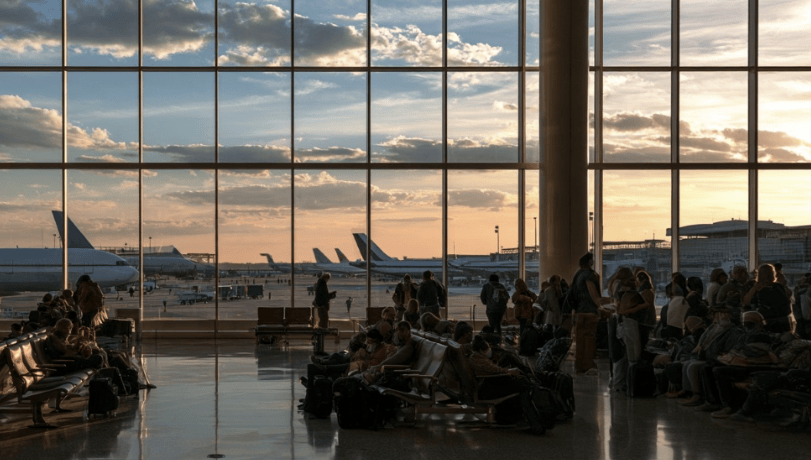
Thousands of passengers faced another day of travel disruption Saturday, November 14, as U.S. airlines struggled to rebuild schedules following a nationwide ground stop. Although federal officials lifted the departure restriction Friday evening, displaced aircraft, disrupted crew assignments and crowded airports complicated the recovery. Nearly 3,900 cancellations had been reported early Saturday, with subsequent reporting indicating that the total had exceeded 4,000.
The outage renewed scrutiny of America’s aging air traffic control technology. Transportation Secretary Sean Duffy blamed overloaded routers and older communications equipment, while officials said the initial evidence did not indicate a cyberattack or national security threat.
FAA Ground Stop Lifted, but Flight Disruptions Continue
The Federal Aviation Administration lifted the nationwide ground stop at 8:15 p.m. Eastern on Friday, following more than four hours of restrictions. The decision allowed departures to resume, but it did not immediately restore normal airline operations.
A ground stop requires affected aircraft to remain on the ground rather than take off. Flights already airborne were permitted to continue toward landing, gradually leaving airports with additional aircraft that could not depart.
By Saturday morning, airlines were managing the consequences of that imbalance. Aircraft and crews were no longer necessarily where their next scheduled flights required them to be, making recovery a network-wide logistical challenge rather than a simple restart. Officials warned that full recovery could take days.
Thousands of Flights Canceled or Delayed
Flight disruption totals increased as airlines revised their schedules. Early Saturday reporting put cancellations near 3,900; NPR subsequently reported more than 4,000 Saturday cancellations, citing flight-tracking service FlightAware.
Friday’s figures also changed throughout the event. Bloomberg reported approximately 6,500 cancellations and 8,800 delays involving flights within, into or out of the United States as of 9:15 p.m. New York time Friday.
These figures should not be confused with final daily totals. Live flight trackers update continuously, and reports may cover different timestamps or categories. Likewise, an earlier projection of approximately 3,000 Saturday disruptions was not a ceiling on the eventual number.
The central message remained consistent: lifting the FAA ground stop ended the immediate departure restriction, not the wider travel emergency.
What Caused the Air Traffic Control Outage?
Duffy said Saturday that an error occurred while a contractor was updating an older FAA telecommunications line. He also said routers involved in the affected facilities had been manufactured in 2001.
At Friday’s briefing, Duffy described switches and routers becoming overloaded with data and producing inconsistent information. Officials halted departures because those inconsistencies created safety concerns.
Homeland Security Secretary Markwayne Mullin similarly said newer technology and patches had overwhelmed older components. That explanation points to difficulties integrating upgrades with legacy infrastructure, although a complete technical investigation is needed to establish the precise failure sequence.
The distinction matters. Officials’ preliminary account identifies aging equipment and the update process as contributing factors; it does not yet provide a comprehensive engineering explanation of every affected system.
Officials Say No Evidence of an Attack
The scale of the outage prompted scrutiny from federal security agencies. CNN reported that the FBI, Department of Homeland Security and National Security Agency participated in assessing whether malicious activity was involved.
Officials said preliminary findings pointed to a communications software problem rather than an intentional attack. Mullin also said the aviation disruption was unrelated to the separate Microsoft outage earlier in the week.
Those statements reflected the evidence available during the response, not the completion of every investigative step. Authorities continued examining potentially exposed network connections while technicians worked to restore reliable service.
For travelers, the immediate cause was less visible than its consequences: canceled departures, uncertain rebooking options and rapidly changing airport information.
Passengers Face Long Queues and Overnight Waits
The disruption left travelers facing lengthy queues, missed connections and uncertainty about where they would spend the night. CNN documented passengers waiting for hours at Chicago O’Hare and others turning to rental cars rather than continuing to wait for flights.
One traveler at Newark arranged a drive to Montreal after learning of the shutdown. Another passenger described spending roughly two and a half hours on the tarmac after arriving in Chicago because the ground stop had disrupted airport operations.
These experiences illustrate how an aviation communications failure can affect more than departing passengers. Arriving aircraft, gate availability, baggage handling and onward travel plans can all become entangled in the recovery.
Aging FAA Technology Prompts New Funding Calls
Duffy urged Congress to provide additional money for air traffic control modernization, describing the situation as an emergency. The appeal came despite an existing overhaul supported by $12.5 billion in congressional funding.
That programme has already replaced thousands of older copper wires with fiber-optic lines and upgraded hundreds of radio systems, according to Associated Press reporting carried in coverage of the disruption.
Read also : Gold : Build Your Wealth and Freedom
The outage highlights the challenge of modernizing a continuously operating national network. New equipment must work alongside older systems during the transition, and Friday’s preliminary explanations suggest that interaction deserves close examination.
Funding decisions will therefore be accompanied by questions about implementation, resilience and the safeguards surrounding future upgrades.
Will the Outage Affect Thanksgiving Travel?
Duffy said he expected operations to recover before the Thanksgiving travel rush. However, he also warned that restoring normal service would be slow, and officials acknowledged the possibility of further disruption.
Passengers should check their flight’s status directly with their airline before leaving for the airport, as JFK and LaGuardia advised during the shutdown.
For now, the aviation system is operating again, but airline schedules remain unsettled. The immediate test is clearing the backlog; the longer-term challenge is ensuring that essential modernization makes the network more reliable without triggering another nationwide interruption.
Our community already has nearly 350,000 readers!
Subscribe to our Telegram channel
Follow us on Telegram, Facebook and Twitter
© Copyright 2026 – Eurasia Business News. Article no. 3265

