
By William Collins, consultant in stock markets – Eurasia Business News, November 18, 2026. Article no 3274
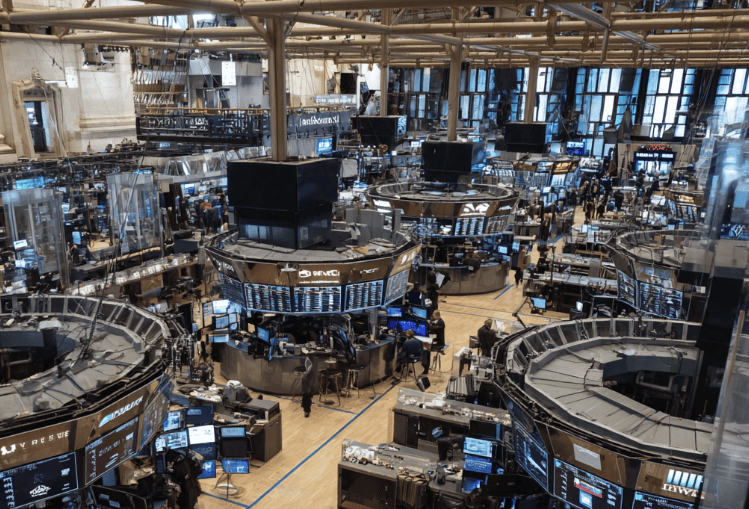
U.S. stocks struggled for direction Wednesday, November 18, as Nvidia’s record revenue and upgraded forecasts failed to restore confidence in the artificial intelligence trade. The Dow Jones Industrial Average declined, while the Nasdaq fluctuated between gains and losses. Investors remained focused on leadership uncertainty, AI financing and the Federal Reserve’s policy outlook.
At 4:40 p.m. Central European Time, or 10:40 a.m. Eastern, regular trading was still underway. The figures below are intraday snapshots, not closing results. Gold fell below $3,800 per ounce, oil weakened as U.S. inventories increased, and Bitcoin traded around $64,000 in a morning report.
Stock Market Today: Nasdaq Wavers While Dow Retreats
The supplied market update placed the S&P 500 near unchanged, the Nasdaq Composite approximately 0.6% higher and the Dow around 0.9% lower. A separate published snapshot showed the Nasdaq near flat and the Dow down 0.3%, illustrating shifting conditions rather than contradictory closing results.
The important development was the market’s inability to sustain a broad earnings-driven recovery. Early optimism about Nvidia competed with continuing concern over AI valuations, financing arrangements and tighter restrictions on advanced-chip access.
Wednesday followed four consecutive declines for the S&P 500 and Nasdaq. Against that backdrop, even modest gains represented an attempted stabilization—not confirmation that the broader technology correction had ended.
Nvidia Delivers Strong Results but Shares Remain Volatile
Nvidia reported fiscal third-quarter revenue of $115.8 billion, increasing 103% year over year. Data-center sales rose 110% to $107.6 billion, underscoring continued demand for the computing infrastructure supporting AI development.
The chipmaker projected fourth-quarter revenue of $130 billion, plus or minus 3%, and raised its fiscal 2028 revenue-growth forecast to 75%. These forecasts exceeded prior expectations but remained guidance rather than completed sales.
Shares initially rose after the announcement, gaining approximately 4.8% in extended trading. By the supplied Wednesday snapshot, however, Nvidia was down around 0.6%. The reversal highlighted the difference between strong operating results and investors’ willingness to pay a particular valuation for future growth.
Why Nvidia’s Earnings Did Not Resolve AI Concerns
The report answered an important backward-looking question: demand remained exceptionally strong during the completed quarter. It did not settle the forward-looking questions surrounding Nvidia’s leadership transition and the durability of spending across its ecosystem.
Interim CEO Colette Kress must maintain customer confidence while directors search for a permanent successor to Jensen Huang. Investors also want clarity about financial support for AI infrastructure companies and whether their expansion can generate sustainable returns.
Profitability deserves attention alongside revenue. Nvidia expects fourth-quarter gross margin between 71% and 72%, compared with adjusted gross margin of 74.9% in the completed quarter. Strong sales growth therefore does not eliminate pressure on the proportion retained after direct costs.
Anthropic IPO Becomes the Next AI Test
Attention now turns toward Anthropic’s anticipated Thursday market debut. The Claude developer’s proposed offering introduces a separate valuation test: investor appetite for a leading AI model company amid weakness across related public stocks.
The supplied update describes the listing as a major next catalyst, but expected timing and targeted valuation should not be confused with final pricing or actual trading performance.
Together, Nvidia’s results and Anthropic’s debut test different parts of the same investment narrative. One measures established demand for infrastructure; the other examines willingness to finance the companies seeking to monetize AI capabilities. Neither event alone establishes the economics of the entire industry.
Fed Minutes and Treasury Yields Shape Sentiment
The Federal Reserve’s October meeting minutes are scheduled for 2 p.m. Eastern—after this report’s timestamp. They had not yet been released, so expectations about their contents remain forecasts.
The supplied bond-market snapshot showed yields declining:
| Treasury maturity | Yield | Reported move |
|---|---|---|
| Two-year | 4.80% | −2 basis points |
| Ten-year | 5.08% | −4 basis points |
| Thirty-year | 5.42% | −4 basis points |
Lower yields offered some relief, but markets continued to anticipate restrictive policy. CoinDesk reported investors assigning a very high probability to a December rate increase, helping explain persistent pressure on gold despite weaker equities.
U.S. Housing Data Present a Mixed Picture
Housing starts rose 9.9% in October to a seasonally adjusted annual rate of 1.309 million units, exceeding expectations. September’s figure was revised to 1.191 million.
The improvement did not extend across every housing indicator. Kitco reported building permits falling 7.4% to 1.295 million, contrary to the supplied description of a smaller-than-expected increase. That reading warrants distinguishing permits from starts rather than grouping both as evidence of strengthening construction.
Pending home sales also disappointed, declining 4.7% to an index level of 63.0, versus an expected 1.4% decrease. The combination suggested an uneven housing sector rather than a clear acceleration.
Oil Prices Today: Brent and WTI Decline
At 07:45 GMT, Brent futures traded at $91.86 per barrel, down 1.4%, while WTI fell 2.2% to $84.16. These earlier quotations are not settlements or synchronized live prices.
Read also : TAX MANAGEMENT STRATEGIES FOR DIGITAL NOMADS
American Petroleum Institute figures showed crude inventories rising 5.28 million barrels, gasoline increasing 5.12 million and distillates adding 351,000 barrels. Inventory growth outweighed immediate support from Persian Gulf security risks.
Iran’s attacks against Kuwait and Bahrain nevertheless demonstrated that regional disruption remained an active threat.
Gold According to Kitco; Bitcoin Holds Near $64,000
Kitco’s post-housing-sales update quoted spot gold at $3,756.02 per ounce, down 2.41%. Earlier readings differed, reflecting a volatile morning rather than interchangeable closing prices.
Read also : Gold : Build Your Wealth and Freedom
Bitcoin traded around $64,000 in CoinDesk’s report. Its relative resilience against gold did not establish safe-haven status: both assets had weakened in dollar terms. With Fed minutes still ahead and AI confidence unsettled, Wednesday’s market remained an exercise in stabilization rather than a convincing return to risk-taking.
Our community already has nearly 350,000 readers!
Subscribe to our Telegram channel
Follow us on Telegram, Facebook and Twitter
© Copyright 2026 – Eurasia Business News. Article no. 3274

