
By Alexander Miller, consultant in energy markets. Eurasia Business News, August 7, 2026. Article n°3056
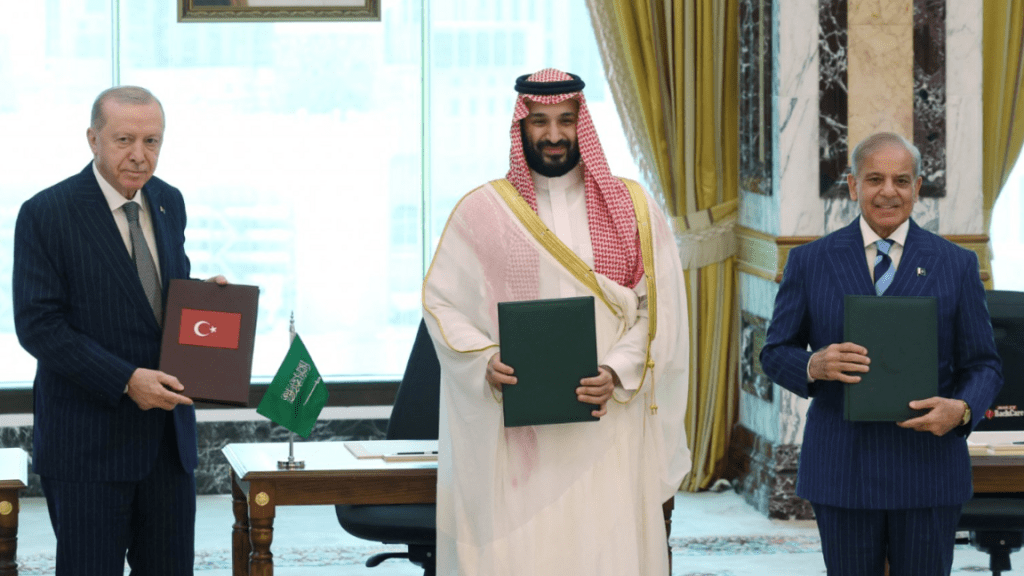
Saudi Arabia, Pakistan and Turkey signed a joint defence agreement on Friday, August 7, establishing a new collective-security framework among three major Sunni Muslim powers. The agreement, signed in Mecca, states that an armed attack against one of the three countries will be treated as an attack against all three, according to Pakistan’s Foreign Ministry.
The Saudi Arabia-Pakistan-Turkey defence pact arrives as the Middle East faces exceptional military and economic stress, including attacks on Gulf energy exporters and disruption to shipping through the Strait of Hormuz. The three states said the accord is intended to strengthen collective deterrence while supporting peace, security and stability in the region and beyond.
What the Defence Agreement Says
The central provision of the Mecca Joint Defence Agreement is mutual defence: an armed attack on Saudi Arabia, Pakistan, or Turkey would be regarded as aggression against the entire three-country group. This elevates the arrangement beyond conventional military cooperation, intelligence exchanges, weapons sales, or joint exercises.
However, the publicly available statement has not specified the precise military obligations that would follow an attack. It remains unclear whether the pact contains predefined troop commitments, shared command arrangements, air-defence integration, intelligence-sharing protocols, or automatic logistical support.
Read also : Tax Management strategies for Digital Nomads
A Turkish official characterized the deal as “purely defensive,” saying it was not directed against a particular country. The official also said the framework would remain open to other regional states and would not supersede existing bilateral or multilateral defence arrangements.
Why the Saudi-Pakistan-Turkey Pact Matters
The agreement brings together three states with complementary capabilities. Saudi Arabia supplies substantial financial resources, strategic energy infrastructure and influence across the Gulf. Turkey contributes a large NATO-standard military, a significant indigenous defence industry and regional operational reach. Pakistan brings a large standing army, combat experience and nuclear weapons—the only nuclear arsenal held by a Muslim-majority country.
Saudi Arabia and Pakistan already maintained close defence links, including Pakistani military training and deployments in the kingdom. The new agreement formalizes a broader trilateral relationship by incorporating Turkey at a moment when Gulf governments are reassessing regional security arrangements. Reuters reported before the signing that regional turmoil and attacks affecting Gulf states had accelerated the push for a joint deal.
Strait of Hormuz Negotiations
The pact coincides with diplomatic efforts to restore safer commercial transit through the Strait of Hormuz, the critical maritime route connecting Gulf oil and gas producers to global markets. On Thursday, August 6, U.S. President Donald Trump said the strait could reopen “very soon,” citing “very good” discussions with Iran.
Read also : Gold : Build Your Wealth and Freedom
Negotiations involving Iran and Oman have focused on mechanisms for securing vessel traffic, but important issues remain unresolved. The United States has said any arrangement must preserve safe international navigation, while Iranian officials have signaled that access would not simply return to its pre-conflict structure.
For oil markets and regional investors, the new Saudi Arabia-Pakistan-Turkey defence agreement signals a durable shift: Gulf security is increasingly being addressed through regional coalitions as well as through long-standing partnerships with Washington.
Our community already has nearly 280,000 readers!
Subscribe to our Telegram channel
Follow us on Telegram, Facebook and Twitter
© Copyright 2026 – Eurasia Business News. Article no. 3056

