
By Alexander Miller, consultant in energy markets. Eurasia Business News, August 7, 2026. Article n°3057
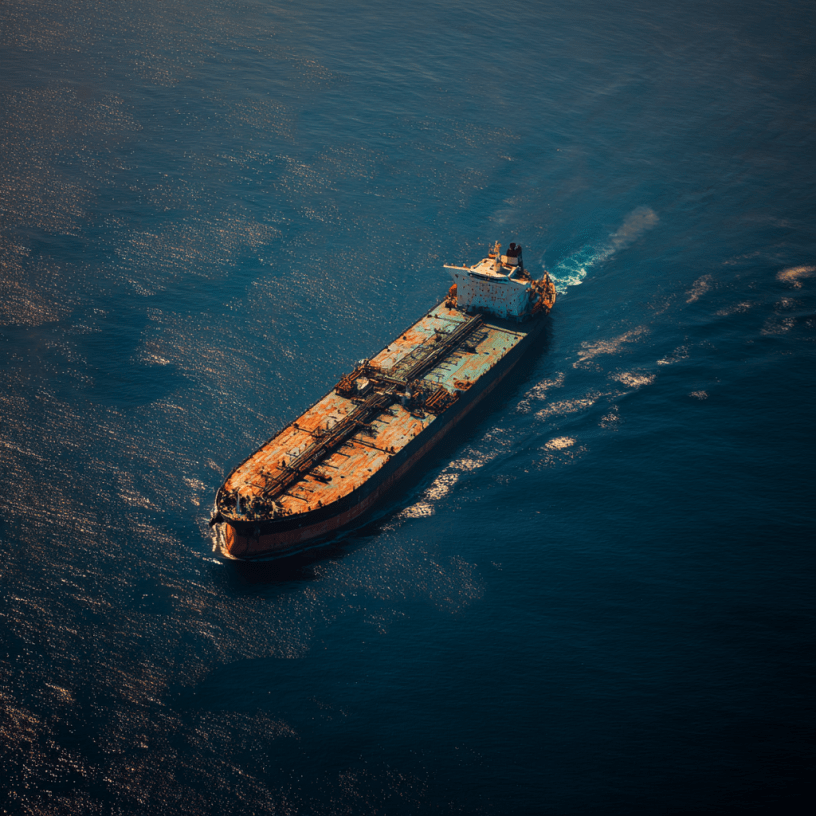
Iran’s oil exports have stalled in August as tankers avoid Kharg Island and a renewed U.S. naval blockade restricts access to Tehran’s main crude-export hub.
Iran’s oil-export system is again under acute pressure in August 2026, with satellite imagery indicating that loading terminals at Kharg Island are empty and a growing queue of tankers is waiting offshore. The disruption follows the U.S. reimposition in July of a military blockade on ships entering or leaving Iranian ports, turning the island—normally the artery for most Iranian crude exports—into a major geopolitical and oil-market flashpoint. NPR’s reporting said U.S. Central Command had redirected vessels and struck an empty tanker it alleged was attempting to breach the blockade.
Kharg Island Oil Terminal Remains Idle
Kharg Island sits in the northern Persian Gulf and has long been Iran’s principal crude-export terminal. The island handles roughly 90% of Iranian oil exports and has deep-water facilities capable of loading very large crude carriers, making it difficult for Iran to replace rapidly with smaller mainland ports. Council on Foreign Relations analysis describes the facility as a critical economic lifeline, with Asian buyers—particularly China—historically taking the bulk of its shipments.
Fresh satellite-based maritime intelligence points to a near-standstill. Imagery collected on August 1 showed all three Kharg terminals empty: the western terminal had been vacant for 14 days, the liquefied petroleum gas terminal for five days, and a tanker that had briefly docked at the eastern terminal had departed. Nineteen tankers operating without normal tracking signals were reported in the nearby waiting area, up from 17 two days earlier. Windward said the growing backlog indicated that tankers were accumulating while loading infrastructure sat idle.
Why Iran’s Oil Exports Are Stalling
The immediate constraint is not simply physical damage to Iran’s export infrastructure. U.S. strikes on Kharg earlier in 2026 reportedly targeted military facilities while avoiding oil installations. Rather, the bottleneck is access: vessel owners, insurers, crews and oil traders face heightened operational and security risks from attempting calls at Iranian ports or transiting the Strait of Hormuz.
Read also : Tax Management strategies for Digital Nomads
This creates a commercially consequential distinction. Iran may still hold crude in storage or on tankers, but stored barrels are not equivalent to reliable exports. Without regular liftings from Kharg, Tehran faces pressure on storage capacity, cash flow, and its ability to sustain production. Before the blockade was renewed, Iran had briefly restarted loadings in June, with three VLCCs—each able to transport about two million barrels—moored at the Sea Island terminal. Bloomberg’s report, republished by gCaptain highlighted how quickly supply lines had reopened under an interim arrangement.
Global Oil Market Implications
For global oil markets, a prolonged interruption to Iranian shipments adds a risk premium even if physical supply has not vanished overnight. Reuters reported that crude prices had retreated toward $80 per barrel on market expectations of a U.S.-Iran agreement that could reopen Hormuz; it also estimated that only about 80 million barrels remained stored inside the Gulf, limiting the scale of any immediate post-blockade supply surge.
The next catalyst is diplomacy. Any credible ceasefire or maritime agreement that restores safe tanker access could rapidly revive Kharg Island loadings. Until then, empty berths, waiting tankers and constrained Iranian oil exports will remain a key source of volatility for crude markets, Gulf shipping, and Asian refiners.
Our community already has nearly 280,000 readers!
Subscribe to our Telegram channel
Follow us on Telegram, Facebook and Twitter
© Copyright 2026 – Eurasia Business News. Article no. 3057

