
By Anthony Marcus for Eurasia Business News, October 5, 2026. Article n°3195
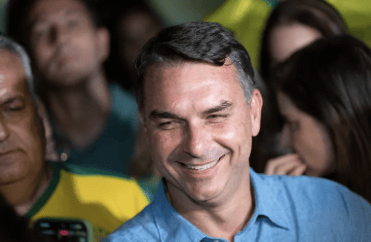
Flávio Bolsonaro has emerged as the early favorite in Brazil’s presidential election after finishing first in the October 4 first round, ahead of incumbent President Luiz Inácio Lula da Silva. The right-wing senator won 47.03% of valid votes, compared with Lula’s 45.16%, forcing a decisive runoff on October 25 because neither candidate surpassed the 50% threshold needed for an outright victory.
Bolsonaro’s stronger-than-expected performance has energized Brazil’s conservative movement and put the country’s left-wing incumbent on the defensive. Although the two-point gap is narrow, the first-round result has shifted political momentum toward the Bolsonaro camp and raised the prospect of a remarkable return to power for the family of former president Jair Bolsonaro.
Flávio Bolsonaro Wins First Round
With the final count completed, Flávio Bolsonaro received approximately 56.1 million votes, compared with 53.8 million for Lula. The result defied pre-election polling, which had largely expected Lula to finish first.
| Candidate | Party | First-round vote | Approximate votes |
|---|---|---|---|
| Flávio Bolsonaro | Liberal Party, PL | 47.03% | 56.1 million |
| Luiz Inácio Lula da Silva | Workers’ Party, PT | 45.16% | 53.8 million |
| Other candidates | Various | About 7.8% | — |
The 45-year-old senator, the eldest son of jailed former president Jair Bolsonaro, performed particularly well among voters seeking political change, tougher action on crime and a more business-friendly economic agenda. His campaign also benefited from strong support in conservative regions and from a broad anti-incumbent mood after four years of Lula’s administration.
Lula, 80, remains a formidable opponent with deep experience, a loyal Workers’ Party base and strong support among lower-income voters and in Brazil’s northeast. Yet the first-round outcome was a significant setback. Lula received almost four million fewer votes than he did in the first round four years earlier, a sign that voter fatigue, concerns over crime and disappointment with the pace of economic improvement may have weakened his coalition.
Why Bolsonaro Is in a Strong Position
Flávio Bolsonaro has a clearer path to victory because the candidates eliminated in the first round were largely from the center and right. Together, they won around 7.3% of the vote, and analysts expect many of their supporters to be more receptive to Bolsonaro than to Lula.
The Bolsonaro campaign is expected to focus on three themes during the runoff:
- Public security and tougher policies against organized crime.
- Economic growth, lower taxes and a more market-oriented agenda.
- Change after years of Workers’ Party influence and political polarization.
Financial markets reacted positively to Bolsonaro’s performance. Reuters reported that the Brazilian real and equities could gain on expectations that a Bolsonaro government would pursue more business-friendly policies and show greater fiscal restraint.
However, the race is not settled. Brazil’s second-round elections are often more unpredictable because campaigns have additional time to form alliances, mobilize abstaining voters and frame the choice as a direct contest between two competing visions of the country.
Lula’s Difficult Runoff Challenge
Lula must now expand beyond his traditional progressive base and win support from centrist voters who may distrust the Bolsonaro family but are dissatisfied with the government’s economic record. His campaign is likely to emphasize democratic institutions, social programs, poverty reduction and the risks of returning to the political style associated with Jair Bolsonaro.
The president acknowledged that he had not expected to finish second, but pledged a renewed campaign ahead of the October 25 vote. Lula may also seek to focus attention on Flávio Bolsonaro’s association with his father, who is serving a 27-year sentence for plotting a coup after losing the 2022 election.
Lula’s most important task will be turnout. If he can mobilize working-class voters, younger Brazilians, women and residents of the northeast at higher rates, the two-point gap could be overcome.
Bolsonaro Family’s Political Comeback
The first-round result represents a major political triumph for the Bolsonaro dynasty, even though Flávio fell short of an outright first-round victory. Jair Bolsonaro remains a powerful symbol for Brazil’s right, and his son has successfully consolidated much of that movement despite the former president’s imprisonment and the family’s internal disputes.
Read also : Gold : Build Your Wealth and Freedom
The Liberal Party also performed strongly in legislative and regional contests, strengthening the prospect that a Bolsonaro presidency could govern with significant congressional support.
What Happens Next
The presidential runoff will take place on Sunday, October 25. Both candidates now have three weeks to win over voters who backed eliminated candidates, reduce abstentions and define the contest for the country’s more than 150 million eligible voters.
Flávio Bolsonaro enters the final stage with momentum, a first-round lead and a favorable pool of center-right voters. Lula retains the advantage of incumbency, a nationwide party organization and a record of winning close elections.
Read also : Tax Management strategies for Digital Nomads
The result will shape the direction of Latin America’s largest economy, its relations with the United States and China, environmental policy in the Amazon, and Brazil’s role in regional politics. For now, the October 4 vote has given Bolsonaro the strongest position—but Brazil’s presidency will be decided only on October 25.
Our community already has nearly 355,000 readers!
Subscribe to our Telegram channel
Follow us on Telegram, Facebook and Twitter
© Copyright 2026 – Eurasia Business News. Article no. 3195

