
By Paul de Neuville, Paris correspondent, for Eurasia Business News – October 7, 2026. Article no 3201
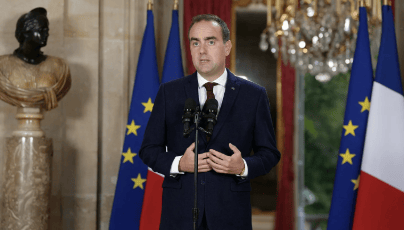
French Prime Minister Sébastien Lecornu moved to ease mounting social tensions on Wednesday, October 7, promising responses to high-school students’ demands and announcing a release of fuel reserves intended to lower prices at the pump. In a televised address from Matignon, he acknowledged young people’s concerns while outlining measures to relieve pressure on households and businesses.
The principal fuel measure concerns diesel, rather than petrol: France will make 10 million barrels from its reserves available to distributors over three months. Lecornu said the operation should reduce diesel prices by approximately 12 to 18 euro cents per litre. That figure is the government’s projected reduction, not an immediate or guaranteed nationwide price cut.
Government Promises Answers to High-School Students
Lecornu’s intervention followed nearly three weeks of high-school protests and blockades. Students have raised concerns about teacher shortages, overcrowded classrooms and inadequate facilities, placing education at the centre of a broader debate about public services and living conditions. The prime minister said the government had a duty to listen to young people rather than dismiss their grievances.
However, he did not announce an immediate package of school reforms. Instead, Lecornu promised that the government’s first decisions would be presented at the end of October, after further consultation. Discussions inside schools were scheduled to continue from Thursday into the following week.
The Education Ministry’s consultation platform had already received more than 40,000 contributions, according to Lecornu. The exercise is intended to collect students’ concerns and inform the government’s response. Its political value will depend on whether participants see concrete changes rather than another consultation without results.
Five Priorities for Education Reform
Lecornu identified five areas for government work: ensuring lessons continue when teachers are absent, improving school buildings, reorganizing school timetables, improving the Parcoursup university-admissions system and providing a clearer framework for students to express their views.
These priorities connect immediate classroom problems with longer-term concerns about students’ futures. Missing lessons affect learning, poor buildings undermine daily conditions, and uncertainty around admissions can intensify anxiety about access to higher education. The government’s challenge is to turn those broad objectives into practical, funded measures.
The prime minister also denied that police had been ordered to confront young protesters. His remarks sought to address concerns about the handling of demonstrations while maintaining the government’s position on public order.
How the Diesel Reserve Release Would Work
The fuel initiative relies on diesel bought before the recent surge in market prices. Lecornu said those stocks would be supplied to distributors at their purchase cost, allowing cheaper fuel to enter the distribution system and potentially reduce retail prices.
The release is planned over three months, rather than as a single injection of supply. Lecornu also intends to meet fuel distributors to discuss implementation. The announced approach uses strategic stocks instead of cutting fuel taxes, a distinction that matters for a government facing difficult budget negotiations.
The policy is therefore a temporary intervention, not a permanent change to fuel taxation. Motorists should also distinguish diesel from petrol: the announcement does not establish an equivalent reduction for petrol users.
Sébastien Lecornu reaffirmed his desire to reduce the deficit to 5% of GDP.
Appeasement Meets a Test of Delivery
Lecornu’s address brought education and household energy costs into one political response. Both issues affect daily life, and both can generate frustration when families believe public authorities are failing to respond. His strategy combines dialogue with students and a more tangible proposal for fuel-price relief.
Yet the timelines differ. Students must wait until late October for initial decisions, while the diesel programme requires implementation and cooperation from distributors. The coming weeks will test whether the government can translate its promises into visible improvements.
Read also : Gold : Build Your Wealth and Freedom
For Lecornu, success means more than calming demonstrations. It requires convincing students that consultation produces results and ensuring the projected diesel savings actually reach consumers at the pump.
The Prime Minister finally called on the French to “unity”. “France is holding on thanks to the work of millions of women and men,” he said.
France’s Debt Burden Deepens
France’s financial position has deteriorated as higher global interest rates raise the cost of refinancing government debt. Public debt reached roughly €3.6 trillion in the second quarter of 2026, equivalent to about 119% of gross domestic product, according to reported official data.
France’s public debt is projected to reach 121.7% of GDP in 2027. The government has proposed a fiscal adjustment worth €54 billion, including €43 billion in new measures, in an effort to reduce the deficit to 5% of GDP.
The government deficit is expected to reach approximately 5.4% of GDP this year, well above the European Union’s 3% fiscal limit. The proposed 2027 budget aims to cut the deficit to 5% through about €54 billion in spending reductions and additional revenue measures.
Our community already has nearly 355,000 readers!
Subscribe to our Telegram channel
Follow us on Telegram, Facebook and Twitter
© Copyright 2026 – Eurasia Business News. Article no. 3201

