
By William Collins, consultant in stock markets – Eurasia Business News, October 7, 2026. Article no 3200
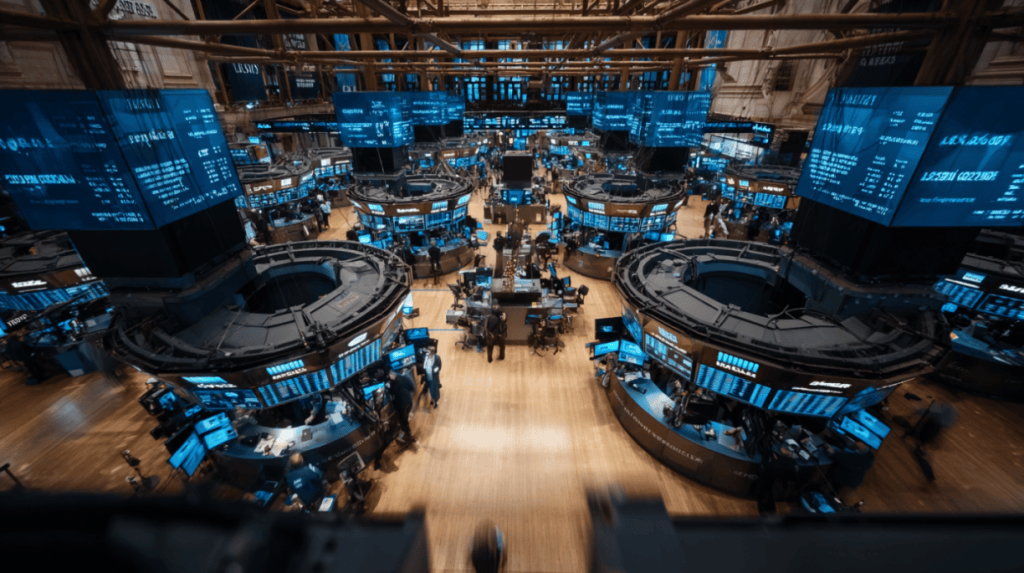
U.S. stocks fell on Wednesday, October 7, retreating from Tuesday’s record highs as Treasury-market volatility unsettled investors. A strong 10-year note auction helped pull bond yields back from fresh multidecade peaks, but the recovery in government debt was insufficient to lift Wall Street into positive territory. Oil prices also pared earlier gains, easing some inflation concerns.
The Dow Jones Industrial Average dropped approximately 342 points, or 0.7%, while the S&P 500 and Nasdaq Composite each declined around 0.2%. Wednesday’s pullback followed an artificial-intelligence rally that had carried the S&P 500 and Nasdaq to record closes. Investors also reviewed Federal Reserve minutes for clues about another potential interest-rate increase before year-end.
Strong Treasury Auction Calms Bond Markets
The benchmark 10-year Treasury yield climbed as high as 5.361% during the session, its highest intraday level since early 2002, before retreating toward 5.276%. Although sharply below its session peak, the closing yield remained slightly higher than Tuesday’s level, underscoring the distinction between an intraday reversal and a daily decline.
A $39 billion auction of 10-year Treasury notes attracted strong demand, helping contain the selloff. The auction cleared at a yield below the prevailing market expectation, a result commonly described as trading “through.” That indicated investors were willing to accept a lower return than anticipated to secure the newly issued debt.
The response mattered because investors had grown increasingly concerned about the market’s capacity to absorb government borrowing at elevated rates. Strong auction demand offered reassurance, although one successful sale does not establish that bond-market volatility has ended.
Fed Minutes Leave Another Hike Possible
Minutes from the Federal Reserve’s September meeting showed that most officials expected another rate increase later this year. However, the discussion did not present a compelling case for acting at the next October meeting. Policymakers had supported September’s increase because inflation remained persistent and some officials saw risks of prices exceeding their forecasts.
The message left investors balancing two possibilities: borrowing costs could remain elevated for longer, but an immediate increase was not inevitable. Wednesday’s muted equity reaction suggested the minutes did not dramatically change the market’s interpretation of the Fed’s policy direction.
AI Rally Faces a Breadth Test
Wednesday’s decline also highlighted the increasingly concentrated nature of Wall Street’s advance. Tuesday’s records relied heavily on large technology companies benefiting from artificial intelligence, while several other parts of the market lagged. Healthcare companies, banks, consumer staples and small-cap stocks had struggled as financing costs increased.
Less than half of S&P 500 constituents closed above their 200-day moving averages on Tuesday. Meanwhile, the combined market capitalization of the Magnificent Seven reached approximately $25 trillion. That contrast shows how a relatively small group of enormous companies can lift an index even when many individual stocks weaken.
Read also : Tax Management strategies for Digital Nomads
For investors, concentration remains an important risk: strong AI earnings expectations can support headline indexes, but disappointment among their largest constituents could have an outsized effect.
Oil Pares Gains, Gold Falls
Brent crude approached $102 a barrel earlier Wednesday before reversing. By 2:08 p.m. Eastern time, futures were down approximately 0.5% at $100.10. That was an intraday quotation rather than a confirmed settlement price. The reversal helped reduce one source of pressure on stocks and inflation expectations.
Gold also weakened as the dollar strengthened and Treasury yields reached multidecade highs. At 9:20 a.m. Eastern time, spot gold was down 1.6% at $4,096.13 per ounce, while December gold futures traded near $4,121.70. Bullion touched its lowest level since August 5. It is an opportunity to start investing in the yellow metal.
Read also : Gold : Build Your Wealth and Freedom
Higher yields increase the opportunity cost of holding non-interest-bearing gold, while a stronger dollar makes dollar-priced bullion more expensive for overseas buyers. Together, those forces outweighed demand for protection against market uncertainty during Wednesday’s trading.
Our community already has nearly 355,000 readers!
Subscribe to our Telegram channel
Follow us on Telegram, Facebook and Twitter
© Copyright 2026 – Eurasia Business News. Article no. 3199

