
By Paul de Neuville, Paris correspondent, for Eurasia Business News – October 12, 2026. Article no 3207
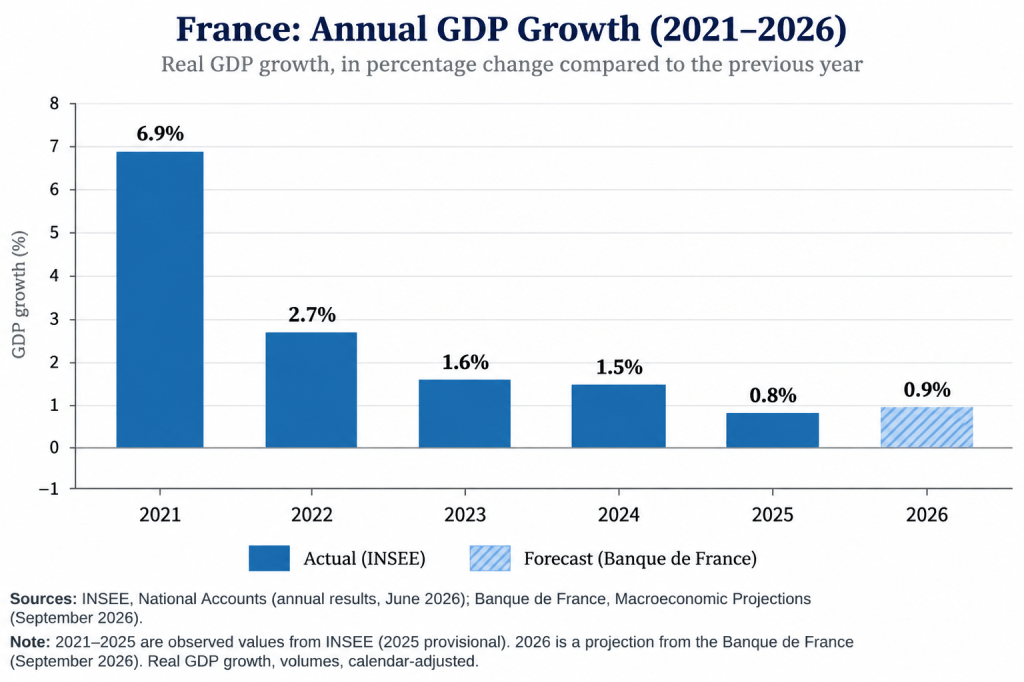
France’s economy is expected to grow by only 0.1% in the third quarter of 2026, according to the Banque de France’s latest business survey. The forecast points to a fragile recovery after GDP contracted by 0.2% in the first quarter and was flat in the second, leaving the eurozone’s second-largest economy close to stagnation.
The Banque de France said services have provided just enough momentum to offset weakness in manufacturing, construction and agriculture. But business uncertainty increased sharply in September, fuelled by higher fuel prices, geopolitical conflict, fiscal concerns and the looming 2027 budget debate.
GDP Growth Forecast Holds at 0.1%
The Banque de France maintained its estimate of 0.1% quarter-on-quarter GDP growth for July through September. INSEE had also forecast the same rate, though the national statistics agency will publish its preliminary official third-quarter GDP estimate on October 30.
| Period | French GDP growth |
|---|---|
| First quarter of 2026 | -0.2% |
| Second quarter of 2026 | 0.0% |
| Third quarter of 2026 forecast | +0.1% |
| Fourth quarter of 2026 forecast | +0.2% |
| Banque de France full-year 2026 forecast | +0.4% |
The numbers describe an economy that is resisting recession but lacks strong momentum. Governor Emmanuel Moulin said France was holding up against the energy shock generated by conflict in the Middle East, but he also stressed that the environment had been weakened by higher oil and industrial-commodity prices and a renewed rise in uncertainty.
Fuel Prices Pressure Businesses and Households
September’s Banque de France survey showed that corporate uncertainty rose after steadily declining since March. Fuel prices were the main concern cited by business leaders, while wider worries included economic conditions and household purchasing power.
Higher oil prices have two effects. For companies, they raise transport, manufacturing and energy costs. For households, they increase spending on fuel and heating, leaving less disposable income for retail, hospitality and other discretionary services.
The central bank reported that some companies were postponing projects and consumers were becoming more cautious. Such behaviour can weaken investment and consumption simultaneously, creating a self-reinforcing drag on growth.
Sector Performance Remains Uneven
Services remained the main source of resilience, while manufacturing, construction and agriculture continued to lag. In October, businesses expected industrial production to accelerate, but car output was set to decline sharply because of temporary plant shutdowns linked to supply shortages. Service activity was expected to continue expanding more slowly, while construction was projected to remain broadly stable.
This uneven pattern matters because it limits the breadth of any recovery. A service-sector expansion can prevent outright contraction, but weaker industry and construction reduce investment, exports and employment opportunities in parts of the economy more exposed to interest rates and foreign demand.
INSEE reported that the unemployment rate rose by 0.2 percentage point to 8.3% in the second quarter. It also found that household purchasing power fell 0.6% per consumption unit over the same period, highlighting the pressure on consumers.
2027 Budget Adds to Uncertainty
France’s fiscal outlook is a further source of concern. The government’s 2027 budget aims to reduce the public deficit to 5.0% of GDP from an expected 5.4% in 2026. The plan assumes 1% economic growth in 2027 and starts a longer-term effort to stabilise the public-debt ratio.
France’s public debt is projected to reach 121.7% of GDP in 2027. The government has proposed a fiscal adjustment worth €54 billion, including €43 billion in new measures, in an effort to reduce the deficit to 5% of GDP.
The challenge is political as well as economic. Fiscal consolidation usually requires spending restraint, tax increases or both. Yet those measures can restrain demand in the short term, particularly when households already face weaker purchasing power and businesses are delaying investment.
Read also : Gold : Build Your Wealth and Freedom
The Banque de France’s September projections expect GDP growth of only 0.4% in 2026, revised down from 0.5%. It expects activity to improve to 0.9% in 2027 and 1.2% in 2028 as domestic demand firms, but warned that private investment would remain constrained by tighter financing conditions and fiscal-policy uncertainty.
The timing is critical for Paris. The French government is presenting its 2027 draft budget with an expected €43 billion in new fiscal measures, rising to €54 billion once prior measures are included. The package includes spending restraint, measures affecting pensioners and high-income taxpayers, and changes to renewable-energy support schemes.
The French 10-year yield’s approach toward 5% shows the urgency. Each sustained rise in yields makes refinancing the state’s large debt stock more expensive and reduces room for public investment and social spending.
What Could Change the Outlook
The greatest downside risk remains energy prices. The Banque de France has identified the Middle East conflict and its impact on oil and gas as the main uncertainty facing the French outlook.
A sustained decline in fuel prices could revive consumer confidence and reduce businesses’ costs. Conversely, renewed energy shocks could push inflation higher, reduce real incomes and delay expected interest-rate relief.
Read also : Tax Management strategies for Digital Nomads
France’s near-term outlook is therefore defined by resistance, not momentum. The economy is avoiding a clear recession, but 0.1% quarterly growth leaves little margin for error. The October 30 GDP release, the direction of energy prices and the outcome of the 2027 budget debate will determine whether France moves toward a gradual recovery or another period of stagnation.
Our community already has nearly 355,000 readers!
Subscribe to our Telegram channel
Follow us on Telegram, Facebook and Twitter
© Copyright 2026 – Eurasia Business News. Article no. 3207

