
By William Collins, consultant in stock markets – Eurasia Business News, November 3, 2026. Article no 3242
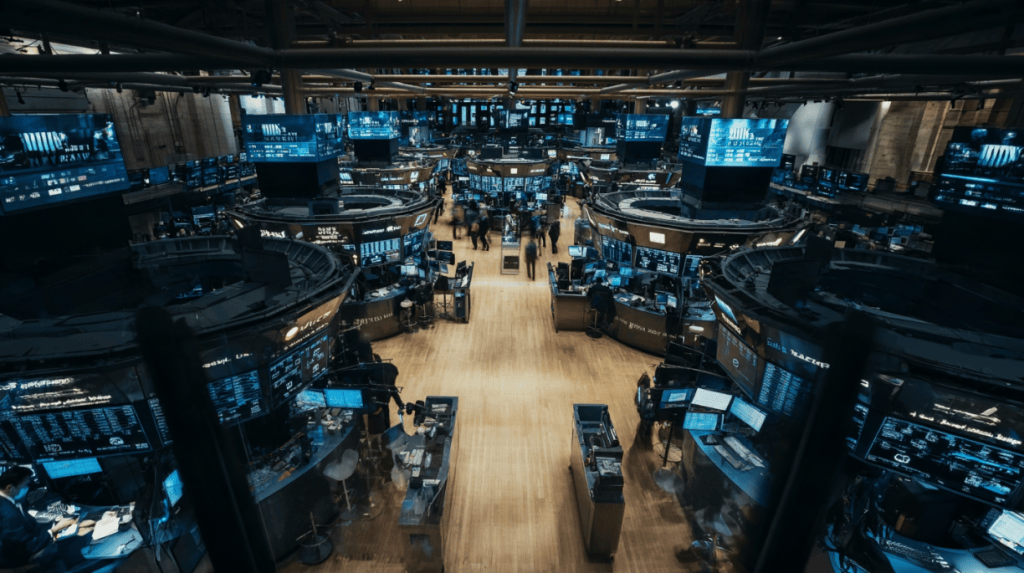
U.S. technology stocks rebounded on Tuesday, November 3, as semiconductor gains outweighed weakness in Apple and Palantir. The Nasdaq Composite rose 0.9%, ending a three-session losing streak, while the S&P 500 added 0.4%, according to the supplied closing report. Investors shifted attention toward congressional elections, although earnings and renewed Middle East tensions remained important market drivers.
The recovery reflected selective buying rather than enthusiasm for every technology company. Chipmakers attracted demand, while investors continued questioning whether strong reported growth could justify demanding expectations for future performance.
The Dow Jones Industrial Average fell 197.26 points, or 0.38%, to close at 51,786.72 on Tuesday, November 3.
Nvidia and Broadcom Support the Nasdaq
Nvidia gained 2.3% and Broadcom advanced 3.1% in the supplied closing account. Their performance helped offset Apple’s 1.9% decline after its quarterly results highlighted constraints associated with a global memory-chip shortage.
Afternoon reporting likewise showed semiconductor shares outperforming, with Nvidia and Broadcom both trading approximately 3% higher. Those intraday readings should not be confused with the subsequent closing percentages.
The divergence highlighted an important feature of the AI investment cycle: demand for computing infrastructure can support semiconductor suppliers while component shortages complicate conditions for device manufacturers.
AMD Earnings Extend the Chip Story After Hours
AMD shares rose after Tuesday’s closing bell following quarterly results that exceeded revenue expectations. The company reported sales of $13.4 billion for the quarter ended September 26, compared with the $13.1 billion expected by analysts surveyed by FactSet.
The report provided another indication of demand supporting AMD’s shift toward data centres. However, an after-hours share reaction is separate from regular-session performance and can change as investors examine guidance and management commentary.
Palantir Growth Meets High Expectations
Palantir fell 1.6% in the supplied closing report despite announcing 96% year-over-year revenue growth. The company reported quarterly revenue of $2.313 billion and raised its full-year revenue outlook to $8.530 billion–$8.534 billion. Its results nevertheless prompted questions about sustaining that expansion.
Chief Executive Alexander Karp framed Palantir’s ambitions around a “moral imperative” to become a dominant AI provider. Management argued that effective military technology could strengthen deterrence and help prevent conflict. Those statements describe the company’s strategic position, not independently established evidence that its products prevent wars.
For investors, the relevant questions remain contract durability, delivery capacity and profitability. Management acknowledged that some newer AI contracts were shorter than usual and that servicing demand required additional resources.
Iran War Keeps Brent and WTI Volatile
Oil rebounded Tuesday as renewed military action weakened confidence in a rapid diplomatic settlement. At 07:44 GMT, Brent crude futures traded at $106.61 per barrel, up 1.76%, while WTI reached $98.06, gaining 1.66%. These were intraday quotations, not closing settlements.
The advance followed reports of a U.S. strike on Iran’s Qeshm Island and comments indicating that the two countries remained far apart on peace terms. Monday’s settlement prices—$104.77 for Brent and $96.46 for WTI—therefore should not be presented as Tuesday’s closes.
Gold and Silver Prices
Gold’s bid price was at $3,936.50 per troy ounce, up $5.30, or 0.13% today. The ask stood at $3,938.50.
Read also : Gold : Build Your Wealth and Freedom
Silver’s bid was $49.70 per ounce, gaining $0.01, or 0.02%, with an ask of $49.95. Both quotations were live spot readings while the market remained open—not settlement prices.
What Democratic Election Odds Mean for Investors
Prediction markets favoured Democrats taking both congressional chambers. Shortly after 5 p.m. Eastern, Kalshi priced a Democratic sweep around 72% and Polymarket around 74%. These were market-implied probabilities, not election results.
For investors, the implication is potential gridlock between a Democratic Congress and the Trump administration. That could constrain major legislation while increasing scrutiny of executive policy. It would not guarantee any particular market direction: earnings, inflation, interest rates and geopolitical developments would still shape investment returns.
Our community already has nearly 346,000 readers!
Subscribe to our Telegram channel
Follow us on Telegram, Facebook and Twitter
© Copyright 2026 – Eurasia Business News. Article no. 3242

