
By William Collins, consultant in stock markets – Eurasia Business News, November 22, 2026. Article no 3280
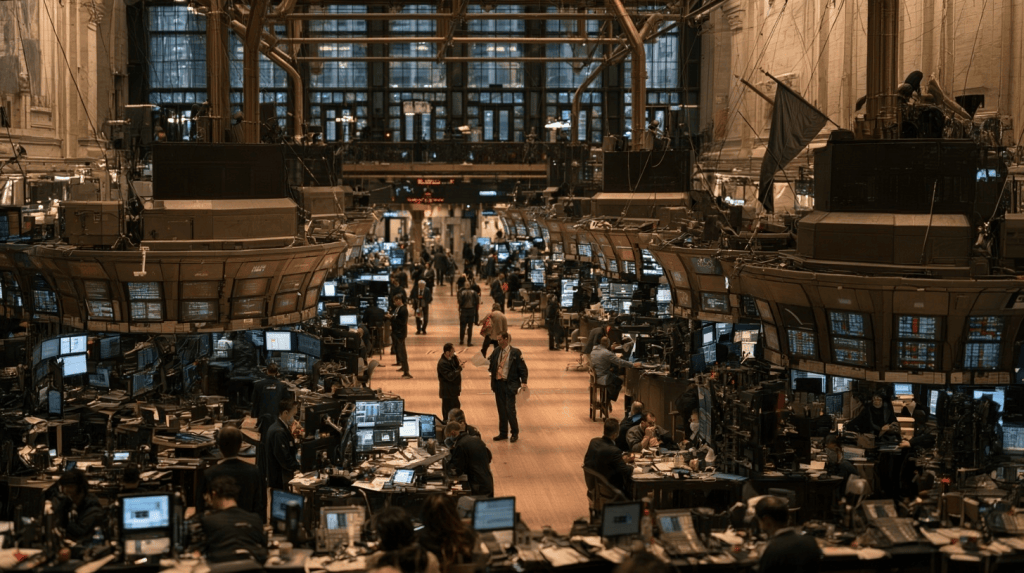
The question dominating Wall Street is no longer whether artificial intelligence will transform the economy. It is whether investors paid too much, too soon, for the profits that transformation might deliver. Friday’s technology selloff sharpened that distinction: the Nasdaq Composite plunged 5.28%, wiping out its 2026 gains, while the S&P 500 dropped 3.7%.
Nvidia fell approximately 14%, and newly listed Anthropic surrendered most of its initial public offering gains. The declines intensified fears that the AI investment boom is unwinding. But falling share prices do not establish that the technology has failed. They demonstrate that investors are demanding a different price for its promise.
AI Bubble Fears Deepen After Wall Street’s Selloff
Friday, November 20, turned a technology correction into a broader confidence shock. Axios reported the Nasdaq down 17.9% and the S&P 500 down 11.6% in its performance comparison. Bloomberg separately reported that the S&P 500 had fallen more than 10% from its October record, putting it in correction territory.
The Nasdaq-100, which is distinct from the broader Nasdaq Composite, fell 5.6% Friday and approached a bear market after losing nearly 20% from its recent high.
These distinctions matter. Different indexes track different groups of companies, and figures measured at different times should not be treated as interchangeable. The consistent message, however, was unmistakable: investors were rapidly retreating from the trade that had powered much of the market’s earlier advance.
Nvidia Stock Becomes the Centre of the Rout
Nvidia’s 14% decline marked its worst session in almost two years. The chipmaker lost 22.9% over the week, its weakest weekly performance since October 2008.
The longer decline was even more striking. Nvidia had fallen 47.5% from its October 6 peak, erasing approximately $2.7 trillion in market capitalisation.
That loss represents a reduction in the market value of outstanding shares, not an equivalent amount of cash leaving Nvidia’s accounts.
Investors also faced overlapping concerns. Axios described declining confidence in AI, tightening credit and a scandal involving Nvidia’s leadership as pressures on the stock. Nvidia’s performance therefore cannot be read as a pure verdict on semiconductor demand: company-specific uncertainty was interacting with broader market anxiety.
Anthropic’s IPO Fails to Restore Confidence
Anthropic’s public-market debut had offered a potential catalyst for the struggling AI trade. Instead, its shares fell 8.5% Friday, closing at $88.91, only modestly above the $83 IPO price.
The stock remained above its offering price, so describing the IPO as having lost all its premium would be inaccurate. Nevertheless, much of the initial enthusiasm had faded within its first two trading sessions.
Axios reported that Anthropic’s offering became the largest on record after underwriters exercised their option to purchase additional shares. Yet the transaction’s scale could not overcome deteriorating sentiment toward the wider sector.
The episode highlighted an important limitation: strong demand for a new listing does not guarantee continuing gains once shares begin trading in an unsettled market.
What the “$6 Trillion in 45 Days” Claim Means
The Kobeissi Letter framed the downturn with the headline “-$6 Trillion In 45 Days,” asking whether the selloff represented a bursting bubble or an opportunity. Its accompanying post said U.S. stocks had lost an average of $225 billion per day over 31 trading days.
The sensible interpretation is that trillions in equity value disappeared during the broader downturn—not that the headline provides an independently verified, exact accounting of every session. Nvidia’s documented $2.7 trillion decline alone illustrates the scale involved.
Why an AI Breakthrough Can Still Produce Investment Losses
The central distinction is between technology adoption and investment returns.
A company can increase sales while its stock falls if investors previously expected even faster growth. Likewise, expanding demand for computing does not guarantee that every supplier, cloud operator or model developer earns attractive returns.
These businesses occupy different positions in the AI economy. Chipmakers sell infrastructure, cloud companies finance and operate computing capacity, and model developers compete to convert usage into revenue. Treating them as one identical investment obscures differences in costs, competition and financing requirements.
Friday’s selloff showed that confidence in the collective AI story had weakened. It did not establish that every business model faced the same operational problem.
Tightening Financial Conditions Raise the Stakes
Axios identified tightening credit as one force weighing on the AI trade. Bloomberg reported that investors moved toward bonds during Friday’s broader market retreat.
That combination matters for an industry whose ambitions require substantial upfront investment. When financing becomes less accommodating, investors examine spending commitments and future returns more critically.
Anthropic’s IPO also raised questions about market liquidity. The Kobeissi Letter argued that demand for the offering absorbed money that might otherwise have supported other stocks. That is an interpretation of the selloff, not a demonstrated explanation for the entire decline.
Has the AI Bubble Actually Burst?
The evidence supports a severe repricing, not a definitive verdict on AI’s economic future. Nvidia’s drawdown, Anthropic’s fading premium and the broader correction show that investors have become less willing to reward distant promises without scrutiny.
The next test will come from business results: revenue durability, spending discipline, financing access and the conversion of investment into cash generation.
For now, “bubble burst” remains an interpretation rather than an accounting fact. What is clear is that the market has shifted from celebrating AI’s potential toward questioning what that potential is worth—and which companies can turn it into durable shareholder returns.
Our community already has nearly 355,000 readers!
Subscribe to our Telegram channel
Follow us on Telegram, Facebook and Twitter
© Copyright 2026 – Eurasia Business News. Article no. 3280

