
By Swann Collins, investor, writer and consultant in international affairs – Eurasia Business News, May 14, 2026. Article no. 2098
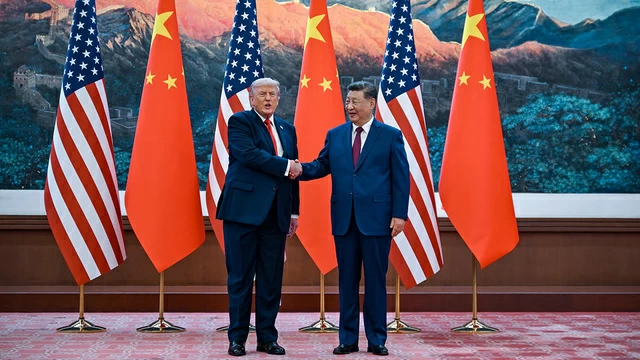
The United States and China are ready to cooperate and develop bilateral dialogue, since relations between these two great powers are the most important for modern international relations, follows from official statements following a bilateral meeting between US President Donald Trump and Chinese President Xi Jinping on May 14.
Despite the general positive mood in these statements, the parties placed different accents. For example, the U.S. version emphasizes China’s agreement with condemnation of the militarization of the Strait of Hormuz or Iran’s development of nuclear weapons. In addition, the U.S. side emphasized Trump’s mention of issues related to fentanyl smuggling and China’s purchase of U.S. agricultural products at the talks.
The Chinese statement following the meeting, presented by the Xinhua news agency, lists the topics raised without specifying the positions of each of the parties: these issues are Iran, the war in Ukraine and the situation on the Korean Peninsula. In addition, Xi Jinping stressed the importance of the Taiwan issue for U.S.-China relations. “Maintaining peace and stability on both sides of the Taiwan Strait is the biggest dividing issue between China and the United States. The American side should exercise special caution in resolving the Taiwan issue,” the Chinese statement said.
Chinese leader Xi Jinping warned President Trump that any mishandling of Taiwan could lead to “an extremely dangerous situation,” directly raising a point of tension that has loomed over what the U.S. president said at the start could be “the best summit ever.”
And during the talks themselves, Xi began with the following question: “Will China and the United States be able to step over the Thucydides trap (the concept when a rising power catches up with the hegemon, which leads to conflict.) and open a new paradigm of relations between major powers? <… >These are questions of history, peace and peoples, as well as the challenge of the era, to which the leaders of the great powers must give a joint response.” He also stressed that the ideas of China’s revival and the greatness of the United States do not contradict each other.
Xi Jinping has demonstrated his knowledge of Western political theory, in particular classical realism. At the same time, Thucydides’ trap can be understood not only in a military sense, but also as a broader definition of the possible trajectory of relations between descending and rising powers. And now this can very likely lead not necessarily to a military clash between the United States and China, but to a tough trade war and competition in the field of new technologies.
The “Thucydides Trap,” developed by Graham Allison, describes the dangerous tensions arising when a rising power challenges an established dominant power. Inspired by ancient Greece, the concept explains how fear, rivalry, and strategic mistrust can increase the likelihood of war between great powers.
Marco Rubio, in an interview with NBC News, said that the Taiwan topic was also touched upon at the current talks in Beijing. “In an ideal world, all they [China] would want is to hold a vote or a referendum in Taiwan that would agree to join. I think that’s what they’d prefer. <… >We believe it would be a terrible mistake to achieve this by force or anything like that,” he said. The U.S. Secretary of State also said that the U.S. president did not ask Xi Jinping for help in resolving the Iranian crisis. And a few hours later, in an interview for Fox News, the US president spoke about the promises of the Chinese leader not to supply Iran with military assistance.
Xi Jinping tried to convince Trump that their countries can coexist, and the rise of China should not necessarily be perceived by the United States as a threat. According to the leader of the PRC, the countries should avoid a military escalation around Taiwan, which could occur – and Xi said this in plain text that an extremely important statement. And if the United States continues its previous policy around Taiwan (its armament, etc.) and prevents peaceful reunification, then, in the opinion of the PRC, it will be impossible to avoid the Thucydides trap.
Read also : The Private Investor Deal Evaluation Handbook
After the official talks, Trump was shown one of Beijing’s iconic sites, the Confucian Temple of Heaven (he became the second sitting U.S. president to officially visit it since Gerald Ford in 1975). During the Ming and Qing empires, the emperor made sacrifices to Heaven, asking him for a good harvest. This gave him legitimacy as an envoy on earth.
Later, President Xi Jinping, like Premier Li Qiang, held a meeting with a large American business delegation from among the top managers of large corporations. And during the gala banquet, Trump invited Xi Jinping on a return state visit to the United States on September 24. According to Trump, China signed an agreement during his visit to purchase 200 Boeing airliners.
Trump’s visit did not fundamentally change the paradigm of relations between China and the United States: they remain the main strategic rivals, but both sides are not yet interested in escalation, Suslov concludes.
Our community already has nearly 245,000 readers!
Subscribe to our Telegram channel
Follow us on Telegram, Facebook and Twitter
© Copyright 2026 – Eurasia Business News. Article no. 2098
 Eurasia Business News