
By Swann Collins, investor, writer and consultant in international affairs – Eurasia Business News, May 18, 2026. Article no. 2099
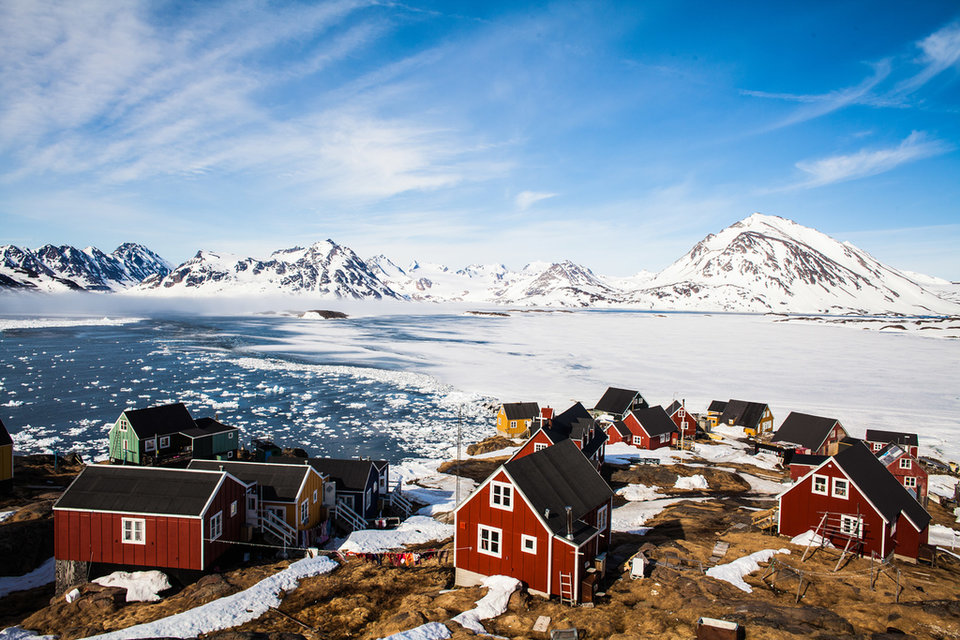
Representatives of the Trump administration and the Danish government are engaged in “confidential negotiations behind closed doors” on Greenland for the past four months. This is reported by The New York Times, citing sources in Washington, Copenhagen and Greenland.
Greenlandic leaders are increasingly alarmed by what’s on the table.
The Hidden Diplomatic Battle Over the Arctic’s Most Strategic Island
While global attention has been fixed on the conflict in Iran, a quieter but potentially history-altering set of negotiations has been unfolding behind closed doors. For the past four months, representatives of the Trump administration, the Danish government, and Greenlandic officials have been meeting in Washington to determine the future of one of the most strategically significant territories on Earth. According to reporting by The New York Times, citing sources in Washington, Copenhagen, and Greenland itself, these talks have been deliberately kept out of the public eye — and the reasons why are becoming clearer by the day.
This is not a routine diplomatic exchange. These are negotiations shaped by extraordinary pressure: President Trump’s repeated and escalating threats to seize Greenland, by force if necessary. The talks were designed to give the president an off-ramp — a diplomatic solution that would satisfy Washington’s strategic ambitions without triggering a full-blown rupture inside NATO. But as details of what the U.S. is actually demanding begin to emerge, Greenland’s leaders are growing deeply worried.
What Is the U.S. Actually Demanding?
At the heart of the negotiations are two U.S. demands that Greenlandic and Danish officials strongly oppose.
First, the United States is seeking a guarantee of indefinite U.S. military presence in Greenland — even in the event that Greenland achieves full independence from Denmark. This is a clause of extraordinary scope. It would mean that no matter what political future Greenlanders choose for themselves, U.S. troops would retain the right to remain on the island permanently. As the New York Times noted bluntly, “this is an indefinite clause, and Greenlanders do not like it.” For a people who have spent decades slowly building toward self-determination, the prospect of trading one form of outside control for another is deeply unwelcome.
Second, Washington is pushing for veto power over major investment decisions in Greenland. The stated goal is to block competitors — specifically Russia and China — from gaining an economic foothold in the Arctic. In practice, however, this would give the United States sweeping oversight of Greenland’s economic sovereignty. Both Greenland and Denmark have strongly objected to this demand, viewing it as an infringement that goes well beyond legitimate security concerns.
The negotiations on the U.S. side are being led by Michael Needham, a key adviser to Secretary of State Marco Rubio — a signal of how seriously Washington is taking this effort at the highest levels of the State Department.
Why Greenland Matters So Much to Washington
To understand why the Trump administration is pressing so hard, it helps to understand what Greenland actually represents geopolitically and economically.
Greenland is the world’s largest island, sitting at the crossroads of the Arctic Ocean and the North Atlantic. Its location gives it extraordinary strategic value: it lies directly along the shortest flight and missile paths between North America and Europe, making it a cornerstone of Arctic defense planning. The United States has operated Pituffik Space Base (formerly Thule Air Base) in northern Greenland for decades — a facility central to American early warning and space surveillance systems.
But geography is only part of the story. Greenland is also sitting atop enormous natural wealth. The island is believed to hold vast deposits of oil, uranium, rare earth elements, and other critical minerals — resources that have become central to the global competition between the U.S., China, and Russia. Most of these deposits remain locked deep beneath Greenland’s ice sheet, but as climate change accelerates and the ice retreats, they are becoming increasingly accessible and economically attractive. The United States, watching China dominate the rare earth supply chain, sees Greenland as a potential answer to a critical strategic vulnerability.
Greenland’s Precarious Position
For Greenland’s roughly 56,000 inhabitants and their elected leaders, these negotiations represent an almost impossible bind. The island has limited leverage. It relies heavily on Denmark for financial support — receiving approximately $600 million annually in block grants — and Danish law controls its foreign affairs. In a negotiation being conducted primarily between Washington and Copenhagen, Greenlandic voices risk being drowned out entirely.
Read also : The Private Investor Deal Evaluation Handbook
Greenlandic officials are not simply worried about the substance of what is being proposed. They are worried about the process itself. The talks have been conducted confidentially, leaving Greenland’s population largely in the dark about decisions that could determine their political and economic future for generations. Many Greenlanders have long harbored aspirations for independence, and the prospect of that independence coming pre-loaded with permanent American military rights and U.S. investment vetoes is, for many, a deeply unappealing version of freedom.
Some Greenlandic politicians have even marked a specific date on their calendars as a moment of potential danger: June 14 — President Trump’s birthday. The fear is that if tensions with Iran subside before then, Trump may redirect his attention — and his aggression — back toward Greenland, potentially escalating pressure or provocative rhetoric at an unpredictable moment.
The NATO Dimension
The stakes extend well beyond Greenland’s shores. Trump’s threats of a military takeover of Greenland — made repeatedly and without retraction — sent shockwaves through the NATO alliance. Denmark is a founding NATO member. An American president openly threatening to seize the territory of an ally struck at the foundational principles of the alliance and raised serious questions in European capitals about whether Washington could still be trusted as a partner.
The confidential negotiations were partly designed to manage this damage — to de-escalate a crisis that, if mishandled, could fracture Western unity at a moment when European security concerns are already at a historic high. Whether the current negotiating framework can achieve that goal without further alienating Greenland itself remains an open question.
What Comes Next?
Neither the United States nor Denmark has disclosed the substance of the talks publicly. That opacity is itself a political problem — it feeds suspicion in Greenland and prevents the kind of public scrutiny that negotiations of this magnitude arguably deserve.
The immediate trajectory will depend partly on events beyond Greenland. If the Iran situation stabilizes and Trump’s focus returns to the Arctic, the pace and pressure of negotiations could intensify rapidly. Conversely, if geopolitical fires elsewhere keep burning, Greenland may gain time — though not resolution.
What is already clear is that the outcome of these secret talks will shape not just Greenland’s future, but the broader question of how Arctic sovereignty, indigenous self-determination, and great-power competition intersect in the 21st century. For a remote island long described as the world’s most isolated place, Greenland has rarely been more at the center of everything.
Our community already has nearly 245,000 readers!
Subscribe to our Telegram channel
Follow us on Telegram, Facebook and Twitter
© Copyright 2026 – Eurasia Business News. Article no. 2099
 Eurasia Business News