
By John Meyer, consultant in financial affairs – Eurasia Business News, May 27, 2026. Article no 3008
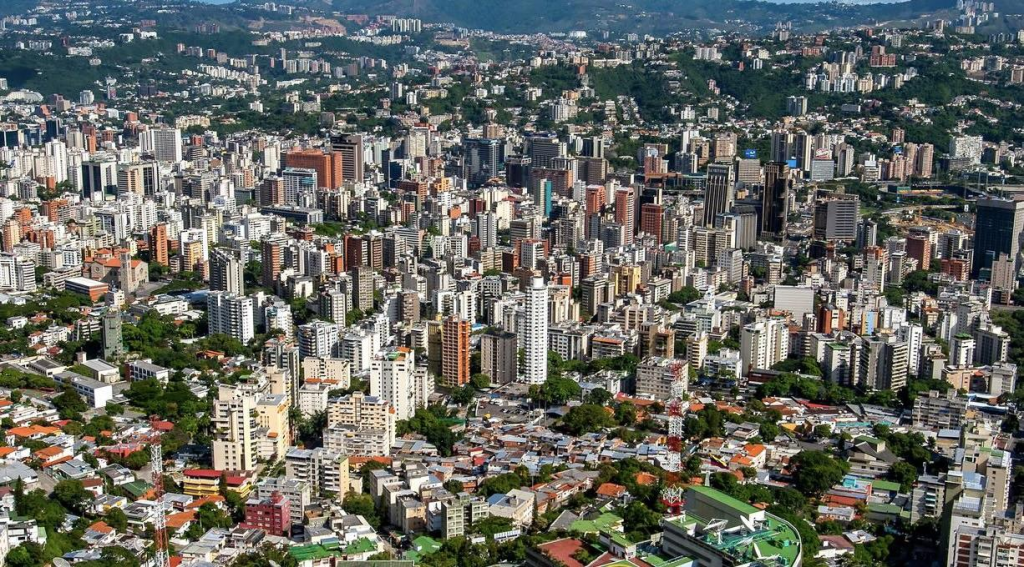
Picture : View on Caracas, capital of Venezuela, June 2024.
One of the most complex sovereign restructurings in history is under way. Here is what investors and policymakers need to understand about the deal, the players, and the stakes.
The mandate that surprised Wall Street
In mid-May 2026, Venezuela formally appointed Centerview Partners as financial advisor to lead the restructuring of approximately $150 billion in sovereign and PDVSA debt — the state oil company that underpins the country’s entire fiscal architecture, reported the Wall Street Journal. The announcement sent Venezuelan government bonds due in 2034 to their highest level since 2014, and PDVSA notes climbed two cents on the dollar, signalling that markets had been waiting for exactly this kind of signal.
Investment bankers—who typically earn a commission ranging between €10 million and €20 million on deals of this kind—cite a Venezuelan state debt of at least $170 billion, or €146 billion.
The selection blindsided competitors. Rothschild, which had held the Maduro government mandate since 2024 and lobbied Washington directly in February, was passed over. Law firm Dentons, another incumbent advisor, was also sidelined. Instead, Caracas turned to a boutique whose name is rarely associated with Latin American sovereign distress — and to a French banker whose politics sit at the opposite end of the spectrum from the Trump administration now calling the shots in Venezuela.
Matthieu Pigasse: the unlikely architect
The Centerview partner leading the engagement is the French banker Matthieu Pigasse, a former head of global M&A at Lazard who advised on the 2012 Greek debt restructuring — still the largest sovereign debt operation in history at the time, involving €206 billion in private-sector holdings. A self-described pro-market socialist with deep ties to France’s left, Pigasse made two trips to Caracas in 2026, navigating the new political landscape with the same pragmatism he displayed in Athens.
His entrée into Venezuela came partly through prior advisory work on a potential sale of Citgo, PDVSA’s U.S. refining arm, where he first built a relationship with acting President Delcy Rodriguez. An invitation to a private White House screening of a Melania Trump documentary — organised by Argentine producer Fernando Sulichin — further expanded his network inside the current administration.
The geopolitical context: Washington in the driver’s seat
The restructuring does not occur in a vacuum. It follows a January 2026 U.S. military operation that resulted in Nicolás Maduro’s capture and his transfer to New York to face narco-trafficking charges. The Trump administration has since assumed de facto control over Venezuelan oil export revenues, channelling them through a tightly managed distribution framework. It also quietly authorised Venezuela to engage financial and legal advisors for a sovereign restructuring — the green light that made the Centerview mandate possible.
Read also : The Million-Dollar Retirement Blueprint for U.S. citizens in 2026
Behind the scenes, former Trump Latin America envoy Mauricio Claver-Carone — now a managing partner at Miami-based private equity firm LARA Fund — would have played a pivotal role. Having worked with Pigasse on Ecuador’s 2020 debt restructuring, Claver-Carone says he personally recommended Centerview to Rodriguez and consulted the State Department and Treasury. His stated motivation: sidelining advisors associated with the Maduro era. A State Department spokesperson has confirmed that Claver-Carone does not act on behalf of the U.S. government.
Meanwhile, a creditor committee including Fidelity Management & Research, Morgan Stanley Investment Management, and Greylock Capital Management has signalled its readiness to engage — contingent on receiving the necessary authorisations. A successful deal, the group notes, could “accelerate financing across all sectors of the Venezuelan economy.”
Why this restructuring is uniquely complex
Venezuela’s situation differs from typical sovereign workouts in several compounding ways. The country has not published comprehensive financial or economic data for the better part of a decade, leaving creditors and economists estimating total liabilities anywhere from $150 billion to over $170 billion depending on how wider obligations — including bilateral debt owed to Russia and China — are counted. Transparency, in other words, will have to be constructed from scratch.
Read also : The Private Investor Deal Evaluation Handbook
The Venezuelan government has pledged to release an initial restructuring framework by June 2026 — a timeline most independent analysts consider optimistic. Venezuela also needs to rebuild institutional credibility with the IMF and multilateral lenders before any meaningful market access can be restored. In parallel, Chevron recently signed an asset exchange agreement expanding its stake in the Petroindependencia joint venture with PDVSA to 49% — a concrete signal that some foreign capital is already re-engaging with Venezuelan hydrocarbons.
What to watch
For investors and policymakers tracking this story, the critical variables are the pace of creditor committee formation, the quality and timeliness of fiscal disclosures, and whether the Trump administration maintains stable political cover for the process. History — from Argentina in 2005 to Greece in 2012 — suggests that sovereign restructurings of this scale rarely proceed on schedule. But they do, eventually, proceed. Venezuela’s $150 billion reckoning has begun.
Read also : Tax Management strategies for Digital Nomads
Our community already has nearly 250,000 readers!
Subscribe to our Telegram channel
Follow us on Telegram, Facebook and Twitter
© Copyright 2026 – Eurasia Business News. Article no. 3007

