
By John Meyer, consultant in business – Eurasia Business News, August 14, 2026. Article no. 3092
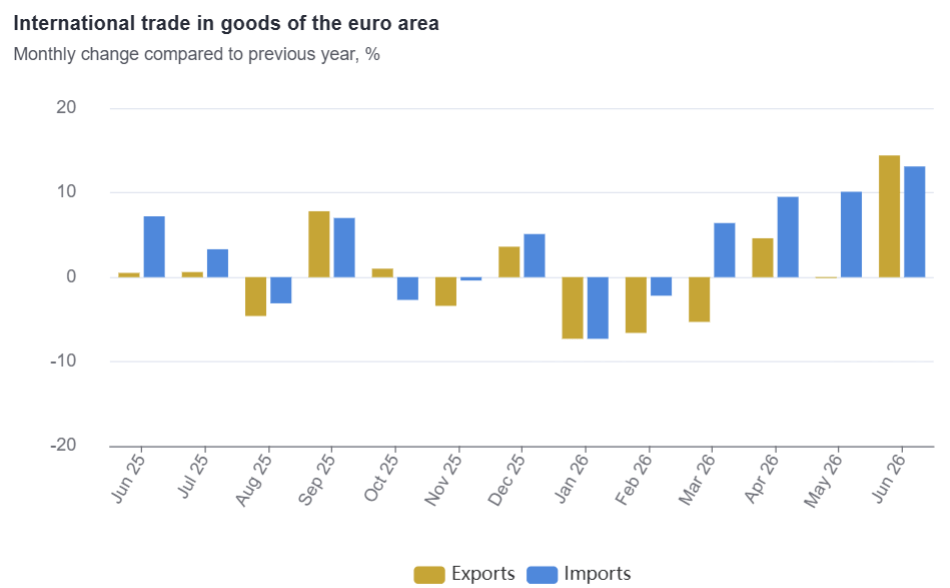
The euro area returned to a goods-trade surplus in June 2026, recording an €8.6 billion surplus after a €9 billion deficit in May. The result exceeded market expectations and reflected a sharp increase in exports, offering a positive signal for the eurozone’s external sector despite weak first-half trade performance.
Analysts surveyed by Trading Economics had expected a €2.2 billion trade deficit. Instead, the June result marked the euro area’s largest monthly goods-trade surplus since February.
Eurozone Trade Balance Rebounds
The June surplus was significantly higher than the €4.8 billion surplus recorded in June 2025. The reversal from May’s €9 billion deficit highlights the volatility of monthly trade data, which can be affected by energy purchases, capital-goods deliveries, seasonal factors and shifts in international demand.
Eurozone exports of goods to the rest of the world reached €272.5 billion in June, an annual increase of 14.4%. Imports rose 13.1% to €264 billion.
Although imports continued to grow strongly, export growth was faster in absolute terms, enabling the euro area to return to surplus. The data suggest that international demand for European goods strengthened in June, even as the region continued to confront trade-policy uncertainty, higher energy costs and uneven industrial activity.
The June export figure was the highest level in more than a year, according to Trading Economics.
Exports Rise Faster Than Imports
The recovery in the eurozone trade balance was driven by the difference between exports and imports. Goods exports increased by €34.3 billion compared with June 2025, while imports rose by €30.6 billion.
This matters because trade balances are determined not simply by whether imports rise or fall, but by the relative pace of growth in external sales and purchases. In June, the increase in exports was sufficient to outweigh the simultaneous rise in imports.
The euro area remains a major exporter of machinery, vehicles, pharmaceuticals, chemicals, industrial equipment, luxury goods and specialised manufacturing products. Stronger global demand in these sectors can support production, employment and corporate earnings across the currency bloc.
However, the data do not necessarily signal a sustained improvement. Monthly trade figures can move sharply because of large aircraft, ship, energy or industrial-equipment transactions. Policymakers and investors will therefore watch the next releases to determine whether June represents the beginning of a more durable export recovery.
First-Half Trade Surplus Falls Sharply
Despite the encouraging June result, the euro area’s overall trade performance in the first half of 2026 remained substantially weaker than a year earlier.
From January through June, the eurozone recorded a trade surplus of €9.8 billion, compared with €82.2 billion during the same period in 2025.
Read also : The Million-Dollar Retirement Blueprint for U.S. citizens in 2026
Exports during the six-month period declined 0.2% to €1.487 trillion, while imports increased 4.9% to €1.477 trillion. The widening import bill and stagnant export performance explain why the half-year surplus contracted by more than €72 billion.
The figures indicate that June’s recovery followed a difficult first half. Earlier in 2026, the euro area experienced weaker export demand and faster growth in imports. In January through March, the trade surplus fell to €16.6 billion from €55.4 billion in the corresponding period of 2025.
What the Trade Data Means for the Eurozone Economy
A trade surplus supports the eurozone by contributing to gross domestic product and generating foreign demand for European goods. It can also support the euro by increasing demand for the region’s currency in international trade transactions.
However, the sharp fall in the first-half surplus underlines the vulnerabilities facing the bloc. Export-oriented economies such as Germany, the Netherlands, Ireland and Italy remain sensitive to global industrial demand, energy prices, supply-chain disruption and trade restrictions.
Read also : Tax Management strategies for Digital Nomads
The June figures offer a welcome boost, but they do not eliminate broader concerns over eurozone competitiveness and sluggish manufacturing growth. Sustained export expansion will depend on global economic conditions, the direction of energy prices, exchange-rate movements and the ability of European industry to maintain market share in technology-intensive sectors.
Read also : Gold : Build Your Wealth and Freedom
For now, the €8.6 billion June trade surplus represents a stronger-than-expected recovery. The key question is whether the eurozone can convert that monthly rebound into a more durable improvement during the second half of 2026.
Our community already has nearly 300,000 readers!
Subscribe to our Telegram channel
Follow us on Telegram, Facebook and Twitter
© Copyright 2026 – Eurasia Business News. Article no. 3092

