
By Swann Collins, investor, writer and consultant in international affairs – Eurasia Business News. August 19, 2026. Article no 3106.
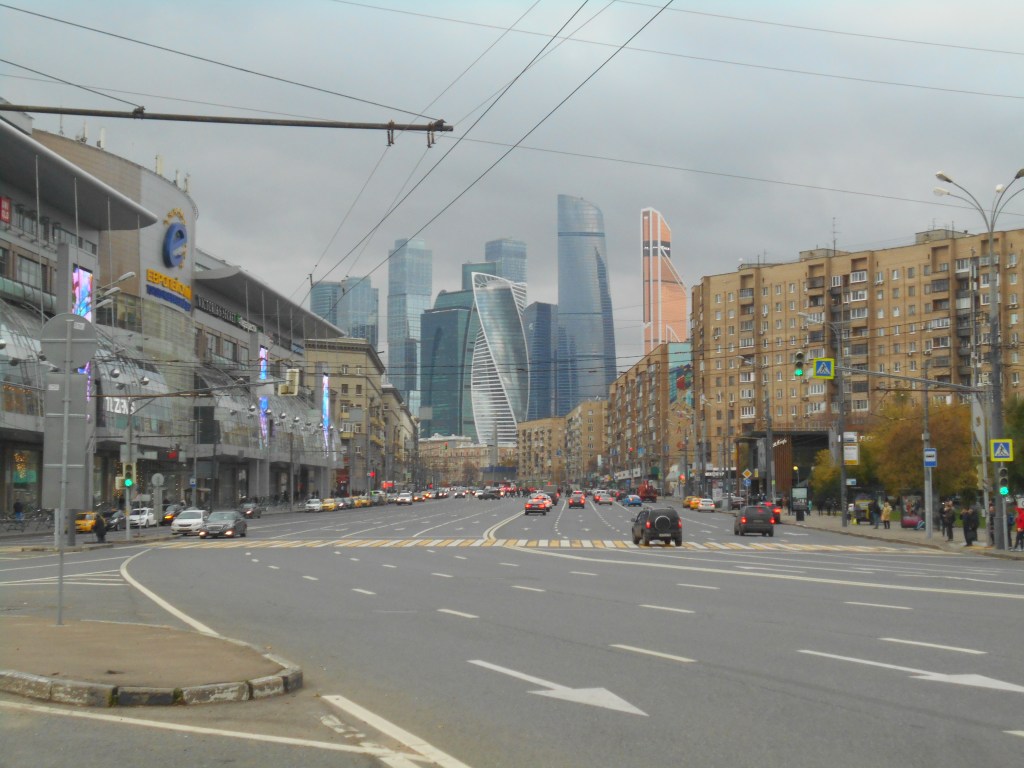
View on the towers of Moscow City, from the Borodinsky Brigde, Moscow – January 2022. Photo credits : Swann Collins.
Russia’s economy is expected to grow slowly in 2026 and 2027 as high inflation, elevated interest rates, labour shortages, sanctions and war-related spending reshape the outlook. While strong commodity prices and government expenditure continue to support activity, most forecasts indicate that Russia has entered a period of lower, more constrained growth.
The International Monetary Fund projects Russian GDP growth of 1.1% in both 2026 and 2027. The Bank of Russia has become more cautious, cutting its 2026 growth forecast to a range of 0% to 1%, while maintaining expectations of stronger growth in 2027.
Russia GDP Growth Forecast
The Russian economy expanded rapidly in 2023 and 2024, driven by state spending, defense production, construction, import substitution and higher wages. However, this model has created capacity constraints rather than a broad improvement in productivity.
The IMF estimates that Russia’s economy will grow by 1.1% in 2026 and another 1.1% in 2027. The forecast is significantly below the 4.3% expansion recorded in 2024, when military expenditure and fiscal stimulus strongly boosted output.
The Bank of Russia now forecasts GDP growth of 0% to 1% in 2026, reducing its previous range of 0.5% to 1.5%. It expects growth to recover to 1.5%–2.5% in 2027, assuming inflation eases, real incomes remain resilient and monetary policy becomes less restrictive.
The divergence between IMF and Bank of Russia forecasts reflects different assumptions about domestic demand, oil revenues, fiscal policy and the speed of interest-rate reductions.
Russian President Vladimir Putin said at a meeting of the Council for Strategic Development and National Projects on August 19 that the country’s gross domestic product (GDP) growth in 2026 is about 1%.
Inflation Remains Above Target
Inflation is likely to remain the central macroeconomic issue for Russia. The Bank of Russia has raised its 2026 inflation forecast to 6%–7%, above its formal 4% target. The revision reflected a sharp increase in fuel prices, stronger consumer spending and persistent cost pressures.
The central bank expects inflation to return closer to its 4% target in 2027. Achieving that objective will depend on the exchange rate, food and fuel prices, government spending, household demand and the labour market.
Russia’s inflation problem is structural as well as cyclical. The economy faces shortages of workers, limited access to imported technology, logistics costs, sanctions-related trade friction and high demand from government procurement. These factors can raise production costs and reduce the effectiveness of conventional monetary tightening.
Interest Rates and Monetary Policy
The Bank of Russia has kept monetary policy restrictive to control inflation. Its key-rate forecast implies an average rate of 13.5%–14.5% in 2026, falling to 8%–9% in 2027, to lower inflation.
High interest rates help restrain credit growth and limit inflation expectations, but they also increase borrowing costs for Russian companies and households. This can slow private investment, residential construction and consumer-credit growth.
The rate outlook will depend on whether inflation decelerates as expected. If prices remain near 6%–7%, the central bank may be unable to ease policy as quickly as businesses and the government would prefer.
Oil, Gas and the Budget
Commodity exports remain central to Russia’s fiscal and external position. Higher oil and other commodity prices prompted the IMF to upgrade its 2026 GDP forecast from 0.8% to 1.1% in April.
However, Russia’s energy sector faces substantial uncertainty. Price caps, sanctions, shipping restrictions, discounts on crude exports and rising transport costs continue to affect export revenues. The country has redirected more oil exports to Asia, but this has increased its dependence on a smaller group of buyers and service providers.
Read also : The Million-Dollar Retirement Blueprint for U.S. citizens in 2026
Government expenditure, particularly defense and security spending, remains a major driver of economic activity. It supports industrial production and employment but may crowd out civilian investment and intensify labour shortages. It also places pressure on public finances, especially if energy revenues weaken.
Consumer Spending and Labour Shortages
Consumer spending has remained more resilient than expected. The Bank of Russia raised its 2026 forecast for household-consumption growth to 1.5%–2.5%, reflecting stronger expenditure in the first half of the year.
Yet this demand resilience is occurring alongside labour-market constraints. Mobilisation, emigration, demographic trends and high demand from military-linked industries have reduced labour availability. As a result, employers face higher wage costs and difficulties expanding production.
Read also : Tax Management strategies for Digital Nomads
Strong wage growth can support household consumption, but it may also sustain inflation and reduce corporate profitability.
Main Risks for 2026–2027
Russia’s economic outlook remains heavily dependent on geopolitical and policy variables. The principal risks include:
- Lower oil prices or further restrictions on energy exports.
- Stronger sanctions and technology-import constraints.
- Persistent inflation and delayed interest-rate cuts.
- A weaker ruble, raising import prices.
- Labour shortages and declining productivity.
- Higher fiscal deficits linked to defense spending.
- Reduced private investment and weakening household confidence.
Russia is unlikely to face an immediate economic collapse, but the growth outlook is constrained. In 2026, the economy is expected to slow sharply. In 2027, a moderate recovery is possible if inflation returns toward target and monetary conditions ease.
The key question is whether Russia can shift from state-driven, war-supported growth to a more sustainable model based on investment, productivity and diversified exports.
Our community already has nearly 325,000 readers!
Subscribe to our Telegram channel
Follow us on Telegram, Facebook and Twitter
© Copyright 2026 – Eurasia Business News. Article no. 3106

