
By William Collins, consultant in stock markets – Eurasia Business News, September 24, 2026. Article no 3185
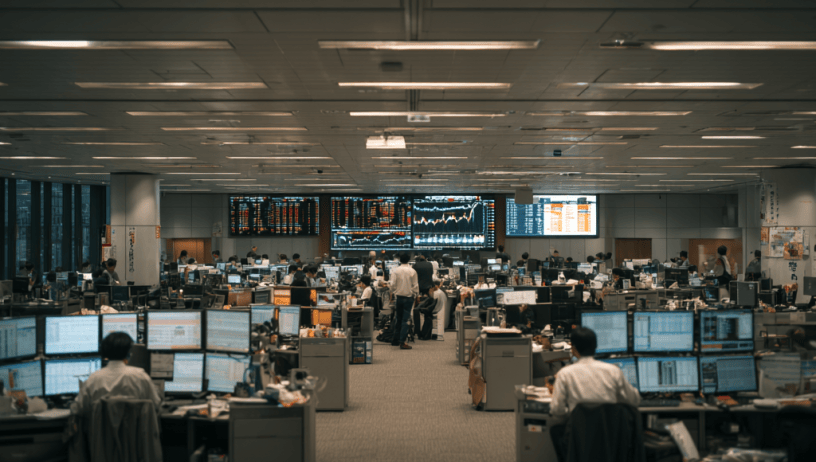
Asian stock markets traded mixed on Thursday, September 24, 2026, as investors weighed rising global bond yields, volatile oil prices and the closely watched meeting between U.S. President Donald Trump and Chinese leader Xi Jinping. Japan’s Nikkei 225 rose strongly after a holiday, while equities in China, Hong Kong and Australia declined amid concern over higher borrowing costs and the Middle East conflict.
The regional picture reflected a divided market. Technology and semiconductor shares supported Japan, but the surge in U.S. Treasury yields above 5% continued to pressure risk appetite across Asia. The MSCI Asia-Pacific ex-Japan index fell 0.64%, demonstrating that most markets outside Tokyo remained under selling pressure.
Japan Outperforms Asian Markets
Japan’s Nikkei 225 was the region’s standout performer, rising 1.73% in the Reuters session data. Other closing reports put the gain at 0.8%, or 495.04 points, to 65,513.99, after Japan returned from a long weekend. Differences reflect intraday timing and index updates during the session.
The advance was fueled by technology and semiconductor-related companies, which benefited from continuing investor enthusiasm surrounding artificial intelligence. Japanese exporters also received support from the yen’s weakness against the dollar, although the rise in Japanese government-bond yields created a counterweight for interest-rate-sensitive sectors.
Japan’s 10-year government bond yield climbed 8 basis points to 3.06%, its highest level since August 1996. The 30-year Japanese yield rose 5.5 basis points to 4.12%. The moves followed a broad selloff in U.S. Treasuries after the U.S. 10-year yield surged above 5%.
| Market | September 24 performance | Main market driver |
|---|---|---|
| Japan Nikkei 225 | Up 0.8% to 1.7% | AI-linked chip shares and post-holiday catch-up buying |
| Japan Topix | Modest gain | Broad support from exporters and technology shares |
| Hong Kong Hang Seng | Down about 0.3% to 0.7% | Weak technology shares and China-growth concerns |
| Shanghai Composite | Down about 0.8% to 1.2% | Bond-yield pressure and cautious sentiment before Trump-Xi talks |
| CSI 300 | Down about 1.5% | Mainland Chinese large-cap selling |
| Australia S&P/ASX 200 | Down 0.7% | Higher yields and weakness in resource shares |
| Taiwan Taiex | Down 0.3% | Profit-taking in technology shares |
| South Korea Kospi | Up about 0.9% in intraday trading | Semiconductor and export-stock support |
China and Hong Kong Stocks Fall
Chinese shares declined as investors awaited the Trump-Xi summit and assessed the risk of fresh tensions over trade, tariffs, semiconductors and Taiwan. The Shanghai Composite fell about 0.8% to 1.2%, while the CSI 300 index dropped approximately 1.5%.
Hong Kong’s Hang Seng Index declined between 0.3% and 0.7%, with technology and semiconductor shares leading losses. The decline came despite the extension of the U.S.-China tariff truce, which is now set to run until January 10. While the extension reduces the immediate risk of new tariffs, it does not resolve deeper disputes over export controls, AI technology, critical minerals and market access.
Chinese markets were also affected by the global rise in bond yields. Higher U.S. yields can strengthen the dollar, increase capital-outflow risk from emerging markets and constrain monetary-policy flexibility across Asia.
Australia and Taiwan Decline
Australia’s S&P/ASX 200 fell 0.7% to approximately 8,702 points. The decline reflected pressure on resource and financial shares as global yields rose and oil-market uncertainty weighed on investor confidence.
Taiwan’s Taiex declined 0.3% to 48,024.60 points. The relatively modest loss suggested that demand for AI-related semiconductor companies remained supportive, even as investors took profits after strong gains earlier in the month.
South Korea’s Kospi was among the more resilient markets in intraday trading, rising around 0.9% toward 7,080. Semiconductor and export-oriented shares helped offset concerns about global borrowing costs.
Oil and Treasury Yields Drive Sentiment
Oil prices remained volatile as investors considered conflicting reports of Houthi attacks, potential talks to reopen the Strait of Hormuz and the broader conflict involving Iran. Brent crude moved back above $105 per barrel, sustaining inflation concerns and putting pressure on global bond markets.
The U.S. 10-year Treasury yield had climbed above 5.1% to its highest level since 2007, while the 30-year yield reached its highest level since 2004. Such moves matter for Asia because higher U.S. yields can draw investment flows toward dollar assets and increase financing costs for governments, businesses and households across the region.
Japan’s rise in yields was especially notable. The 3.06% yield on its 10-year government bond represents a sharp change for an economy accustomed to extremely low interest rates. Higher domestic yields can influence Japanese bank stocks and insurers positively, but they also increase the cost of borrowing for companies and households.
Trump-Xi Summit in Focus
The Trump-Xi meeting was the central geopolitical event for Asian investors. Washington and Beijing agreed to extend their trade truce by two months, avoiding tariff increases that were scheduled for November.
Markets hoped the summit could produce progress on trade, tariff policy and AI safety cooperation. However, expectations for a comprehensive breakthrough remained low given the scale of disagreements over Taiwan, advanced semiconductors, security policy and China’s industrial strategy.
The September 24 trading session showed that Asia remains sensitive to three forces: U.S. interest rates, Middle East energy risks and U.S.-China relations. Japan’s technology-led rally offered a note of resilience, but broader regional weakness demonstrated that investors remain cautious as bond yields and geopolitical uncertainty continue to rise.
Our community already has nearly 330,000 readers!
Subscribe to our Telegram channel
Follow us on Telegram, Facebook and Twitter
© Copyright 2026 – Eurasia Business News. Article no. 3185

