
By Anthony Marcus for Eurasia Business News, September 19, 2026. Article n°3174
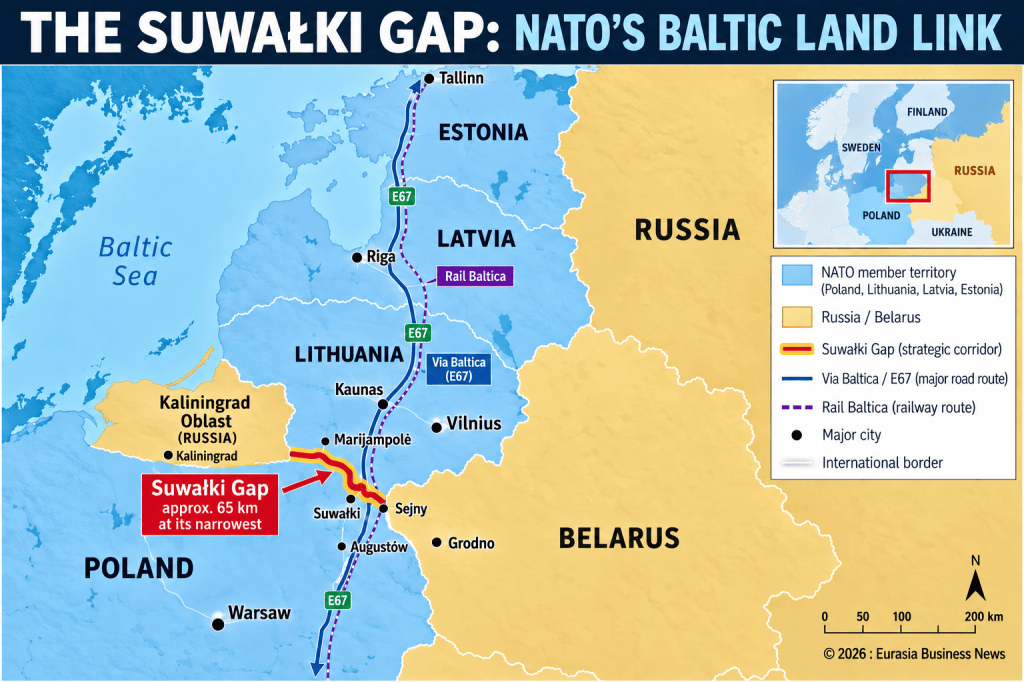
The Suwałki Gap is one of NATO’s most important—and most vulnerable—geographic chokepoints. This narrow stretch of territory along the Poland-Lithuania border is the only direct land connection between the Baltic states and the rest of the NATO alliance, making it crucial for military reinforcement, civilian logistics and deterrence on Europe’s northeastern flank.
Its strategic importance comes from its location: the corridor lies between Belarus, Russia’s close military partner, and Kaliningrad, Russia’s heavily militarized exclave on the Baltic Sea. In any conflict, the ability to keep the route open could determine how quickly NATO can support Lithuania, Latvia and Estonia.
Where Is the Suwałki Gap?
The Suwałki Gap—also called the Suwałki Corridor—is an imprecisely defined area centered on the Polish-Lithuanian border near the Polish city of Suwałki. Descriptions of its width vary, but it is commonly treated as a land corridor roughly 65 to 100 kilometers wide between Belarus to the east and Russia’s Kaliningrad region to the west.
The geographical arrangement is unusual:
| Location | Strategic role |
|---|---|
| Poland | NATO member and the Baltic states’ principal land link to Central Europe |
| Lithuania | NATO and EU member; connects directly to Latvia and Estonia |
| Belarus | Russia’s closest regional military partner, located east of the corridor |
| Kaliningrad | Russian exclave west of the corridor with major military and naval assets |
| Baltic Sea | Limits alternative land approaches and complicates logistics |
The corridor is therefore more than a border zone. It is the sole overland route through which NATO can move substantial forces, equipment, fuel, ammunition and humanitarian supplies from Poland into Lithuania and onward to Latvia and Estonia.
The Baltic States’ Lifeline
If the Suwałki Gap were blocked in a hypothetical conflict, Lithuania, Latvia and Estonia would lose their only direct land connection to allied territory. NATO could still provide support by air and sea, but both options would be more difficult, more vulnerable and potentially slower under contested conditions.
The Baltic Sea is not an uncontested logistics route. Kaliningrad hosts Russian military infrastructure, including air-defense systems, missile capabilities and naval forces. At the same time, airlift operations require protected airspace, functioning airports and sufficient capacity. That makes secure land access through Poland and Lithuania especially valuable.
For NATO, preserving access to the corridor is not simply a matter of moving troops after a crisis begins. It is central to deterrence: an adversary is less likely to test the alliance if it believes NATO can rapidly reinforce and sustain its Baltic members.
Why Kaliningrad and Belarus Matter
The Suwałki Gap sits between two territories that make it strategically sensitive.
Kaliningrad is separated from mainland Russia and is surrounded by NATO members Poland and Lithuania. It gives Russia a major military foothold on the Baltic Sea and, in a crisis, could exert pressure from the west.
Belarus lies on the other side of the corridor and maintains deep military, economic and security ties with Moscow. If forces operating from Belarus and Kaliningrad could simultaneously threaten the narrow Poland-Lithuania link, NATO’s land corridor to the Baltic states could be put at risk.
A commonly discussed contingency—not a prediction—is that an attempt to seize or deny access to the corridor could isolate the Baltic states from the rest of NATO by land while also creating a direct land link between Belarus and Kaliningrad. This is the scenario that makes the Suwałki Gap a central element of NATO defense planning.
Military and Civilian Importance
The corridor matters for both military mobility and civilian resilience. In a serious security emergency, it could be needed for:
- Moving NATO reinforcements from Poland to Lithuania.
- Transporting tanks, air-defense equipment, fuel and ammunition.
- Supporting evacuation and humanitarian-assistance routes.
- Maintaining commercial and civilian transport links between the Baltic states and the rest of the European Union.
- Protecting road, rail, telecommunications and energy infrastructure.
The limited geography means the route can be exposed to long-range missiles, artillery, drones, cyberattacks and sabotage. Modern warfare has made resilience as important as troop numbers: bridges, railways, ports, communications networks and fuel supplies all need protection and redundancy.
NATO’s Deterrence Response
NATO and its eastern members have increased their focus on the region through forward deployments, military exercises, improved cross-border mobility and investments in defensive infrastructure. Poland’s East Shield initiative and the Baltic states’ Baltic Defence Line are intended to strengthen border defenses and complicate any attempt to create a rapid fait accompli.
Recent reports of Belarusian military activity near the area have also renewed attention on the corridor. Such activity does not by itself prove an imminent threat, but it illustrates why NATO closely monitors the region and emphasizes readiness, surveillance and coordination between Poland, Lithuania and other allies.newsukraine.
The Suwałki Gap is strategic because it combines geography, logistics and alliance credibility in one narrow space. Keeping it secure ensures that NATO’s Article 5 collective-defense commitment to Lithuania, Latvia and Estonia remains practical—not merely political.
Our community already has nearly 330,000 readers!
Subscribe to our Telegram channel
Follow us on Telegram, Facebook and Twitter
© Copyright 2026 – Eurasia Business News. Article no. 3174

