
By Anthony Marcus for Eurasia Business News, August 25, 2026. Article n°3123
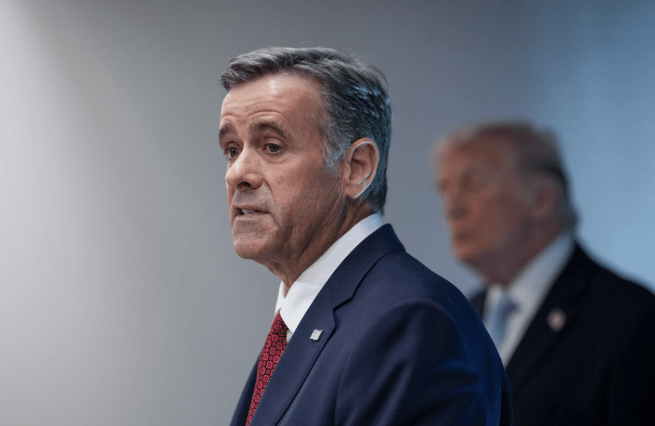
CIA Director John Ratcliffe traveled to Moscow on August 25 for unannounced meetings with Russian officials, according to sources familiar with the visit, reported CBS news and Interfax press agency. The rare trip comes as U.S.-mediated efforts to end the war in Ukraine remain stalled and American intelligence assessments warn that President Vladimir Putin may be increasingly willing to test NATO through covert or deniable actions.
Ratcliffe’s visit was not publicly announced by either Washington or Moscow. Reports emerged after a U.S. Air Force Boeing C-17A Globemaster III transport aircraft and a U.S. diplomatic motorcade were spotted at Moscow’s Vnukovo Airport.
C-17 Flight Raises Questions
Public flight-tracking data showed the U.S. military transport aircraft departing Joint Base Andrews near Washington on Sunday evening, making a stop in Riga, Latvia, and then traveling to Moscow on Tuesday morning. The C-17 landed at Vnukovo Airport shortly after 9 a.m. local time.
Neither the White House, CIA nor Russian government disclosed the purpose of Ratcliffe’s meetings. The CIA declined immediate comment, and the Kremlin did not confirm a formal meeting schedule involving the Trump administration.
The lack of official detail is not unusual for senior intelligence contacts, which can take place outside normal diplomatic channels. Such meetings may cover sensitive issues including detainee negotiations, de-escalation measures, intelligence warnings, military communication and conflict-management efforts.
Ratcliffe’s Moscow visit appears to be his first known trip to Russia since becoming CIA director. It is also the highest-profile known visit to the Russian capital by a Trump administration official since the administration took office in early 2025.
Ukraine Asked to Pause Strikes
Before the CIA director’s arrival, the United States informed Ukraine that a senior delegation would be traveling to Moscow and asked Kyiv to suspend strikes until the delegation had departed, according to a senior Ukrainian official.
The reported request highlighted the operational sensitivity of the visit. Ukraine has intensified long-range attacks against military and energy targets inside Russia, including targets close to Moscow. A temporary pause would reduce the risk of an attack occurring during the presence of U.S. personnel or creating confusion over the purpose of the delegation.
It remains unclear whether Ukraine agreed to the request or how long any suspension would last. Neither Ukrainian nor U.S. officials publicly released details about coordination around the CIA delegation’s travel.
Peace Talks Remain Stalled
Ratcliffe’s meeting comes while U.S.-mediated Russia-Ukraine peace discussions remain largely deadlocked. Moscow and Kyiv continue to disagree on key issues, including territory, security guarantees, military arrangements and the terms of any ceasefire.
The trip could indicate an effort to establish or maintain direct communication with Russian intelligence counterparts during a period of increased strategic risk. Intelligence channels can remain active even when formal diplomatic negotiations fail to make progress.
The CIA has historically played a role in discreet contacts with foreign governments, particularly when sensitive security matters cannot be handled easily through public diplomatic channels. Direct conversations between intelligence agencies can help reduce misunderstandings, clarify red lines and communicate warnings.
However, Ratcliffe’s visit does not by itself establish that negotiations are advancing or that a breakthrough is imminent. With no official statement on the agenda or outcomes, the purpose of the meetings remains uncertain.
NATO Risks and Putin’s Calculus
The visit also follows recent U.S. intelligence assessments suggesting that Putin’s risk calculations may be changing. According to the assessment described by CBS News, Russia could become increasingly willing to authorize provocative activity against NATO countries, including hybrid operations and other actions below the threshold of conventional military conflict.
Hybrid activity can include cyberattacks, disinformation campaigns, sabotage, interference with infrastructure or covert operations designed to create uncertainty without triggering an immediate military response. Such actions can test alliance cohesion and gauge the willingness of NATO members to respond collectively.
The possibility of more assertive Russian actions increases the importance of direct communication. A senior CIA visit can serve multiple purposes: gathering intelligence, delivering a private message, discussing security concerns and reinforcing the consequences of escalation.
Stanley Druckenmiller, Treasury Secretary Scott Bessent’s former mentor, called the bond buyback plan a “mistake” on the same day, highlighting broader tensions within the Trump administration’s approach to national security and economic policy. However, there is no public evidence linking Druckenmiller’s remarks to Ratcliffe’s Moscow trip.
CIA Role in Detainee Exchanges
Ratcliffe has previously been involved in negotiations for detainee exchanges with Russia. In April 2025, the CIA helped secure the release of U.S.-Russian dual national Ksenia Karelina, who had been imprisoned in Russia after being accused of supporting Ukraine. Ratcliffe personally negotiated aspects of the case.
The agency was also involved in the 2024 prisoner exchange that led to the release of Wall Street Journal reporter Evan Gershkovich and former U.S. Marine Paul Whelan. Those cases demonstrate why intelligence channels can be important even during periods of severe political and military tension.
Detainee issues may be one possible subject of Ratcliffe’s Moscow meetings, though no official source has confirmed that. Other potential subjects include intelligence warnings, Ukraine, nuclear security and Russian activities affecting NATO countries.
Comparison With Burns’s 2021 Visit
Ratcliffe is not the first CIA director to travel to Moscow during a period of crisis. In November 2021, then-CIA Director William Burns met senior Russian officials and spoke directly with Putin as the United States warned Moscow against launching a full-scale invasion of Ukraine.
The warning did not prevent Russia’s February 2022 invasion. Still, the episode illustrated the role intelligence chiefs can play in conveying high-stakes messages when ordinary diplomacy is constrained.
Ratcliffe’s secret Moscow trip similarly underscores the seriousness of the current moment. While the visit may help maintain essential channels of communication, its impact will depend on whether Russia and the United States can reduce escalation risks and create space for progress on the war in Ukraine.
Our community already has nearly 320,000 readers!
Subscribe to our Telegram channel
Follow us on Telegram, Facebook and Twitter
© Copyright 2026 – Eurasia Business News. Article no. 3123

