
By Alexander Miller, consultant in energy markets. – Eurasia Business News, October 29, 2026. Article no 3234
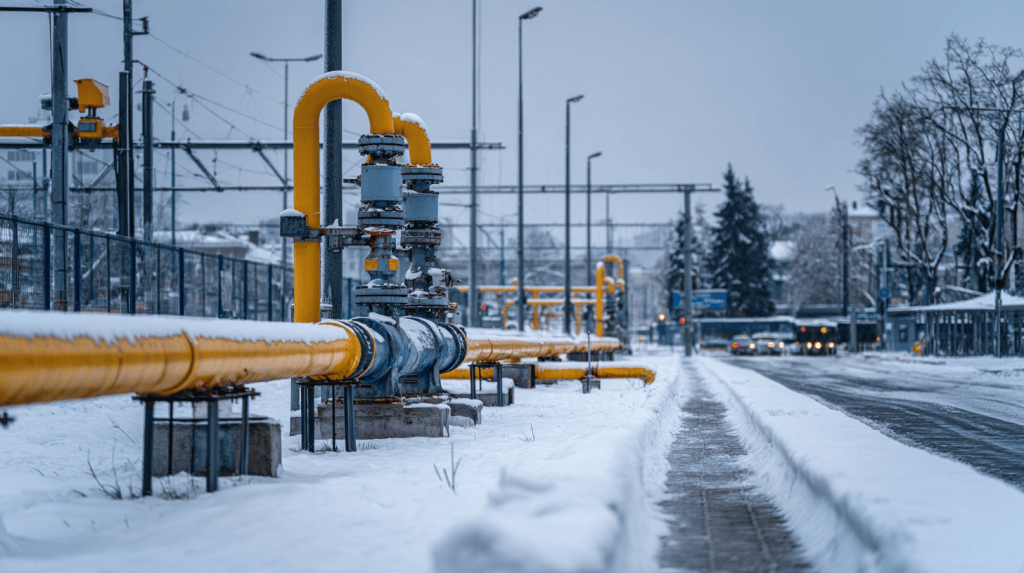
Europe gas prices have returned to €100 per megawatt-hour, raising concerns about household energy bills and industrial costs this winter. The Dutch TTF front-month contract briefly reached that threshold on October 28, its highest level since December 2022, as disrupted Middle Eastern liquefied natural gas shipments tightened supplies ahead of colder weather.
The increase does not mean household tariffs will immediately match wholesale prices. However, it signals renewed pressure on suppliers, businesses and consumers—particularly if cold weather coincides with weak wind generation and further shipping disruption.
Why Europe Gas Prices Are Rising
The immediate problem is restricted LNG availability. Disruption around the Strait of Hormuz has constrained cargoes from the Gulf, intensifying competition between European and Asian buyers. Unlike some crude exports, LNG depends on specialized ships rather than alternative pipelines that can bypass the chokepoint.
Europe’s increasing reliance on global LNG markets has made regional prices more sensitive to international demand, transport conditions and geopolitical shocks. The European Commission identifies this exposure as a structural change in how European gas prices are determined.
The €100 quotation was an intraday milestone, not necessarily the day’s settlement. ICE data cited by S&P Global subsequently showed the November contract at €100.425 per MWh at 15:03 GMT. Contract selection and timing matter when comparing reports.
Low Gas Storage Leaves Europe Exposed
EU gas storage stood at 74.9% of capacity on October 26, according to Gas Infrastructure Europe data cited by S&P Global. Reuters placed Germany’s storage near 60%, substantially below last year.
Those inventories provide a smaller cushion against unexpected demand. Rystad Energy analyst Mathieu Utting warned that Europe has fewer options to replace disrupted supply quickly. He said the continent’s LNG imports were 30% below their year-earlier level in the week ending October 9.
Cold weather could therefore trigger another price surge. Even a mild winter would not necessarily restore cheap gas: rebuilding depleted inventories could sustain competition for cargoes beyond the heating season.
Why Expensive Gas Can Push Electricity Prices Higher
Gas-fired plants still frequently determine European wholesale electricity prices. Under marginal pricing, the final generator needed to meet demand establishes the clearing price for that trading interval.
When wind and solar output fall, gas generation can become more important. Higher fuel costs then translate into expensive electricity during affected periods. This reflects weather-dependent output, not necessarily a decline in installed renewable capacity.
Renewables nevertheless reduce exposure overall. The Commission estimates that fossil fuels set electricity prices during roughly 50% of hours in 2025, compared with about 70% in 2020. Gas remains influential, but the relationship is no longer equally strong at every hour.
The supplied claims of October 29 electricity prices above €550/MWh across several countries could not be independently established from the retrieved evidence. Individual peak intervals should also not be confused with daily averages.
What €100 Gas Means for Household Bills
A wholesale gas price of €100/MWh equals €0.10 per kilowatt-hour before distribution, supplier charges and taxes. It is not a complete retail tariff.
Read also : Why European Navies Should Secure the Red Sea for Oil Supplies
The ECB explains that transmission depends on contract terms and national pricing arrangements. Flexible market-based tariffs adjust faster, while fixed-price contracts and regulated rates can delay changes. Wholesale increases therefore reach households unevenly across Europe.
Nor would a 50% wholesale increase necessarily produce a 50% rise in the entire bill. Energy procurement is only one component, alongside network charges, taxes and other costs. The Commission reports that electricity itself averaged nearly 49% of European household electricity bills in 2024.
Winter Outlook: Risk, Not Certainty
The central issue is vulnerability. Restricted LNG flows and comparatively low storage make Europe sensitive to cold spells and supply shocks. Another winter spike is possible, but neither its timing nor its effect on individual bills is predetermined. Weather, cargo availability and retail contracts will determine the outcome.
Our community already has nearly 345,000 readers!
Subscribe to our Telegram channel
Follow us on Telegram, Facebook and Twitter
© Copyright 2026 – Eurasia Business News. Article no. 3234

