
By Anthony Marcus for Eurasia Business News, September 19, 2026. Article n°3173
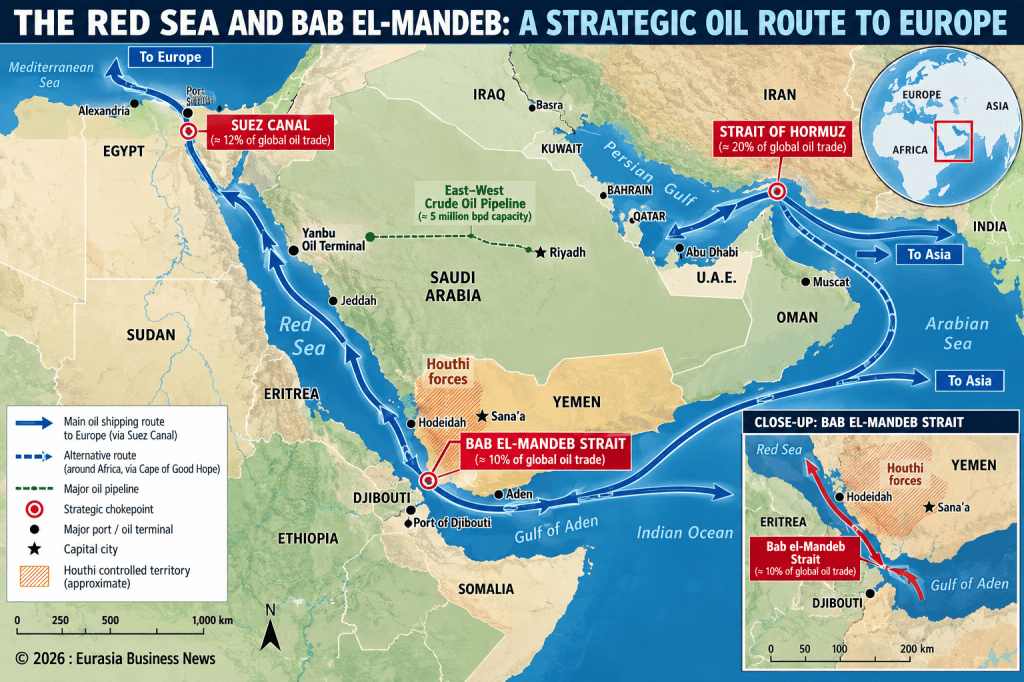
European navies should expand their role in securing the Red Sea because the route through the Bab el-Mandeb Strait and the Suez Canal is vital to Europe’s energy security, trade flows and inflation outlook. With oil shipments facing pressure around both the Strait of Hormuz and the Red Sea, protecting merchant vessels is no longer only a regional security task—it is an economic necessity for Europe.
The European Union’s naval mission, Operation Aspides, has already increased the alert status of its vessels as attacks and threats against commercial shipping intensified. Yet the scale of the risk argues for additional ships, stronger escort capacity, surveillance assets and sustained coordination among European naval forces and regional partners.
The Red Sea’s Energy Importance
The Bab el-Mandeb Strait links the Red Sea to the Gulf of Aden and the wider Indian Ocean. It is the southern gateway to the Suez Canal, the most direct maritime route connecting Europe with the Middle East and Asia.
For oil markets, this narrow waterway is a critical chokepoint. The U.S. Energy Information Administration estimates that about 9.3 million barrels per day of crude oil and petroleum products moved through Bab el-Mandeb in 2023. The route became even more important as disruption in the Strait of Hormuz forced exporters and tanker operators to seek alternatives.
A severe interruption at Bab el-Mandeb could force Europe-bound tankers to sail around the Cape of Good Hope. That diversion adds thousands of nautical miles, increases fuel consumption, ties up vessels for longer and raises freight and insurance costs. The impact ultimately reaches European consumers through higher prices for diesel, petrol, heating fuel and imported goods.
| Strategic route | Why it matters to Europe |
|---|---|
| Bab el-Mandeb Strait | Connects Middle East and Asian shipping with the Red Sea |
| Red Sea | Main sea route toward the Suez Canal |
| Suez Canal | Shortest maritime route linking Europe with Asian and Gulf markets |
| Cape of Good Hope | Costly alternative if Red Sea access is unsafe |
| Strait of Hormuz | Major Gulf oil chokepoint; disruption increases reliance on Red Sea routes |
Hormuz Makes Bab el-Mandeb More Critical
Europe faces a twin-chokepoint problem. The Strait of Hormuz is a vital exit route for Persian Gulf oil and liquefied natural gas, while Bab el-Mandeb is essential for vessels moving toward the Red Sea and Suez Canal.
When Hormuz traffic becomes constrained, Saudi Arabia and other regional exporters seek alternative options, including pipeline routes to Red Sea terminals such as Yanbu. But the security of those alternatives depends on ships being able to transit Bab el-Mandeb safely.
The recent disruption of Saudi Arabia’s East-West pipeline underscored the limits of relying on a single bypass route. If the Red Sea also becomes unsafe or inaccessible, exporters have fewer options to move crude to Europe and other global markets. This raises the risk of supply shortages and a sustained geopolitical risk premium in oil prices.
Oil flows through Bab el-Mandeb reportedly increased from an average of 5.4 million barrels per day in the fourth quarter of 2025 to 8.1 million barrels per day in the second quarter of 2026. That increase illustrates why protecting the route has become more urgent.
Inflation and Economic Security
European economies remain heavily dependent on imported energy. Higher oil and shipping costs quickly raise fuel prices, complicate central-bank policy and pressure household budgets.
The effects extend beyond filling stations. Marine fuel costs, insurance premiums and longer voyages raise the price of goods imported from Asia, including consumer products, machinery, industrial components and food. Manufacturers can also face higher logistics and input costs, weakening competitiveness at a time when European industry is already dealing with high energy prices.
Read also : The Million-Dollar Retirement Blueprint for U.S. citizens in 2026
Naval security can therefore help manage inflation risk. While warships cannot determine the global price of oil, credible escorts and stronger maritime surveillance can reduce the risk of successful attacks, lower insurance costs and encourage shipping companies to resume normal Red Sea transits.
Operation Aspides Needs More Assets
Operation Aspides was established by the European Union in 2024 as a defensive mission to protect commercial vessels from attacks in the Red Sea, Gulf of Aden and adjacent waters. The operation has provided escorts, monitored transit routes and assisted crews in distress.
Read also : Tax Management strategies for Digital Nomads
Its record demonstrates that naval protection can produce tangible results. European officials said Aspides has protected more than 720 merchant vessels, monitored over 2,300 transits and rescued 128 seafarers.
However, the mission’s capacity is constrained by the number of available frigates, destroyers, support ships, maritime patrol aircraft and surveillance systems. Italy, which currently holds the rotating command and is a major contributor, has called for more European naval support and considered independently escorting Italian merchant vessels because of delays in broader EU decision-making.
Read also : The Private Investor Deal Evaluation Handbook
European governments should avoid a fragmented approach in which each country protects only vessels flying its own flag. A coordinated European operation offers better coverage, shared intelligence, more efficient use of scarce naval assets and clearer rules of engagement.
A Defensive, Collective Mission
The purpose of a stronger European naval presence should be defensive: protect civilian sailors, preserve freedom of navigation and deter attacks on merchant shipping. It should not become an open-ended campaign of escalation.
A robust approach would include:
- More escort-capable warships and replenishment vessels.
- Continuous drone, satellite and maritime-patrol surveillance.
- Shared intelligence with Gulf states, Egypt, Djibouti and international partners.
- Faster convoy coordination for commercial vessels.
- Mine-countermeasure and rescue capabilities.
- Clear communication with shipping companies and insurers.
Securing the Red Sea is in Europe’s strategic interest because energy security, supply-chain resilience and economic stability depend on it. As threats to shipping grow, the cost of insufficient naval protection may increasingly be measured not only in maritime risk, but in higher oil prices and deeper economic disruption across Europe.
Our community already has nearly 330,000 readers!
Subscribe to our Telegram channel
Follow us on Telegram, Facebook and Twitter
© Copyright 2026 – Eurasia Business News. Article no. 3174

