
By Anthony Marcus for Eurasia Business News, September 19, 2026. Article n°3177
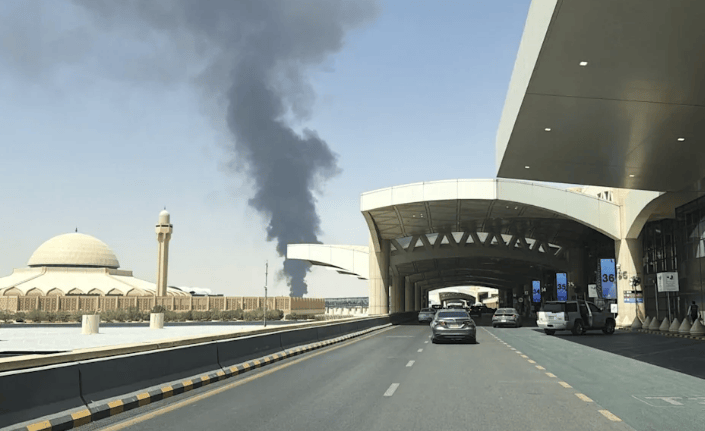
Yemen’s Houthi movement has claimed it carried out strikes against “sensitive sites” in Saudi Arabia’s capital, Riyadh, and against Saudi Aramco facilities in the Red Sea port city of Yanbu. The claim came after explosions were reported in Riyadh and a fuel-storage depot near King Khalid International Airport caught fire, sending a large plume of black smoke above the Saudi capital.
Saudi authorities issued an emergency warning of a “hostile aerial threat” over Riyadh before the incident, but had not publicly confirmed whether the fire at the airport-area fuel facility was directly caused by a Houthi missile or drone strike. The Houthis’ claims have not been independently verified.
Fire Reported at King Khalid Airport
Reuters photographs and video showed black smoke rising near Riyadh’s main airport on September 19, with airport access roads, terminal structures and nearby facilities visible in the foreground. Flames were seen behind what appeared to be fuel tanks.
An AFP journalist reported that firefighters extinguished a blaze involving a fuel tank bearing the logo of Saudi oil giant Aramco at a depot near King Khalid International Airport. The incident disrupted flight operations, and tracking service FlightRadar24 temporarily listed the airport at its maximum disruption level before traffic began to resume.
The cause of the fire has not been officially confirmed. Saudi authorities had earlier warned residents about possible danger in the capital, but did not immediately provide details about the nature of the threat, the extent of any damage or possible casualties.
Houthis Claim Two Operations
Houthi military spokesperson Yahya Saree said the group conducted two military operations using ballistic missiles, cruise missiles and drones. According to the statement, one operation targeted sites in Riyadh and the other targeted Aramco facilities in Yanbu.
The group described the Riyadh targets as “sensitive sites” but did not provide specific locations. Its assertion that it struck oil facilities at Yanbu is significant because the Red Sea port is a major Saudi crude-export hub and the terminus of the East-West Pipeline.
That pipeline has become strategically important because it provides a route for Saudi oil exports to bypass the Strait of Hormuz. It was damaged in earlier drone attacks and has been undergoing restoration, while Saudi Arabia has curtailed crude deliveries to several European refiners.
Escalation in Saudi-Houthi Conflict
The reported Riyadh attack represents a notable escalation in Houthi operations against Saudi territory. The group, which controls much of northern Yemen, has repeatedly used drones and missiles to target Saudi energy infrastructure, airports and shipping-related facilities.
The latest incident follows a widening regional crisis that has also disrupted maritime traffic through the Red Sea and Bab el-Mandeb Strait. Houthi threats to commercial shipping have forced some vessels to reroute around southern Africa, increasing transit times, freight rates and fuel costs.
Read also : Why European Navies Should Secure the Red Sea for Oil Supplies
The attacks are occurring while oil markets remain highly sensitive to risks surrounding Middle East production, pipelines and shipping routes. Brent crude has remained above $100 per barrel in recent weeks, reflecting a substantial geopolitical risk premium tied to concern about energy supply disruptions.
Impact on Aviation and Oil Markets
King Khalid International Airport is Saudi Arabia’s principal aviation hub for Riyadh. Disruption at the airport can affect domestic and international flights, cargo operations and the movement of workers linked to the kingdom’s energy industry.
Read also : The Private Investor Deal Evaluation Handbook
A fire at a jet-fuel depot also raises concerns about the resilience of Saudi Arabia’s energy and transport infrastructure. Even if damage is limited, attacks on fuel-storage facilities can create operational delays, increase insurance and security costs, and require authorities to review airport safety procedures.
The impact on oil markets will depend on whether the reported Yanbu strike caused verified damage to export infrastructure. Yanbu is especially important because Saudi Arabia has relied on Red Sea routes as an alternative to the Persian Gulf during periods of higher risk around Hormuz.
If operations at Yanbu or the East-West Pipeline are further disrupted, refiners in Europe and Asia may need to secure additional replacement crude in the spot market. This could add pressure to regional oil-price differentials and freight costs.
What Is Confirmed and What Is Not
Several facts are supported by reporting:
- Riyadh authorities issued an aerial-threat warning.
- Explosions and a large smoke plume were reported near King Khalid International Airport.
- Firefighters responded to a blaze at a fuel tank carrying the Aramco logo.
- The Houthis claimed attacks in Riyadh and Yanbu.
- Airport operations faced significant disruption before traffic began recovering.
However, Saudi officials had not publicly confirmed that the Houthis caused the airport-area fire, nor had they verified the claimed strike on Aramco facilities in Yanbu. The number of casualties, the full extent of damage and any impact on oil exports remained unclear.
Read also : Tax Management strategies for Digital Nomads
The episode nevertheless illustrates how the conflict is expanding from sea lanes and pipelines to aviation and fuel infrastructure. The next response from Saudi Arabia—and any verification of damage at Yanbu—will be closely watched by regional governments, airlines, shippers and global energy markets.
Our community already has nearly 330,000 readers!
Subscribe to our Telegram channel
Follow us on Telegram, Facebook and Twitter
© Copyright 2026 – Eurasia Business News. Article no. 3177

