
By John Meyer, consultant in business – Eurasia Business News, October 28, 2026. Article no. 3232
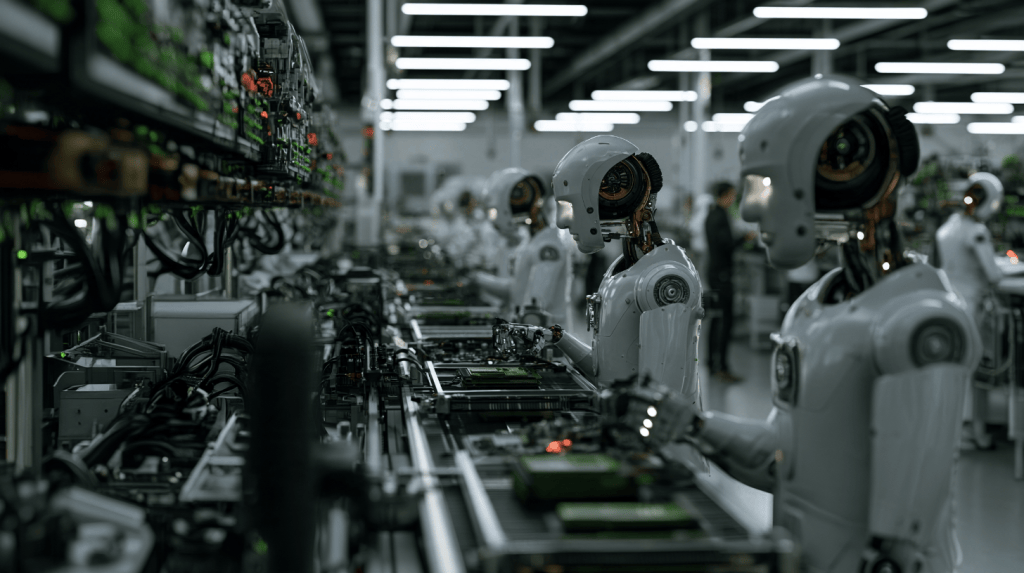
AI and robotics news in October 2026 has centred on a shift from spectacular demonstrations toward commercial scale. Anthropic filed for a major stock-market listing, Nvidia expanded its European investment strategy, and humanoid developers outlined plans for more capable machines and higher production. The challenge is separating confirmed developments from ambitious forecasts.
This roundup covers developments reported through October 27. Across software and robotics, the central question is increasingly practical: can companies turn impressive capabilities into reliable products, sustainable revenues and measurable productivity gains?
Anthropic Files for a Landmark AI IPO
Anthropic, the developer of Claude, filed for an initial public offering on October 26. The company plans to list on Nasdaq under the ticker “ANT,” with trading potentially beginning as early as November 16. That remains a proposed timetable rather than a guaranteed debut date.
The filing highlights rapid business expansion alongside substantial losses, infrastructure commitments and safety risks. Financial Times coverage identified approximately $800 billion in data-centre commitments, underscoring the scale of resources required to compete in advanced AI. Commitments should not be confused with money already spent.
For investors, the IPO could provide direct exposure to a major model developer. For customers, it raises questions about pricing, computing capacity and the relationship between commercial expansion and AI governance.
Nvidia Expands Its European AI and Robotics Network
Nvidia’s European push extended into Germany with planned investments in Agile Robots, Avelios Medical, Mirelo and Reflex Aerospace. Reporting described the commitments as part of nearly $10 billion directed toward European companies, universities and research institutions.
Agile Robots is especially relevant to physical AI. The Munich-based company develops robotic arms and its Agile ONE humanoid for applications including manufacturing and logistics. Its inclusion illustrates Nvidia’s effort to support businesses that connect AI computing with machines operating in real environments.
Germany followed earlier investment announcements involving French and British startups. Together, the initiatives suggest a European strategy spanning healthcare, industrial automation and other applications—not simply sales of chips.
Unitree Promotes “Self-Improving” Humanoid Robots
China’s Unitree attracted attention with plans for an AI system designed to help humanoid robots improve through simulations, feedback and automated development. Founder Wang Xingxing described the initiative as “Unitree Rehearsal.”
Wang also forecast that humanoids could complete 80% of tasks given through spoken instructions as early as 2028. That is a company leader’s projection, not a demonstrated benchmark across ordinary homes or workplaces.
The distinction matters. A robot learning efficiently in controlled settings is different from a machine safely handling unfamiliar objects, people and environments. October’s announcements indicate the direction of development, but do not establish that general-purpose autonomy has arrived.
Tesla and Figure Focus on Manufacturing Scale
Tesla reported that Optimus production had begun in Fremont, California. October reporting cited Elon Musk’s ambition to reach approximately 20,000 robots weekly by 2027, while noting that further engineering work would be required. The target should not be presented as current output.
Figure also reported progress toward its fourth-generation humanoid. According to October coverage, production of Figure 03 had reached four figures, though that does not establish how many units were deployed commercially or operating without assistance.
Read also : Gold : Build Your Wealth and Freedom
For both companies, manufacturing volume and useful autonomy are separate milestones. Producing more robots does not automatically prove that customers can operate them economically.
Hospitality Trials Offer a More Concrete Test
YYForce announced plans to deploy its first humanoid robot at Novotel Singapore on Stevens in early November. The company described the initiative as an evaluation of hospitality applications, not a completed rollout.
Such trials make reliability the decisive issue: robots must fit existing workflows and perform consistently. October’s strongest story is therefore not imminent human replacement, but the growing pressure to demonstrate practical value.
Our community already has nearly 345,000 readers!
Subscribe to our Telegram channel
Follow us on Telegram, Facebook and Twitter
© Copyright 2026 – Eurasia Business News. Article no. 3232

