
By William Collins, consultant in stock markets – Eurasia Business News, October 15, 2026. Article no 3210
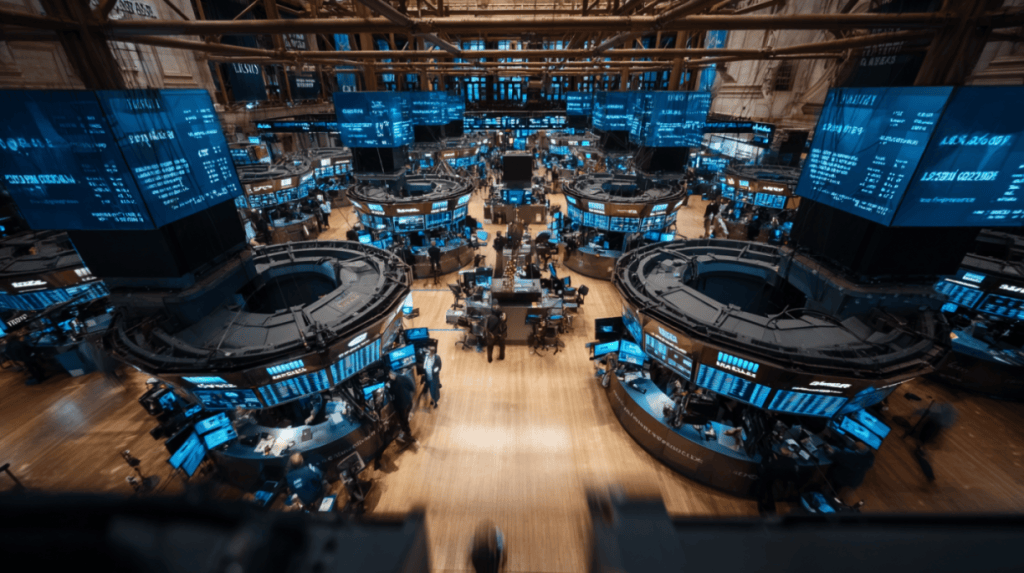
Investors shifted toward Treasury bonds and blue-chip stocks on Thursday, October 15, as concerns about artificial-intelligence valuations and financing costs kept technology shares under pressure.
The Dow Jones Industrial Average gained approximately 0.9% during the reported session, while the S&P 500 edged 0.1% higher and the Nasdaq Composite slipped 0.4%. Treasury yields fell sharply as investors sought relative safety.
The divergence highlighted a market rotating rather than selling indiscriminately. Strong AI-company results failed to restore confidence across technology, while consumer-related shares, healthcare and other established businesses attracted buyers. Gold also advanced, benefiting from lower yields and renewed demand for protection against market uncertainty.
Dow Gains While Technology Stocks Struggle
The Dow rose roughly 500 points at one stage, supported by Nike, Home Depot and Sherwin-Williams, according to the supplied market snapshot. Seven of the S&P 500’s 11 sectors traded higher, with healthcare leading and information technology posting the largest decline.
These figures describe intraday conditions, not confirmed closing results. Nevertheless, the pattern was clear: investors were reducing exposure to highly valued growth companies while increasing allocations to other parts of the market. Technology’s weakness persisted even as Treasury yields declined, showing that concerns extended beyond interest rates to valuations, debt and future returns on AI investment.
Anthropic and TSMC Results Fail to Reassure Investors
Anthropic reportedly generated approximately $16.8 billion in third-quarter revenue, up 45% from the previous quarter. The Claude developer presented the figures to prospective public-market investors as it prepared for a possible initial public offering. The report demonstrated substantial revenue growth, although it did not settle questions about the wider industry’s investment requirements.
Taiwan Semiconductor Manufacturing Company also reported record quarterly profit, its sixth consecutive record quarter. Yet its U.S.-listed shares fell approximately 2.5% in reported trading, illustrating how even strong earnings struggled to overcome changing sentiment.
TSMC maintained its 2026 capital-expenditure plan of $60 billion to $64 billion. For investors, that spending illustrates both the scale of demand and the capital intensity of expanding AI infrastructure. Strong sales alone do not establish how quickly every participant will earn attractive returns.
CoreWeave Recovers From Early Losses
CoreWeave initially fell as much as 9.5%, according to the supplied update, before recovering after Nvidia chief executive Jensen Huang said its “strength is improving every day.”
The rebound followed heavy selling in both its shares and debt. Earlier reporting showed the stock extending Wednesday’s roughly 15% decline, reflecting concern about financing the construction of AI data centers.
CoreWeave’s experience captures an important distinction: declining Treasury yields do not automatically lower borrowing costs for every company. Investors can demand a larger credit premium from highly leveraged businesses even while buying government bonds. Funding access therefore remains central to the AI-infrastructure debate.
Treasury Yields Fall Despite Hot Inflation
The benchmark 10-year Treasury yield fell approximately nine basis points to 5.09%, its lowest level in three weeks. Investors’ demand for bonds outweighed an unexpectedly strong producer-inflation report.
September’s producer price index for final demand rose 1.3% month over month, exceeding expectations for 0.5%. August’s increase was revised to 0.5% from 0.4%, reinforcing concerns about persistent wholesale-price pressure.
Consumer spending also remained resilient. September retail sales increased 0.8% to $745 billion, comfortably above the 0.3% consensus forecast. These are nominal sales figures, however, so the increase should not be interpreted entirely as stronger purchasing volumes.
The combination complicates the Federal Reserve outlook. Strong spending and inflation favour restrictive policy, while falling bond yields reveal investors’ growing concern about financial-market risks.
Oil Prices and Gold on October 15
Early Asian trading quotations supplied for Thursday placed Brent crude near $106.26 a barrel and West Texas Intermediate near $94.66. These are not settlement prices; they indicate that energy costs remained elevated despite an early pullback.
Read also : Gold : Build Your Wealth and Freedom
Gold moved higher. Spot gold was at $4,156.52 per troy ounce at 9:30 a.m. Eastern time, up 1.3%. December gold futures rose 1.7% to $4,177.80. Lower Treasury yields and a weaker dollar helped bullion recover after three losing sessions.
The recovery marked a change in direction following the recent decline. Both spot prices and futures moved higher, with the December contract recording the larger percentage increase at the reported time.
Lower Treasury yields and dollar weakness provided a more supportive backdrop for gold, helping the precious metal regain ground. However, these quotations represent a morning snapshot rather than the session’s final closing prices.
A Narrow Rally Hides Broader Weakness
The Kobeissi Letter estimated that 84% of S&P 500 constituents were at least 10% below their individual record highs. That measures distance from different historical peaks, not simultaneous declines over one common period.
Calling this a “quiet bear market” is an interpretation, not a formal index classification. The underlying message is concentration: headline benchmarks can remain resilient while many shares struggle. Thursday’s rotation tested whether broader participation could offset technology weakness without requiring the entire market to fall.
Our community already has nearly 355,000 readers!
Subscribe to our Telegram channel
Follow us on Telegram, Facebook and Twitter
© Copyright 2026 – Eurasia Business News. Article no. 3210

