
By Swann Collins, investor, writer and consultant in international affairs – Eurasia Business News, April 27, 2026. Article no. 2091
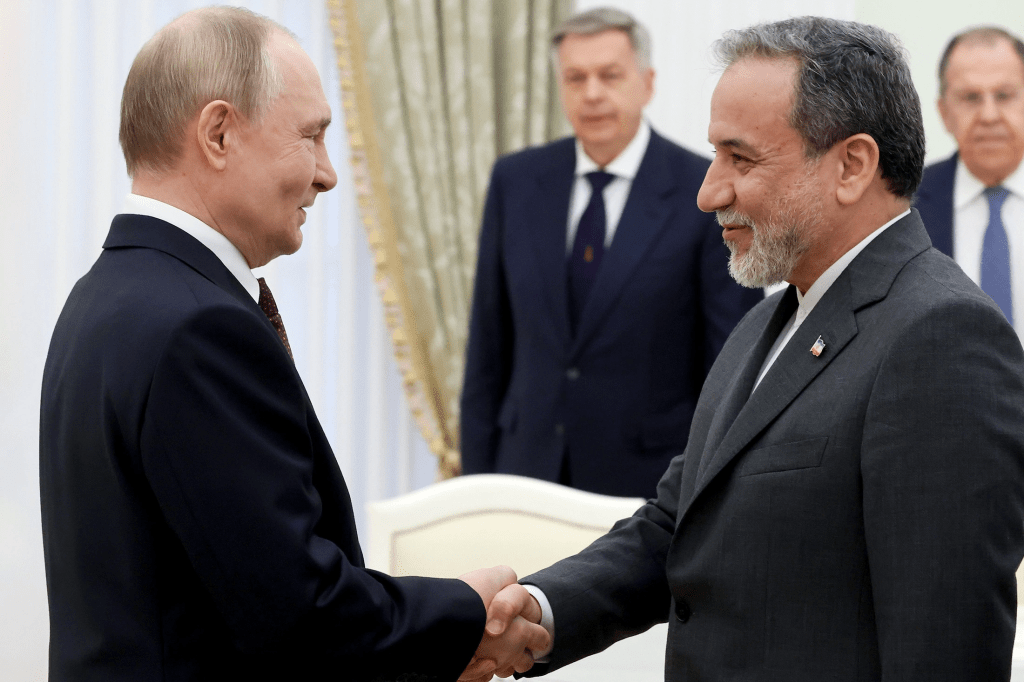
The Russian President Vladimir Putin held talks with Iranian Foreign Minister Abbas Araghchi in St. Petersburg on April 27. This is the first meeting between a senior Iranian official and the Russian president since the start of the war between Israel and the United States with Iran on February 28.
On January 30, Putin had met with the Secretary of the Supreme National Security Council of Iran, Ali Larijani, in Moscow. He was then killed in an Israeli strike on the night of March 16-17. At the beginning of the meeting, Araghchi promised to inform Putin about the events that have taken place in Iran over the past month.
Putin’s meeting with Araghchi took place at the Presidential Library in St. Petersburg. The president said he received a message from Iran’s Supreme Leader Mojtaba Khamenei last week. He asked Araghchi to convey to the ayatollah words of gratitude for the message and confirm that Russia intends to continue strategic relations with Iran. “We see how courageously and heroically the people of Iran are fighting for their independence, for their sovereignty,” Putin said, expressing hope that the Iranian people will go through a difficult period of trials and peace will come.
The Russian president said that “Russia will do everything that meets the interests of Iran and other peoples of the region to ensure that peace in the Middle East is achieved as soon as possible”.
Araghchi, in turn, thanked Putin for his words of condolences in connection with the death of Ayatollah Ali Khamenei and for congratulating him on the election of the new leader of Iran. According to Araghchi, the Iranian leadership asked him during the trip to confirm that Iranian-Russian relations mean a strategic partnership for the country at the highest level and will continue to be so. “It has been proven to the whole world that the Iranian people, with their resistance and courage, were able to resist American attacks and American aggression and will withstand this period of time. And it has also been proven to everyone that Iran has such friends and allies as the Russian Federation, who stand by Iran in difficult moments,” the Iranian Foreign Minister said. Then the negotiations continued behind closed doors, they lasted about two hours.
From the Russian side, the meeting was attended by Foreign Minister Sergei Lavrov, presidential aide Yuri Ushakov and head of the Main Directorate of the General Staff of the Russian Armed Forces Igor Kostyukov.
Read also : The Real Reason Global Conflict Risk Is Rising
The conflict between the United States and Israel with Iran began on February 28, 2026 After the outbreak of hostilities in the Middle East, Putin spoke on the phone several times with Iranian President Masoud Pezeschkian. However, the current visit of Araghchi is the first visit of a high-ranking Iranian official to the Russian Federation. “There is a chance to discuss with our Russian friends the events related to the war that have taken place during this time, and the current situation, as well as to once again consider the state of affairs. Naturally, it is also necessary to carry out appropriate coordination of actions,” Araghchi said upon arrival in Russia.
In addition to Russia, Araghchi visited Pakistan and Oman. IRNA reported that the purpose of the visits is to hold bilateral consultations and discuss the latest developments in the region. In addition, there were expectations that Araghchi would meet with American representatives Steve Whitkoff and Jared Kushner in Pakistan, but American President Donald Trump canceled their trip to Islamabad. In Oman, Araghchi met with Sultan Haytham bin Tariq, discussing the efforts of mediators to end the conflict in the Middle East.
Read also : The Private Investor Deal Evaluation Handbook
The outbreak of a new war involving Iran in March 2026 further underscores this trend. Triggered by escalating confrontations between Iran and regional adversaries—particularly Israel—and involving indirect U.S. military engagement, the conflict has rapidly expanded beyond proxy dynamics into direct interstate confrontation. Strikes on strategic infrastructure, maritime disruptions in the Persian Gulf, and heightened risks around the Strait of Hormuz have introduced significant volatility into global energy markets. More importantly, the conflict illustrates how regional rivalries are increasingly embedded within broader great-power competition, with external actors providing diplomatic, logistical, or military support. The Middle East, long characterized by proxy warfare, is thus re-emerging as a theater of direct strategic confrontation with global implications.
Our community already has nearly 245,000 readers!
Subscribe to our Telegram channel
Follow us on Telegram, Facebook and Twitter
© Copyright 2026 – Eurasia Business News. Article no. 2091

