
By Anthony Marcus, correspondent. Eurasia Business News, August 9, 2026. Article n°3068
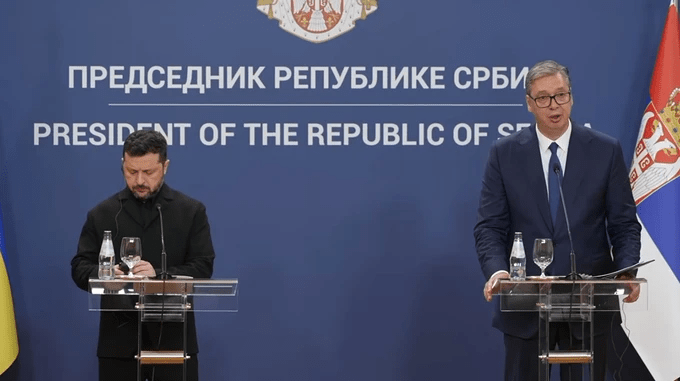
Serbia has promised to support Ukraine’s efforts to join the European Union as quickly as possible, marking a significant diplomatic development in relations between Belgrade and Kyiv. Serbian President Aleksandar Vučić made the commitment during a joint press conference with Ukrainian President Volodymyr Zelensky in Belgrade on August 8.
Vučić said Serbia wanted Ukraine to open and close all EU accession negotiation clusters as soon as possible. He added that Belgrade would do everything within its power to help Ukraine advance on its European path.
Vučić Backs Ukraine’s EU Membership Bid
“Ukraine will always have our support on its path to the EU,” Vučić said, according to reports of the press conference. He stressed that Serbia would not oppose Ukraine’s progress or attempt to place its own accession ambitions ahead of Kyiv’s application.
The Serbian president’s statement is notable because Belgrade has traditionally maintained close political, economic and cultural ties with Russia. Serbia has not joined Western sanctions against Moscow, even though it formally supports Ukraine’s territorial integrity. At the same time, Serbia remains an EU candidate country and has repeatedly declared membership in the bloc to be its strategic objective.
This balancing policy has allowed Vučić to preserve relations with Russia while seeking closer cooperation with European institutions. His support for Ukraine’s EU accession could therefore help strengthen Serbia’s image in Brussels, particularly as the European Union continues to assess Belgrade’s commitment to democratic reforms, foreign-policy alignment and regional stability.
Ukraine and Serbia Share a European Goal
Serbia received EU candidate status in 2012, while formal accession negotiations began in 2014. However, Serbia’s membership process has progressed slowly, with disagreements over the rule of law, media freedom, institutional reforms and its relationship with Kosovo affecting the talks.
Ukraine formally applied for EU membership shortly after the outbreak of the war on February 22, 2022 with Russia. The European Union granted Kyiv candidate status later that year and subsequently opened formal accession negotiations. Ukraine must now complete reforms across a range of policy areas, commonly organised into negotiation clusters covering the judiciary, public administration, economic governance, competition, agriculture, environmental standards and foreign policy.
Vučić’s promise to support Ukraine is therefore likely to focus on sharing Serbia’s experience of the accession process, facilitating technical exchanges and backing Kyiv’s progress in European institutions. Serbian officials have previously discussed cooperation with Ukraine on European integration, including a memorandum intended to institutionalise collaboration between the two countries.
A Diplomatic Shift in Belgrade
Zelensky’s visit to Serbia is politically significant because it is his first official visit to the country since the beginning of the war with Russia on February 22, 2022. Serbia has maintained friendly ties with Moscow, and Belgrade has been cautious in publicly criticising Russia.
The meeting with Vučić indicates that Serbia is seeking a more active relationship with Kyiv. The two leaders discussed European integration, economic cooperation, security and bilateral relations. They also expressed an interest in increasing trade and completing a free-trade agreement by the end of the year.
For Ukraine, Serbian support is valuable because it demonstrates that Kyiv’s European ambitions can receive backing even from countries that maintain close relations with Russia. For Serbia, the initiative may provide an opportunity to present itself as a constructive regional actor capable of communicating with both Eastern and Western partners.
Serbia’s Limits on Russia Policy
Despite supporting Ukraine’s EU aspirations, Vučić stopped short of promising that Serbia would impose sanctions on Russia. Belgrade continues to depend on Russian energy and retains political connections with Moscow. This means Serbia’s support for Ukraine is likely to remain focused on European integration, humanitarian assistance, economic cooperation and diplomatic engagement rather than military alignment with Kyiv.
Serbia has provided Ukraine with non-military aid since the beginning of the war, including financial, humanitarian and energy assistance. Reuters reported that Serbian support had reached approximately €60 million, while Belgrade avoided signing declarations calling for additional military assistance or stronger sanctions against Russia.
What Serbia’s Promise Means
Serbia’s pledge to support Ukraine’s EU accession does not guarantee a faster membership timetable. Every EU member state must approve key stages of the accession process, and Ukraine still faces extensive legal and institutional reforms.
Nevertheless, Vučić’s statement carries political weight. It places Serbia publicly behind Ukraine’s European future and suggests that Belgrade does not view the two countries’ accession bids as competing priorities. The decision could also encourage greater Serbia-Ukraine cooperation in trade, infrastructure, energy and postwar reconstruction.
For Kyiv, the message reinforces its diplomatic campaign to build support across Europe. For Belgrade, it represents an attempt to balance relations with Russia while demonstrating that Serbia remains committed to its own European path. As Ukraine’s EU negotiations advance, Serbia’s promised assistance may become an important test of whether its diplomatic support translates into practical cooperation.
Since February 2022, Serbia has pursued a carefully balanced foreign policy between Kyiv, Moscow and the European Union. Belgrade has formally supported Ukraine’s territorial integrity and voted for several United Nations resolutions condemning Russia’s aggression, but it has refused to impose Western sanctions on Moscow. This combination has made Serbia one of Europe’s most distinctive diplomatic actors during the war.
Read also : Tax Management strategies for Digital Nomads
At the beginning of the war, Serbian President Aleksandar Vučić said Russia’s violation of Ukraine’s territorial integrity was wrong and contrary to international law. However, he also argued that Serbia would not join sanctions against Moscow because of its national interests, historical ties and previous experience with international sanctions.
Serbia’s policy is shaped by competing strategic interests. Russia remains an important political, energy and cultural partner, while the European Union is Serbia’s largest economic partner and the country’s declared long-term destination. Belgrade is also an EU candidate country, which means its relationship with Moscow is increasingly scrutinised by Brussels.
Our community already has nearly 300,000 readers!
Subscribe to our Telegram channel
Follow us on Telegram, Facebook and Twitter
© Copyright 2026 – Eurasia Business News. Article no. 3067

