
By William Collins, consultant in stock markets – Eurasia Business News, August 18, 2026. Article no 3099
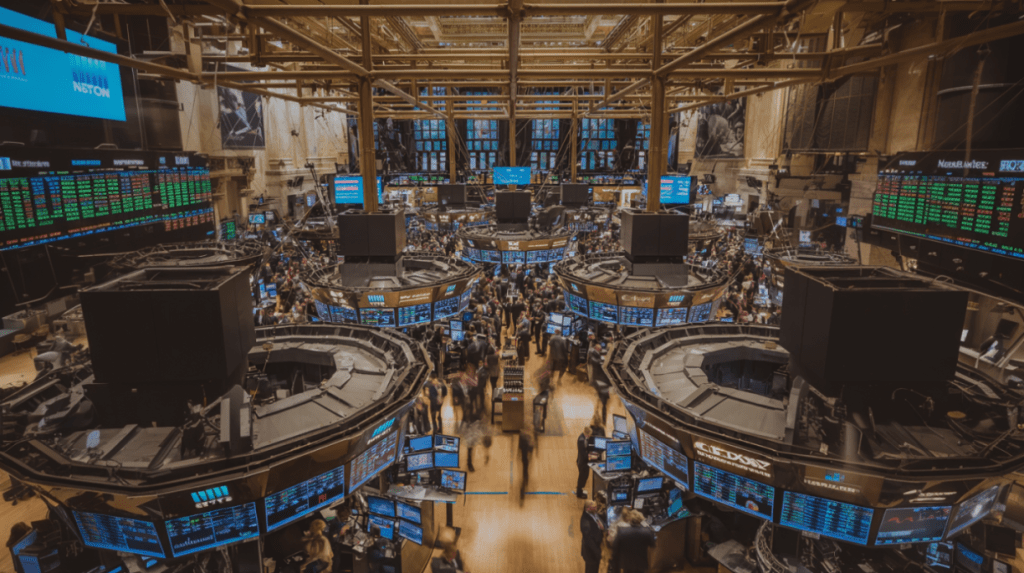
US equity markets traded lower on Tuesday as rising long-term borrowing costs, higher oil prices and renewed Middle East tensions weighed on investor sentiment. The technology sector led the decline, while healthcare stocks provided limited support across the S&P 500.
The Dow Jones Industrial Average fell 0.2% in late trading, while the S&P 500 declined 0.6%. The Nasdaq Composite dropped 1.8%, reflecting significant weakness in semiconductor and AI-linked shares. Seven of the S&P 500’s 11 major sectors traded higher, led by healthcare, but information technology was the day’s weakest group.
Technology and Chip Stocks Sell Off
Semiconductor stocks came under intense pressure as rising bond yields made high-valued growth companies less attractive. The PHLX Semiconductor Index fell more than 5%, while Intel, Marvell Technology, Arm Holdings, Coherent and Teradyne each declined 7% or more.
The sell-off illustrates the market’s vulnerability to a rise in long-term interest rates. Technology companies often trade on expectations of earnings many years in the future. When bond yields rise, investors apply a higher discount rate to those projected cash flows, reducing the present value of future profits.
AI-related companies face another challenge: the enormous capital expenditure required to build data centres, acquire advanced chips and secure power capacity. Large technology groups are increasingly using debt markets to finance AI infrastructure, creating competition for capital with governments and other borrowers.
US Treasury Yields Reach Multi-Year Highs
The 30-year US Treasury yield hovered near 5.3% after reaching a 19-year intraday high. It traded as high as 5.34%, its highest level since 2007. The 10-year Treasury yield rose to around 4.74%.
The increase in borrowing costs is not limited to the United States. Japan’s 30-year government-bond yield moved close to a record high, while long-dated yields in France, Germany and the United Kingdom also rose toward multi-year peaks.
Investors are demanding higher returns to buy government debt because of persistent inflation concerns, expanding fiscal deficits and record borrowing needs. US Treasury auctions have continued to find buyers, but only at higher yields. A recent 10-year Treasury auction cleared at 4.683%, the highest yield in 19 years, while a 30-year auction cleared at 5.216%, a 25-year high.
Trump Rules Out Iran Talks
Market uncertainty increased after President Donald Trump said no talks with Iran were underway or planned. In a Truth Social post, Trump dismissed speculation that Washington and Tehran were approaching a near-term agreement.
The comments came after a 60-day US-Iran truce expired with little evidence of progress toward a permanent settlement. An unidentified projectile reportedly struck a cargo ship in the Strait of Hormuz overnight, according to the British navy’s maritime-security monitoring agency.
The Strait of Hormuz is one of the world’s most important energy transit routes. Before the war, it carried roughly one-fifth of global oil supplies. Disruptions to tanker traffic raise concerns over crude availability and increase the geopolitical risk premium embedded in energy prices.
Oil Prices Rise Above $91
Brent crude traded near $91.32 per barrel, while West Texas Intermediate crude reached approximately $84.25. Higher oil prices are adding to investor concerns because they can increase transport, manufacturing and household fuel costs.
Persistent energy inflation could complicate the Federal Reserve’s efforts to manage price stability. If oil prices stay elevated, the central bank may find it harder to ease monetary policy, even if broader consumer demand slows.
Energy stocks benefited from the rise in crude, but the broader market reaction remained negative as investors focused on the impact of higher energy costs on consumer spending and corporate margins.
Outlook for US Equities
The combination of rising Treasury yields, high oil prices and geopolitical uncertainty has created a difficult environment for equity markets. Technology and semiconductor stocks are especially exposed because of their high valuations and growing dependence on debt-financed AI investment.
Read also : The Million-Dollar Retirement Blueprint for U.S. citizens in 2026
Investors will now monitor whether long-term yields stabilise above 5%, whether the US-Iran conflict escalates further and whether oil prices remain near $90 per barrel. Until those risks ease, US equities may continue to face pressure—particularly in AI, semiconductors and other rate-sensitive growth sectors.
Gold price falls
The combination of rising Treasury yields, high oil prices and geopolitical uncertainty has created a difficult environment for equity markets. Technology and semiconductor stocks are especially exposed because of their high valuations and growing dependence on debt-financed AI investment.
Read also : Gold : Build Your Wealth and Freedom
Investors will now monitor whether long-term yields stabilise above 5%, whether the US-Iran conflict escalates further and whether oil prices remain near $90 per barrel. Until those risks ease, US equities may continue to face pressure—particularly in AI, semiconductors and other rate-sensitive growth sectors.
Read also : Tax Management strategies for Digital Nomads
Gold prices declined sharply on August 18, with spot gold trading near $4,359.70 per ounce in New York afternoon dealings, down $56.40, or 1.28%. The bid stood at $4,359.30, while the ask was $4,361.30. Gold traded within a daily range of $4,351.50 to $4,436.80. Investors sold some of their gold on the market to get cash amid increased tensions over Iran and Hormuz straits.
The metal was down 1.09% over three days and 0.65% over seven days, but remained up 8.52% over 30 days and 30.76% over one year.
Stocks to Watch on August 19
Investors may focus on:
Energy, healthcare, home-improvement and selective semiconductor stocks—while treating richly valued AI names as high-volatility trading opportunities rather than broad market leaders. The key market variables remain Brent crude near $91, the 30-year Treasury yield near 5.3%, and any new development in the US-Iran conflict.
Energy is the clearest near-term momentum trade. Brent crude near $91 and WTI above $84 reflect a renewed geopolitical risk premium. Integrated majors such as Exxon and Chevron may offer more balance-sheet resilience than smaller exploration companies, while service providers such as Schlumberger and Halliburton offer higher sensitivity to sustained spending on drilling and production.investopedia+1
Healthcare is the principal defensive sector to monitor. If long-term yields keep rising and technology remains under pressure, large pharmaceutical and managed-care names may continue attracting capital because their earnings tend to be less dependent on the economic cycle.
Our community already has nearly 320,000 readers!
Subscribe to our Telegram channel
Follow us on Telegram, Facebook and Twitter
© Copyright 2026 – Eurasia Business News. Article no. 3099

