
By Alexander Miller, consultant in energy markets. – Eurasia Business News, August 30, 2026. Article no 3129
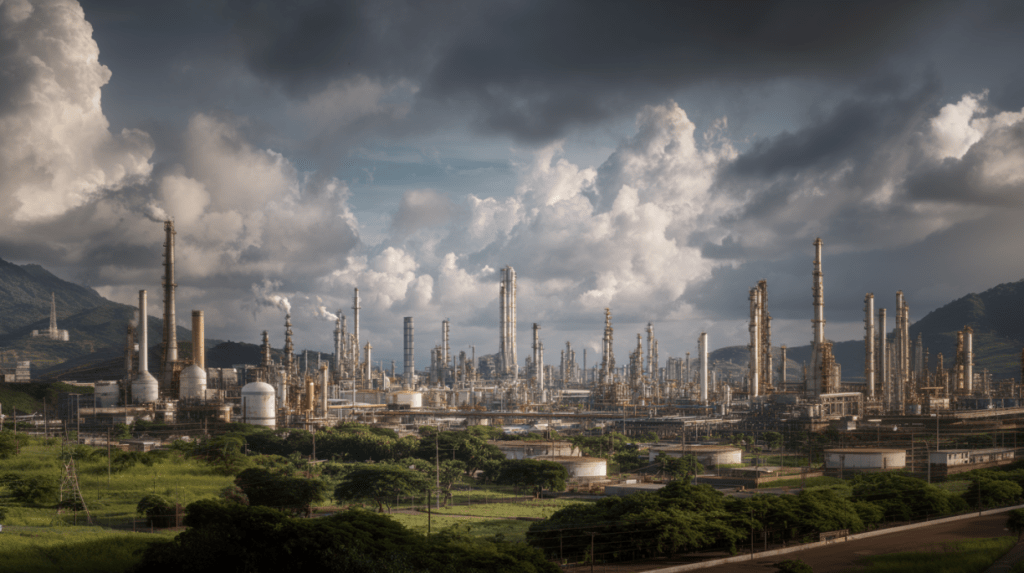
Venezuela’s interim President Delcy Rodríguez says a new energy agreement with the United States will run for 25 years, cover development of 17 strategic oilfields and aim to lift crude production above 1.5 million barrels per day. Rodríguez described the arrangement as a “historic” bilateral project that would bring U.S. capital and technology into Venezuela’s energy sector while preserving Venezuelan ownership of its natural resources.
The announcement provides the first detailed Venezuelan account of the agreement, which President Donald Trump previously described as giving the United States majority control over more than 65 billion barrels of Venezuela’s proven oil reserves. The publicly available details remain limited, and neither government has released the full legal text of the deal.
25-Year Venezuela-U.S. Oil Agreement
Rodríguez said the energy agreement establishes a 25-year framework for cooperation between Venezuela and the United States. It targets the development of 17 existing oilfields and carries an initial crude-production goal of more than 1.5 million barrels per day.
“This 25-year bilateral project envisages the development of 17 strategic oilfields with a production target of more than 1.5 million barrels per day,” Rodríguez said in a televised address. She stressed that the production objective relates specifically to the U.S.-Venezuela agreement, rather than Venezuela’s total national oil output.
The plan also includes development of eight additional greenfield blocks—areas not yet producing oil—as part of a longer-term effort to expand Venezuela’s energy industry. The initial 1.5 million-barrel-per-day target is therefore only one element of a broader programme to restore production capacity.
Venezuela’s oil industry has been weakened by years of underinvestment, operational challenges, sanctions, infrastructure deterioration and the loss of technical expertise. Reviving output will require significant capital spending, specialised equipment, diluent supplies, export infrastructure and reliable access to international markets.
U.S. Capital and Technology, Venezuela Keeps Ownership
Rodríguez said the agreement is based on a division of responsibilities. Venezuela will contribute its oil resources, existing industrial assets and the experience of its workforce. The United States, she said, will provide capital, technology and operational expertise.
“The agreement is based on a very simple premise: each party contributes what it does best,” Rodríguez said. In return, Venezuela expects greater production, new employment, infrastructure investment, higher public revenue and benefits for domestic industries.
The Venezuelan government has been careful to distinguish between ownership of oil reserves and foreign participation in their development. Rodríguez said Venezuela will retain ownership of its natural resources and sovereignty over its petroleum sector, even while granting U.S.-linked companies a major role in field operations.
That distinction matters. A foreign company can receive operating rights, production-sharing rights or long-term concessions without becoming the legal owner of underground petroleum reserves. Full agreement terms—including ownership structures, revenue sharing, operational control and dispute-resolution provisions—have not been publicly disclosed.
65 Billion Barrels and Revenue Claims
Trump said the United States had obtained majority control of more than 65 billion barrels of Venezuela’s proven oil reserves through a private-sector partnership. Venezuela holds approximately 303 billion barrels of proven reserves, the world’s largest total. The 65-billion-barrel figure represents roughly 21% of that national reserve base.
Rodríguez said Venezuela would receive $19 for each barrel produced and sold to the United States under the project. She estimated the arrangement could generate as much as $209 billion annually for Venezuela, using a benchmark oil price of $65 per barrel. That estimate is dependent on production volumes, oil prices, costs, contractual terms and the pace at which the fields are developed.
The $19-per-barrel figure suggests a substantial revenue stream, but it should not be treated as a guaranteed annual result. Oil markets can move sharply, heavy Venezuelan crude can trade at discounts to benchmark prices and large-scale field redevelopment requires major upfront investment.
Strategic Petroleum Reserve Link
Trump said Venezuelan oil from the new agreement would be used to replenish the U.S. Strategic Petroleum Reserve, which has been drawn down in recent years during periods of high fuel prices and global supply disruption. He said the replenishment process would begin shortly.
The SPR contains crude oil held for emergency use. Venezuelan heavy crude could be suited to certain U.S. Gulf Coast refineries configured to process heavier grades, although the practical use of any oil delivered under the agreement will depend on logistics, refinery demand and final commercial terms.
Read also : The Private Investor Deal Evaluation Handbook
For Washington, deeper involvement in Venezuelan oil could provide an additional source of heavy crude while potentially supporting energy security. It could also offer a way to offset supply risks arising from geopolitical tensions in other oil-producing regions.
The deal does not occur in a vacuum. It follows a January 2026 U.S. military operation that resulted in Nicolás Maduro’s capture and his transfer to New York to face narco-trafficking charges. The Trump administration has since assumed de facto control over Venezuelan oil export revenues, channelling them through a tightly managed distribution framework.
Risks and Next Steps
The agreement faces significant execution risks. Venezuela will need to reassure investors that contracts, operations and revenue payments will remain secure over a 25-year period. U.S. companies will require clarity on sanctions, licences, legal protections and the ability to repatriate profits.
Read also : The Million-Dollar Retirement Blueprint for U.S. citizens in 2026
Political risk is also considerable. Venezuela’s interim political situation, the future of U.S. policy and uncertainty over the terms of the agreement could all affect its durability. Environmental, labour and infrastructure challenges may also slow development.
Nevertheless, the proposed 25-year U.S.-Venezuela energy partnership represents a potentially major shift for Venezuelan oil production. If substantial capital and technology are deployed, the agreement could help restore output, generate export revenue and alter oil-trade flows across the Americas.
Venezuela has the world’s largest proven crude oil reserves, at roughly 303 billion barrels, equal to about 17–20% of global reserves. These reserves are largely extra‑heavy crude concentrated in the Orinoco Belt, which makes extraction and processing more complex and capital‑intensive than many Middle Eastern light crudes. However, the U.S. oil extraction companies have the technology and the funds to extract this extra‑heavy crude.
Read also : Gold : Build Your Wealth and Freedom
Venezuela is currently producing on the order of about 1 million barrels of oil per day, which translates to roughly 365 million barrels per year when annualized. This is only a fraction of its historical output of more than 3 million barrels per day in the 1990s and early 2000s.
Our community already has nearly 320,000 readers!
Subscribe to our Telegram channel
Follow us on Telegram, Facebook and Twitter
© Copyright 2026 – Eurasia Business News. Article no. 3129

