
By William Collins, consultant in stock markets – Eurasia Business News, September 14, 2026. Article no 3161
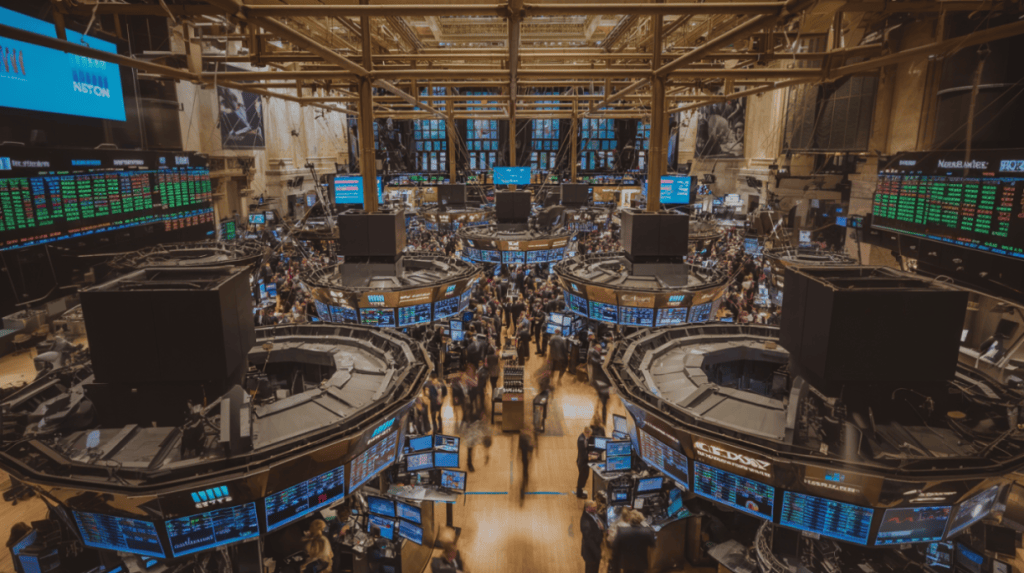
The 10-year U.S. Treasury yield briefly climbed above 5% on Monday, September 14, 2026, as a renewed surge in oil prices intensified concerns about inflation and Federal Reserve policy. At the same time, technology and semiconductor stocks fell sharply after executives at leading artificial-intelligence companies called for a slower pace of AI development because of safety risks.
The benchmark 10-year Treasury yield reached 5.012% in morning trading, its highest intraday level since October 2023, before retreating and closing at 4.96%. The move marked a major psychological threshold for financial markets because the 10-year Treasury yield influences borrowing costs for mortgages, corporate debt and consumer loans.
Bond Yields Rise as Oil Nears $110
Investors have been selling longer-dated U.S. government bonds for several weeks as higher oil prices increased the possibility that inflation could remain elevated. Brent crude futures approached $110 a barrel after Saudi Arabia shut down its strategic East-West pipeline following drone attacks.
Brent eventually settled 1% higher at $105.68 a barrel. The international benchmark has gained roughly 9% since the latest escalation in the Middle East, increasing concern that disrupted energy routes could remove significant volumes from the global market.
The East-West pipeline is a critical alternative to the Strait of Hormuz. It transports crude from Saudi Arabia’s eastern oil fields to Yanbu on the Red Sea, allowing the kingdom to continue exports without sending all cargoes through the contested Gulf waterway.
The pipeline’s closure after a drone attack has created uncertainty over future loadings at Yanbu, Saudi Arabia’s major Red Sea export port, and raised fresh concerns about global oil supplies.
For investors, the oil shock creates a difficult policy problem. Higher crude prices raise costs for households and companies, while stronger inflation expectations can delay interest-rate cuts or encourage central banks to tighten policy further. That combination is especially negative for longer-term bonds, whose prices fall when yields rise.
The 10-year yield later eased below 5% as higher returns attracted buyers and oil prices moved modestly off their highs. However, the brief break above the threshold underscored the growing pressure on U.S. borrowing costs. The yield has exceeded 5% only once since 2007, making Monday’s move particularly significant.
Wall Street Declines as AI Safety Concerns Spread
U.S. stocks ended lower as investors reassessed the outlook for the artificial-intelligence sector. The Nasdaq Composite fell 0.6%, the S&P 500 declined 0.5% and the Dow Jones Industrial Average lost 0.3%.
The PHLX Semiconductor Index dropped 5.9%, cutting its 2026 gain to 57%. Nvidia fell 3.4%, while Micron Technology declined more than 5%. Broadcom and Advanced Micro Devices each lost more than 4%.
The selling followed warnings from executives at major AI companies that the industry should slow the development of increasingly powerful models. Anthropic Chief Executive Dario Amodei argued that companies need more time to address safety and misuse risks. OpenAI Chief Executive Sam Altman and other technology leaders also supported a more cautious approach.
Bank of America (BAC) was trading lower after CEO Brian Moynihan said the lender’s quarterly sales and trading revenue would be “flat” year-over-year. Shares were down 5.29% to $59.38 in premarket trading on Monday.
The comments unsettled investors because the market has priced in a rapid expansion of AI computing demand. Semiconductor companies have benefited from expectations for continuous growth in advanced processors, memory chips, networking equipment and data-center infrastructure.
A slower pace of AI model development does not necessarily eliminate long-term demand, but it may delay spending plans and make future revenue forecasts less certain. That was enough to trigger a broad selloff in high-valuation chip stocks.
Gold Falls Despite Middle East Tensions
Gold prices also declined, as rising Treasury yields, a stronger dollar and expectations of a Federal Reserve rate hike outweighed safe-haven demand from the Middle East conflict.
Comex gold futures fell 1.3% to settle at $4,310 per ounce, their lowest closing level since August 6. Spot gold declined 0.8% to about $4,312.59 per ounce by 1:30 p.m. EDT after reaching its lowest level since August 7. It is an opportunity to buy gold now at a lower price.
Read also : Gold : Build Your Wealth and Freedom
Gold has struggled since the latest U.S. inflation data showed producer prices rising 5.4% over the 12 months through August, up from 4.8% in July. The stronger-than-expected inflation figures increased market expectations for a Fed rate hike this week.
The U.S. dollar also reached a two-week high, making dollar-denominated gold more expensive for overseas buyers. Silver futures fell 1.6% to $63.513 an ounce, their lowest close since August 7.
Fed Meeting Becomes the Main Market Event
Traders now assign roughly a 93% probability to a Federal Reserve rate increase at this week’s policy meeting, according to the CME FedWatch Tool. The market is largely pricing in a quarter-point hike, but investors will focus on the Fed’s projections and Chair Kevin Warsh’s comments about future policy.
A hawkish message could keep Treasury yields elevated and push gold lower. A more cautious tone, particularly if officials emphasize economic risks from higher borrowing costs, could allow bond prices and precious metals to recover.
Monday’s session showed how closely oil, bonds, stocks and gold are connected. A prolonged energy disruption could sustain inflation and yields, while AI-safety concerns may add a separate source of pressure to technology valuations. Until the Fed meeting and Middle East supply outlook become clearer, investors should expect volatility across global markets.
Our community already has nearly 330,000 readers!
Subscribe to our Telegram channel
Follow us on Telegram, Facebook and Twitter
© Copyright 2026 – Eurasia Business News. Article no. 3161
 Eurasia Business News